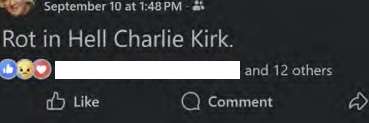
In Johnston v. County of Gila (D. Ariz.), Judge Dominic Lanza rejected, on procedural grounds, plaintiff's challenge to a Gila County Personnel Commission decision upholding his firing from his job as "a legal secretary with the Gila County Attorney's Office"; here's the factual and legal analysis from the Commission decision (see exhibit 10):
asserted
analysis → reject → exhibit
On September 10, 2025, at around 2:00 p.m. Arizona Time Appellant posted "Rot in Hell Charlie Kirk" on/via his Facebook account.
asserted
Appellant → post → account
Multiple GCAO employees, including some who are not Appellant's Facebook friends and/or who do not personally use Facebook, saw and otherwise learned of Appellant's post on September 10 and in the days that followed.
asserted
that → include → days
Multiple GCAO employees discussed the post with each other and complained about the post to GCAO's Chief Deputy Joseph Collins as well as to Gila County Attorney Bradley Beauchamp.
asserted
employees → discuss → Beauchamp
Beauchamp believed that the post appeared to condone murder based on the victim's political viewpoints and statements and became concerned that this post and perception would reflect on GCAO in the public's eyes and thereby undermine the public's trust in GCAO's official duty to prosecute homicides without bias and without regard to a victim's views, statements, or affiliations.
asserted
post → believe → views
Several other GCAO employees shared the perception that Appellant's post appeared to condone the murder of someone based on their statements and views and shared the concern that this would reflect poorly on GCAO and undermine public trust.
asserted
this → share → trust
Multiple GCAO employees reported being offended or otherwise bothered by the post.
asserted
employees → report → post
Appellant's post resulted in immediate meetings and changes to office practices due to concerns of disharmony within the office and the effects it would have on GCAO operations.
asserted
it → result → operations
Appellant's Facebook account was reportedly set to 'private' which Appellant believed would limit his post to only being seen by his existing Facebook friends and that all his friends had to do if they were upset by his post was 'unfollow' him.
uncertain
they → set → him
Notwithstanding Appellant's Facebook account setting and his belief as to the setting's effect on post-exposures, his post apparently reached multiple witnesses within a short timeframe, including some who either were no t his Facebook friends or did not use Facebook at all….
asserted
who → reach → Facebook
The evidence introduced in this matter demonstrated that Respondent's decision to dismiss Appellant for Appellant's social media post "Rot in Hell Charlie Kirk" was based on the following:
- Appellant's post occurred minutes after Kirk was publicly reported as dead following him being shot at a college campus during a public speech.
- Appellant's post occurred during Appellant's work hours and while Appellant was in the office.
asserted
Appellant → introduce → office
- The public perception that Kirk was killed due to his political views, beliefs, statements, and/or affiliation(s).
asserted
Kirk → kill → views
- Respondent's perception that Appellant's post condoned killing someone based on their views, beliefs, statements, and/or affiliation(s).
asserted
post → condone → views
- The public legal role that Respondent and his office fill in deciding whether and how to prosecute homicides throughout Gila County.
asserted
Respondent → fill → County
- Respondent's concern that members of the public would likewise perceive Appellant's post as condoning killing someone based on their views, beliefs, statements, and/or affiliation(s).
asserted
members → perceive → views
- Respondent's concern that this would damage the public's trust in Respondent and his office's ability to fairly and impartially decide whether and how to prosecute homicides regardless of a victim's views, beliefs, statements, and/or affiliation(s).
asserted
this → damage → views
- Appellant's public role in Respondent's office as being the first person many see upon entering Respondent's office.
asserted
many → see → office
- Respondent's concern that Appellant's post would similarly cause disharmony among staff and disrupt the operations of his office.
asserted
post → cause → office
- Testimony from multiple witnesses attesting to staff disharmony and disruptions occurring almost immediately after, and in the days following, Appellant's post—including staff complaints, colleagues being bothered and offended by Appellant's post, an office meeting, and an immediate change to office standards regarding political debate to avoid further disharmony and staff complaints.
asserted
colleagues → attest → disharmony
- Appellant ultimately decided to dismiss Appellant five days after the post was made.
asserted
post → decide → Appellant
Accordingly, Respondent's reason for dismissing Appellant did not appear to have been decided at random or on a whim, to be founded in prejudice, or to lack a reasonable basis.
asserted
reason → dismiss → basis
With regard to Appellant's assertions that his dismissal violated his rights under the 1st Amendment to the United States Constitution, the evidence presented in this hearing did not support Appellant's claim, particularly in light of the close direct nexus between the central mission of Respondent's office—the fair and impartial prosecution of all criminal matters without regard to a crime victim's personal views, opinions, or affiliations and Appellant's post about a public homicide victim, Appellant's role in the office and exposure to members of the public, Respondent's concerns regarding inferences the public would make based on Appellant's post, the fact that almost immediately multiple parties complained regarding Appellant's post and their perception that it condoned murder and reflected poorly on the office, the immediate disruption it caused in Appellant's office, and the immediate and widespread knowledge of Appellant's post.
uncertain
it → violate → post
Here's a slightly adapted version of my analysis of the general First Amendment issue that I posted right after the Kirk shooting:
asserted
I → adapt → shooting
In such cases the government is acting as employer, and in that capacity it has more latitude to discipline and fire employees than it does to imprison or fine them.
asserted
it → act → them
Generally speaking, the government may discipline an employee based on the employee's speech if
- the speech is said by the employee as part of the employee's job duties, Garcetti v. Ceballos (2006), or
- the speech is not on a matter of public concern, Connick v. Myers (1983), or
- the damage caused by the speech to the efficiency of the government agency's operation outweighs the value of the speech to the employee and the public, Pickering v. Bd. of Ed. (1968).
uncertain
damage → speak → .
There is no categorical exception even as to government employment for speech that praises violence; indeed, Rankin v. McPherson (1987) (which Johnston cited in his arguments to the Commission) held that the First Amendment was violated by the firing of a law enforcement clerical employee for saying, after President Reagan was wounded, "if they go for him again, I hope they get him":
asserted
they → be → him
[The statement] plainly dealt with a matter of public concern.
asserted
statement → deal → concern
The statement was made in the course of a conversation addressing the policies of the President's administration.
asserted
statement → make → administration
It came on the heels of a news bulletin regarding what is certainly a matter of heightened public attention: an attempt on the life of the President.
asserted
what → come → President
While a statement that amounted to a threat to kill the President would not be protected by the First Amendment, the District Court concluded, and we agree, that McPherson's statement did not amount to a [punishable] threat … or, indeed, that could properly be criminalized at all.
The inappropriate or controversial character of a statement is irrelevant to the question whether it deals with a matter of public concern.
uncertain
it → amount → concern
"Just as erroneous statements must be protected to give freedom of expression the breathing space it needs to survive, so statements criticizing public policy and the implementation of it must be similarly protected.
asserted
statements → protect → it
But Rankin stressed that the speech actually didn't create much upset or disruption for the office, whether because of an internal reaction or an external one.
asserted
speech → stress → reaction
There is no dispute that McPherson's comment was made during a private conversation with a co-worker who happened also to be her boyfriend.
asserted
who → be → worker
She had no intention or expectation that it would be overheard or acted on by others….
asserted
it → have → others
The risk that a single, offhand comment directed to only one other worker will lower morale, disrupt the work force, or otherwise undermine the mission of the office borders on the fanciful.
asserted
comment → direct → fanciful
The majority likewise reasoned,
Interference with work, personnel relationships, or the speaker's job performance can detract from the public employer's function; avoiding such interference can be a strong state interest….
asserted
avoiding → reason → interference
[But w]hile McPherson's statement was made at the workplace, there is no evidence that it interfered with the efficient functioning of the office….
asserted
it → make → office
Constable Rankin testified that the possibility of interference with the functions of the Constable's office had not been a consideration in his discharge of respondent and that he did not even inquire whether the remark had disrupted the work of the office.
asserted
remark → testify → office
Nor was there any danger that McPherson had discredited the office by making her statement in public.
asserted
McPherson → discredit → public
McPherson's speech took place in an area to which there was ordinarily no public access; her remark was evidently made in a private conversation with another employee.
asserted
remark → take → employee
…and 22 more, not listed.
 The Aporia