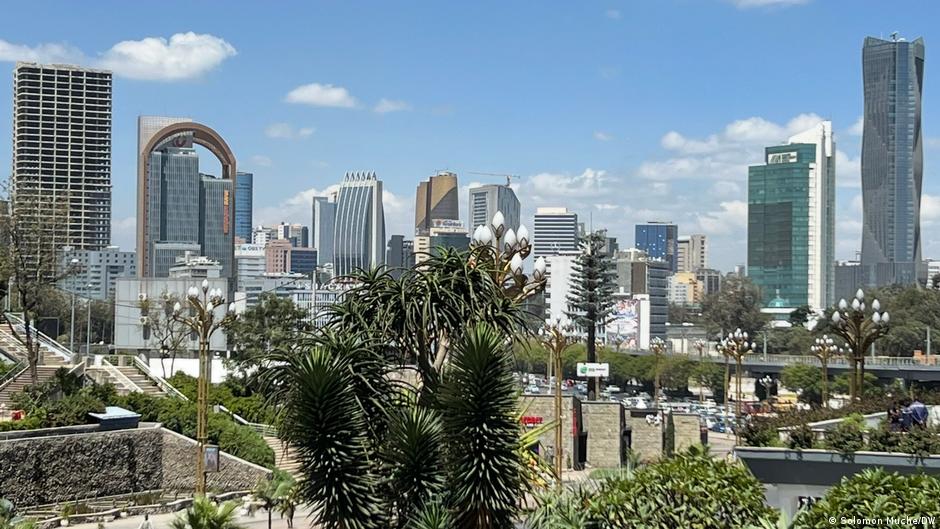
Ethiopia's economy is growing strongly.
asserted
economy → grow → ?
The International Monetary Fund (IMF) forecasts real growth of 9.2% for the 2025–26 fiscal year.
asserted
Fund → forecast → year
But renewed fighting in the north, high reconstruction costs and climate-related crop problems are threatening the country's economic recovery.
asserted
fighting → relate → recovery
London-based financial analyst Abdulmenan Mohammed warns of the consequences of further escalation.
asserted
Mohammed → base → escalation
"If there is a major conflict [...] the current economic growth will not be sustainable," he told DW.
asserted
he → be → DW
The costly legacy of the Tigray war
The war that raged in Tigray and other parts of Ethiopia between 2020 and 2022 inflicted extensive damage.
asserted
that → rag → damage
Infrastructure was destroyed, businesses lost production capacity and agricultural land could no longer be cultivated in some areas.
uncertain
land → destroy → areas
A World Bank-backed damage and needs assessment puts the damage caused by several conflicts in Ethiopia between November 2020 and December 2021 at more than $22.6 billion (€20.2 billion).
asserted
assessment → back → billion
Economic losses amounted to around $6 billion.
asserted
losses → amount → billion
The estimated bill for reconstruction and economic recovery stands at approximately $19.7 billion, which covers the total funding needed, not annual costs or damage caused by the current escalation.
asserted
which → stand → escalation
A reconstruction plan covered the period from 2023 to 2028.
asserted
plan → cover → 2028
However, it remains uncertain whether the work can be fully funded and completed within that timeframe.
asserted
work → remain → timeframe
Financial analyst Abdulmenan Mohammed believes the economic consequences of the Tigray war were even more severe.
asserted
consequences → believe → war
In addition to the direct destruction, he points to lost economic output, high inflation and foreign currency shortages at the time.
asserted
he → point → time
International trade conditions also deteriorated: in 2022, Ethiopia lost its benefits under the US African Growth and Opportunity Act (AGOA), which had allowed certain African exports to enter the US market duty-free.
asserted
exports → deteriorate → market
Growth despite the crisis
Following the Pretoria peace agreement in November 2022, the economy began to recover.
asserted
economy → follow → November
According to the IMF, it grew by 7.2% in 2022–23 and 8.1% in 2023–24.
uncertain
it → accord → 2023–24
The organization puts growth at 9.2% for 2024–25 and forecasts a further 9.2% for 2025–26.
asserted
organization → put → 2025–26
This does not contradict the economic damage caused by the war.
asserted
This → contradict → war
Gross domestic product (GDP) measures the total economic output of a country.
asserted
product → measure → country
If major sectors outside conflict-affected areas continue to expand, the overall economy can grow even while individual regions are still suffering the consequences of violence.
asserted
regions → affect → violence
However, high growth rates do not mean that the country's economic problems have been resolved.
asserted
problems → mean → ?
Reconstruction remains a major challenge, inflation continues to put pressure on households and the government has to service its debt.
asserted
government → remain → debt
In late 2023, Ethiopia defaulted after missing an interest payment on a Eurobond.
asserted
Ethiopia → default → Eurobond
Reforms supported by an IMF program launched in 2024 are intended to address structural weaknesses in the economy.
asserted
Reforms → support → economy
More military spending, less money for development
A renewed escalation could put additional pressure on public finances.
uncertain
escalation → renew → finances
The government would have to spend more on military personnel, equipment and logistics.
asserted
government → have → personnel
At the same time, economic activity and, consequently, tax revenues could decline in the affected regions.
uncertain
activity → decline → regions
"A substantial share of government resources would be tied up in military spending that would otherwise be available for infrastructure, education and social services," warned Abdulmenan Mohammed.
asserted
Mohammed → tie → infrastructure
The extent of this impact would depend on the scale and duration of any renewed conflict.
asserted
extent → depend → conflict
A prolonged war could also prompt businesses to postpone investments.
uncertain
war → prompt → investments
International lenders and donors might become more cautious, while the government would need additional funds for security and humanitarian assistance.
uncertain
government → become → security
This could leave less money available for roads, energy infrastructure and other development projects.
uncertain
This → leave → roads
The IMF forecasts an average inflation rate of 11.7% for 2025–26.
asserted
IMF → forecast → 2025–26
Prices are therefore expected to continue rising, although at a slower pace than in previous years.
asserted
Prices → expect → years
Abdulmenan Mohammed expects a further escalation to intensify inflationary pressures.
asserted
escalation → expect → pressures
"If the conflict escalates further, inflation is likely to rise," he said.
asserted
he → escalate → ?
To finance additional spending, the government might resort to more domestic borrowing.
uncertain
government → finance → borrowing
This could crowd out private businesses by making it harder for them to access credit and finance investments.
uncertain
them → crowd → investments
The military also needs foreign currency to purchase equipment from abroad.
asserted
military → need → equipment
…and 17 more, not listed.
 The Aporia