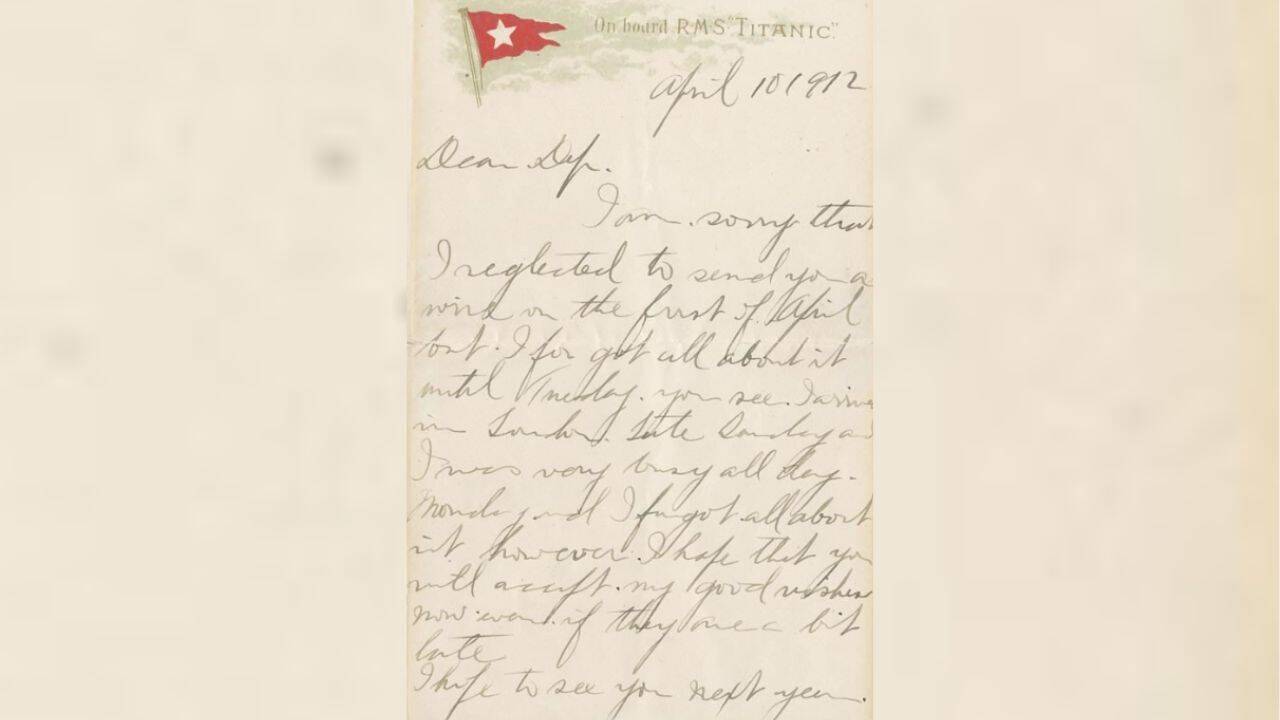
A letter written by a Canadian businessman shortly before the Titanic began its first voyage offers a glimpse into the final days of a passenger who never returned home.
asserted
who → write → passenger
George Graham, a first-class passenger travelling from Southampton, England, to New York, wrote to a business colleague in Berlin, Germany, on April 10, 1912.
asserted
Graham → travel → April
In the letter, he apologised for forgetting to send his greetings earlier and expressed hope that they would meet the following year again.
asserted
they → apologise → hope
Four days later, the Titanic sank in the North Atlantic, killing Graham and many others on board.
asserted
Titanic → sink → board
The letter survived the disaster and was eventually sold for $16,100 at an auction conducted by Spink Smythe in New York City.
asserted
letter → survive → City
According to a report published by World Record Academy on February 23, 2009, the sale established a world record for the most expensive letter from the Titanic.
uncertain
sale → accord → Titanic
Graham was from Harriston, Canada, and worked as a sales manager for the Eaton's department store company.
asserted
Graham → work → company
He had boarded the Titanic at Southampton with a first-class ticket numbered 112053 and was staying in cabin B-52.
asserted
He → board → B-52
The letter was posted in Southampton shortly before the ship departed on April 10 for its planned transatlantic journey to New York.
asserted
ship → post → York
Although Graham did not survive the voyage, his letter remained preserved and later became an important item connected with the disaster.
asserted
letter → survive → disaster
What George Graham wrote in his letter
The letter was addressed to a business colleague in Berlin.
asserted
letter → write → Berlin
Graham wrote about a greeting he had forgotten to send at the beginning of April.
asserted
he → write → April
He explained that he had reached London late on Sunday and had been occupied with work the following day.
asserted
he → explain → work
By the time he remembered the message, several days had already passed.
asserted
days → remember → message
Graham wrote, "I am sorry that I neglected to send you a wire on the first of April, but I forgot all about it until Tuesday, you see."
asserted
you → write → Tuesday
He continued by explaining his busy schedule and asking the recipient to accept his delayed wishes.
asserted
He → continue → wishes
The final part of the message was particularly significant in light of what happened days later.
asserted
what → happen → light
Graham wrote, "I hope to see you next year and that you and your good wife will enjoy good health."
asserted
you → write → health
However, the Titanic never reached its destination.
asserted
Titanic → reach → destination
How the letter survived and reached an auction
According to World Record Academy, the letter was mailed in Southampton before the Titanic left England.
uncertain
Titanic → survive → England
Its survival made it one of the rare pieces of correspondence associated with passengers aboard the ship.
asserted
it → make → ship
The letter also retained several original postal features.
asserted
letter → retain → features
Its second page could be folded to form an envelope-like postal cover, with the White Star Line logo on the reverse.
uncertain
page → fold → reverse
A two-and-a-half-penny stamp was attached to the address section.
asserted
stamp → attach → section
The auction description also recorded signs of ageing and previous display.
asserted
description → record → ageing
These included uneven discolouration on parts of the letter and several pieces of plastic tape remaining along its edges.
asserted
These → include → edges
However, the tape did not affect the readability of the writing, and the letter was otherwise described as being in very good condition.
asserted
letter → affect → condition
Spink Smythe later sold the letter in New York for $16,100.
asserted
Smythe → sell → 16,100
World Record Academy reported the sale as a record for a letter associated with the Titanic.
asserted
Academy → report → Titanic
A final message that gave his wife false hope
Graham's letter was not the only message he sent before the disaster.
asserted
he → give → disaster
According to the account cited by World Record Academy, he sent a telegram to his wife in Canada hours before the Titanic struck an iceberg.
uncertain
Titanic → accord → iceberg
In that message, he said he was well and indicated that he expected to arrive in New York on Wednesday.
asserted
he → say → Wednesday
His wife received the telegram on Tuesday morning, when reports of the Titanic disaster were already circulating.
asserted
reports → receive → disaster
Because the message said Graham was safe, she initially believed that he had survived the sinking.
asserted
he → say → sinking
Litzenberger, quoted in the report, explained that the telegram had led her to misunderstand what had happened.
asserted
what → quote → her
The hope did not last.
asserted
hope → last → ?
Days later, Graham's wife was informed that his body had been recovered from the North Atlantic.
asserted
body → inform → Atlantic
The Titanic struck an iceberg during its maiden voyage and sank in April 1912.
asserted
Titanic → strike → April
 The Aporia