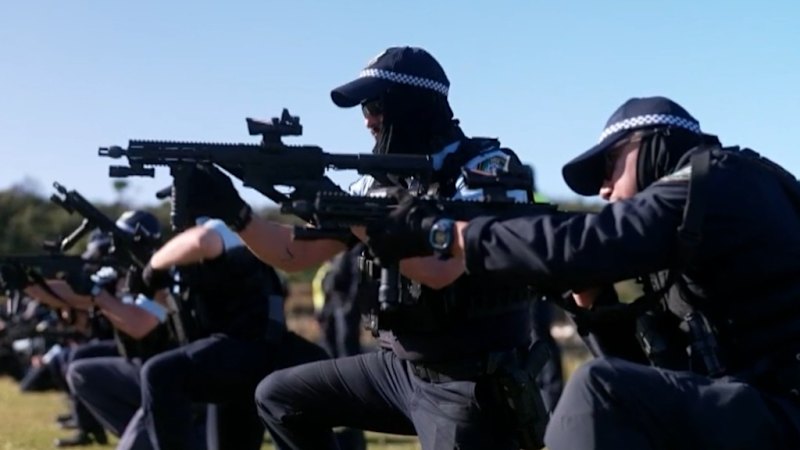
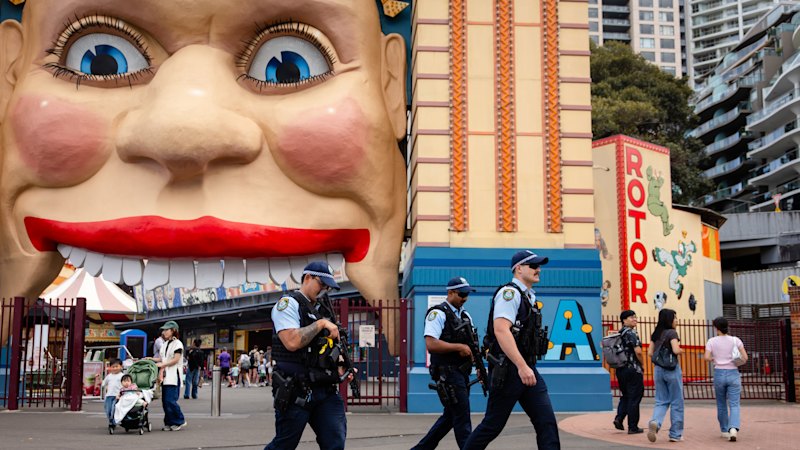
Heavily armed police officers carrying assault rifles have begun patrolling Sydney's streets in an unprecedented security operation introduced in the wake of last December's deadly Bondi Beach shooting.
asserted
officers → carry → shooting
The Armed Response Command (ARC), which officially began operations on Sunday, will deploy specially trained officers across tourist hotspots, crowded public spaces, sporting venues, major events and places of worship in New South Wales (NSW).
asserted
which → begin → Wales
The patrols, the first of their kind in Australia, are designed to deter potential attackers and enable police to respond more rapidly to serious threats, including armed assaults.
asserted
patrols → design → assaults
The state government has committed A$94.3m (£50m) to establish the unit, which will eventually comprise 250 officers and 28 civilian staff, supported by a round-the-clock operations centre, reported SBS News.
asserted
News → commit → centre
Officers will travel in specially equipped vehicles and carry Australian Combat Assault Rifles, selected after field and endurance testing, according to NSW Police.
uncertain
Officers → travel → Police
Their six-month training programme included rifle proficiency, responses to armed offenders, advanced driving and tactical medical care.
asserted
programme → include → offenders
The deployment follows the 14 December 2025 attack at a Hanukkah celebration on Bondi Beach, where two gunmen opened fire killing 15 people, including a 10-year-old girl.
asserted
gunmen → follow → girl
The massacre was Australia's deadliest mass shooting in almost three decades and prompted sweeping changes to gun laws and measures to tackle antisemitism.
asserted
massacre → prompt → antisemitism
During a Royal Commission hearing in May, NSW Police deputy commissioner David Hudson said officers responding to the attack had been outgunned by the assailants.
uncertain
officers → say → assailants
Police at the scene were carrying standard-issue 9mm Glock pistols, while the attackers had rifles and shotguns.
asserted
attackers → carry → rifles
The new command is also intended to take over the high-visibility patrol responsibilities of Operation Shelter, which was established in October 2023 amid rising antisemitic and Islamophobic incidents.
asserted
which → intend → incidents
The two operations will initially work alongside each other before Operation Shelter is gradually scaled back, according to the NSW government.
uncertain
Shelter → work → government
The introduction of the armed patrols has received support from sections of Australia's Jewish community, but has also raised concerns about the potential misuse of police powers.
Alex Ryvchin, co-chief executive of the Executive Council of Australian Jewry, welcomed the increased police capability.
asserted
Ryvchin → receive → capability
"No Australian wants to see officers with military weapons on our streets, but the sight of body bags is far worse," he said.
asserted
he → want → bags
He argued that the new unit could help deter future attacks or enable officers to bring them to an end more quickly.
uncertain
unit → argue → end
However, Amnesty International Australia has called for stronger safeguards to ensure the unit is not used to intimidate demonstrators or suppress peaceful protests.
asserted
unit → call → protests
Andrew Witheford, the organisation's strategic campaigner, said: "People must be able to exercise their rights to freedom of expression and peaceful assembly without fear of intimidation or excessive force."
asserted
People → say → intimidation
"The NSW government must provide clear assurances that the Armed Response Command will not be used to intimidate or suppress peaceful protest, and ensure its operations are subject to rigorous human rights safeguards and independent scrutiny."
"Any expansion of police powers and capabilities must be accompanied by clear, publicly accessible rules, robust independent oversight and accountability," he said.
asserted
he → provide → rules
Concerns have also been raised by political opponents of the NSW government.
asserted
Concerns → raise → government
Sue Higginson, a Greens member of the state's upper house, described the ARC as an "intimidation unit" and an "escalation in state violence".
asserted
Higginson → describe → violence
She questioned whether visibly deploying officers with long-range rifles could increase public anxiety rather than reassure residents, reported SBS.
uncertain
SBS → question → residents
The debate has centred particularly on whether the officers could be deployed at demonstrations.
uncertain
officers → centre → demonstrations
NSW police commissioner Mal Lanyon previously indicated that he did not expect the unit to attend protests, saying the state's existing public order and riot squad was responsible for managing such situations.
However, police minister Yasmin Catley has declined to rule out deploying ARC officers at demonstrations, saying decisions would be left to police based on the level of risk.
asserted
decisions → indicate → risk
"If they're required to be there because of the heightened risk, they will be, but police will make those decisions.
asserted
police → require → decisions
They are the experts," she said, according to The Guardian.
uncertain
she → say → Guardian
ARC commander Detective Superintendent Andrew Evans also said he could not guarantee that officers would never be present at protests, adding that they might be positioned nearby if intelligence suggested a particular group faced an armed threat.
uncertain
group → say → threat
The introduction of permanent armed patrols marks a departure from the approach taken by neighbouring New Zealand following the 2019 Christchurch mosque shootings, in which 51 people were killed.
asserted
people → mark → which
New Zealand police trialled armed patrol teams after the attack for six weeks but abandoned the initiative in 2020 following public opposition and consultation with members of the community.
asserted
police → trialle → community
Then police commissioner Andrew Coster said the patrols did not align with the style of policing New Zealanders expected.
asserted
Zealanders → say → policing
 The Aporia