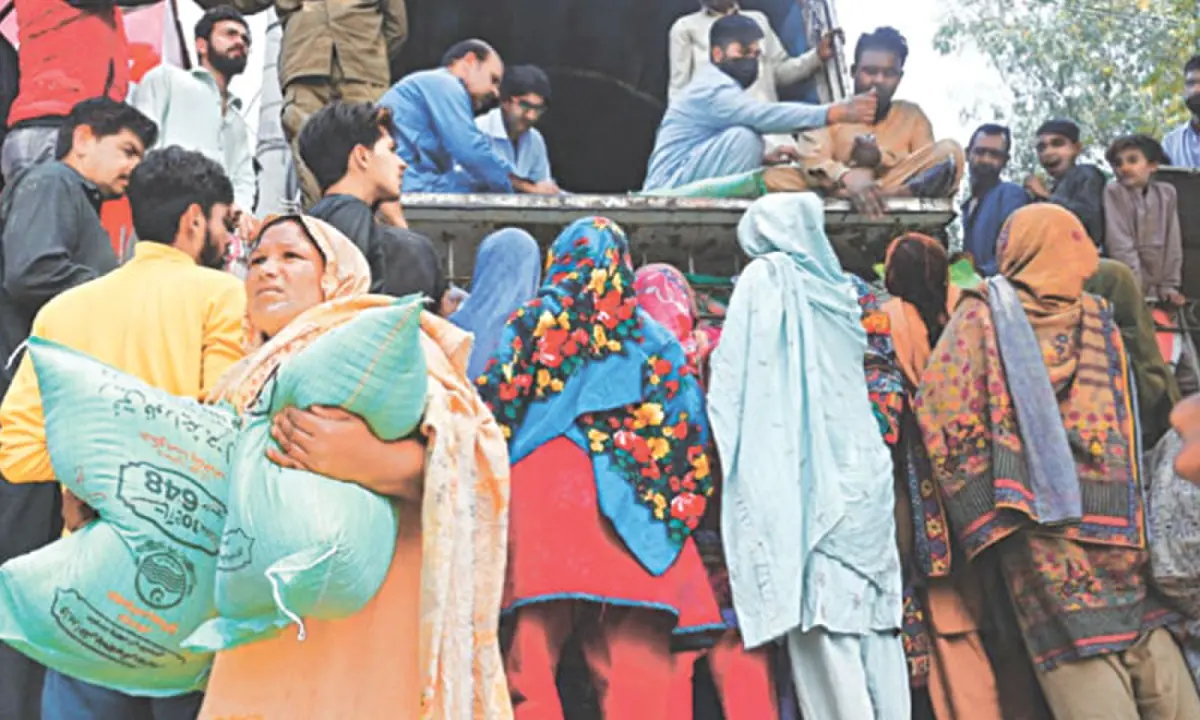
Wheat flour, once a modest household expense, has become an existential daily struggle for millions of working people.
asserted
flour → become → people
Persistent policy failures, flawed policy experiments, and poor execution have fractured wheat and flour supply chains, threatening household food security.
asserted
failures → fracture → security
As flour, a basic staple, prices multiply, ordinary families are forced into impossible choices: who gets to eat and who starves, whether to serve a full meal or make-do with less, and whether to put food on the table today or make ends meet tomorrow.
asserted
ends → multiply → table
Roti has become something to be rationed, negotiated over, and sometimes sacrificed altogether.
asserted
Roti → become → ?
As a result, what is unfolding is far more than a price crisis; it is a gradual unravelling of the country’s social fabric.
asserted
it → unfold → fabric
Millions are being pushed deeper into poverty as food insecurity tightens its grip and hunger becomes a structural feature of everyday life.
asserted
hunger → push → life
At its core, this is a crisis of human dignity – an indictment of a system unable to protect the most fundamental condition of a decent life: access to affordable food.
asserted
this → protect → food
Punjab’s aggregator model turned out to be an utter disaster as nine out of 11 companies could not even start purchasing owing to banks’ reservations.
uncertain
companies → turn → reservations
Others managed to procure 160,000 tonnes of grain against 3m tonnes target
asserted
Others → manage → tonnes
Let’s see how we got here?
asserted
we → let → ?
Over the past five years, flour prices have surged from Rs50 per kg to current Rs150 to Rs170 nationally - a staggering over 200pc increase.
asserted
prices → surge → Rs170
In Punjab, the country’s breadbasket, flour is selling for over Rs200 per kg in deficit districts like Rawalpindi.
asserted
flour → sell → Rawalpindi
The price of roti has already surged by more than 212pc – from Rs8 in 2021 to Rs25 in 2026.
asserted
price → surge → 2026
For the first four of the five years since 2021, government-supplied flour provided a lifeline to the most vulnerable segments of society.
asserted
flour → supply → society
This year, Punjab holds barely 25pc of its own requirement, leave alone serving other federating units, because of its failed experiment with procurement, leaving the private sector with a dictatorial share of stocks and power over prices.
asserted
Punjab → hold → prices
Government-supplied flour, regardless of the quantity released, is officially priced at Rs110 per kg, while the private flour sells at Rs150 per kg – a difference of Rs40, or 36.4pc.
asserted
flour → supply → Rs40
This price differential, over and above normal profit margins, opens a window for retailers to reap windfall gains at the expense of consumers.
asserted
retailers → open → consumers
As prices continue to climb and people’s purchasing power erodes, the pattern of purchase is changing accordingly: consumers who can no longer afford a full 10kg bag are turning to loose flour in smaller quantities to meet their daily needs.
asserted
who → continue → needs
Retailers, responding to this shift, are opening officially supplied wheat flour bags and selling it by the kilogram at private market rates.
asserted
Retailers → respond → rates
Consequently, every purchase is being diverted into retail margins.
asserted
purchase → divert → margins
The roots of the crisis lie in Punjab’s decision earlier this year to abandon conventional wheat procurement under pressure from lenders and replace it with a bureaucratically conceived scheme to engage private-sector aggregators to procure wheat on its behalf.
asserted
roots → lie → behalf
Under the plan, these aggregators were to be helped obtain bank loans and use public warehouses to keep strategic reserves of three million tonnes of wheat.
asserted
aggregators → help → wheat
But the scheme ran into trouble from the outset.
asserted
scheme → run → outset
Disputes over financing terms deterred banks, while the substantial gap between the government’s procurement rate and the open-market price stalled farmers from selling to the aggregators.
asserted
gap → deter → aggregators
The result was a spectacular failure of execution: against the ambitious target of 3m tonnes, the aggregators managed only 160,000 tonnes.
asserted
aggregators → manage → tonnes
Nine out of 11 aggregators were not able to even start purchase as banks shied away.
asserted
banks → start → purchase
Even the Bank of Punjab refused to be part of the financing arrangement.
asserted
Bank → refuse → arrangement
The failure looks even more glaring against the backdrop of the scheme itself: the government had only withdrawn from direct procurement but was shouldering the financial cost and risks of maintaining reserves.
asserted
government → look → reserves
The plan neither achieved the targeted stocks nor freed the government from the costs and risks it was supposed to manage.
asserted
it → achieve → costs
The scale of the failure should have jolted the government into action as soon as the procurement drive ended in May this year.
uncertain
drive → jolt → May
But it did not.
asserted
it → do → ?
Instead of firming up an import plan to bridge the emerging supply deficit, it continued to insist that the entire crop was stocked or hoarded within the country and would eventually find its way into the market.
asserted
crop → firm → market
In support of this argument, crop size was grossly exaggerated.
asserted
size → exaggerate → argument
Hoarders and stockists release their inventories when they anticipate ample supplies from other sources and fear financial losses of keeping stocks.
asserted
they → release → stocks
They do not when they know they control a decisive share of supplies and feel no competitive pressure.
asserted
they → know → pressure
Punjab’s current release of approximately 3,500 tonnes of wheat daily, compared with the traditional supply of around 25,000 tonnes, appears insufficient to stabilise the market.
asserted
release → compare → market
This represents only 14pc of the traditional daily supply, leaving an 86pc shortfall.
asserted
This → represent → shortfall
Can such a release exert pressure on stockists to release their stocks or bring prices down?
asserted
release → exert → prices
Wheat would continue pouring in from private stocks but at a price of choice of those who control the supply.
asserted
who → pour → supply
That is precisely what is happening.
asserted
what → happen → ?
…and 3 more, not listed.
 The Aporia