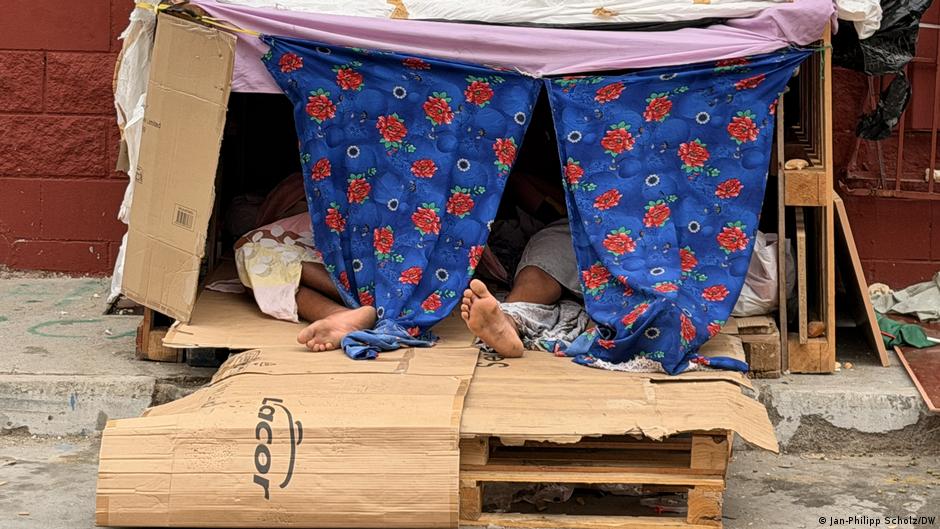
Some are living on the streets because they cannot find a spot in one of the already overcrowded reception facilities in the enclave.
asserted
they → live → enclave
Amina (not her real name), a 14-year-old Moroccan girl, and her brother were among the 80,000 people who crossed the border into Spain from Morocco in late July.
asserted
who → cross → July
Though most of these have since left Ceuta, some 9,000 remain, according to the local authorities — and many are minors.
uncertain
many → leave → authorities
"
What's worst is that we don't have toilets," said Amina.
asserted
Amina → have → toilets
"We have to go somewhere in the bushes, but I don't dare go alone."
asserted
I → have → bushes
Close by is a Moroccan woman called Malika (also not her real name) who has spread out several blankets for herself and her four children.
asserted
who → call → herself
She told DW she was not making enough as a cleaning lady in Morocco, adding that she earned the equivalent of €7 ($8) per day.
asserted
she → tell → day
"That's just not enough to provide for everyone," she said.
asserted
she → provide → everyone
"School will start again soon, and I don't have any money for books, nor even decent clothes for the children.
asserted
I → start → children
That's why she decided to take part in the mass crossing of the Spanish border last month when she read about it on social media.
asserted
she → decide → media
But now she doesn't know what to do.
asserted
she → know → what
"One child got sick.
asserted
child → get → ?
He had a high fever, but I couldn't get help anywhere," she said.
asserted
she → have → help
In the end, she made compresses with water and vinegar to see if that would help.
asserted
that → make → water
But now she is particularly worried about her 12-and 14-year-old daughters, because the number of sexual assaults has risen sharply in the past week.
asserted
number → rise → week
Police are currently investigating at least 15 suspected cases of rape.
asserted
Police → investigate → rape
The local authorities suspect the actual number of cases to be much higher.
asserted
number → suspect → cases
Conditions particularly difficult for girls
Susana Ascaso, an emergency doctor at Ceuta University Hospital, said she had treated several young girls in recent days.
asserted
she → say → days
"Just yesterday, another 12-year-old came to the emergency room," she said.
asserted
she → come → room
"She said that other migrants had harassed her and touched her inappropriately.
asserted
migrants → say → her
She arrived here completely terrified and in tears.
asserted
She → arrive → tears
She was with a woman who had found her on the street.
asserted
who → find → street
That woman saved the girl."
asserted
woman → save → girl
Ascaso said conditions were particularly difficult for "girls under 18" who were "particularly at risk."
asserted
who → say → risk
She added that there was a major imbalance in the numbers of male and female migrants.
asserted
She → add → migrants
"That doesn't help, of course."
asserted
That → help → course
Several high-ranking politicians in Ceuta have called for more support from the central government in the Spanish capital, Madrid.
asserted
politicians → rank → capital
Nabila Benzina, the regional minister for health and social affairs, told DW that the current crisis was the "worst moment in Ceuta's history" and said more police officers were needed in the enclave.
asserted
officers → tell → enclave
Ceuta's president, Juan Jesus Vivas, spoke of a "high-risk situation," in which it was increasingly difficult to maintain public services.
asserted
it → speak → services
"As far as minors are concerned, we are currently 5,000% over capacity," he said.
asserted
he → concern → capacity
"That means nobody can look after them adequately.
asserted
nobody → mean → them
'I'd like to be an architect one day'
asserted
I → like → ?
The Spanish government has announced plans to transfer unaccompanied minors to the mainland but there is no concrete timeline.
asserted
government → announce → mainland
Several regions, in which the far-right Vox party is part of the government, have said they refuse to take in any migrants.
asserted
they → say → migrants
Vivas told DW that the minors should be "reunited with their families.
asserted
minors → tell → families
Otherwise, the Moroccan social services should assume responsibility for them."
asserted
services → assume → them
He said this was the only solution, adding that Madrid should put the "appropriate legal proceedings" in motion.
asserted
Madrid → say → motion
Many of the minors in Ceuta said they do not want to go back to Morocco or elsewhere in Africa despite the conditions in Ceuta.
asserted
they → say → Ceuta
Ibrahim, a 7-year-old child from Sudan, said he would not give up until he could provide "a better life for his parents back home."
uncertain
he → say → parents
Amina, 14, also said she would not go back to Morocco.
asserted
she → say → Morocco
…and 3 more, not listed.
 The Aporia