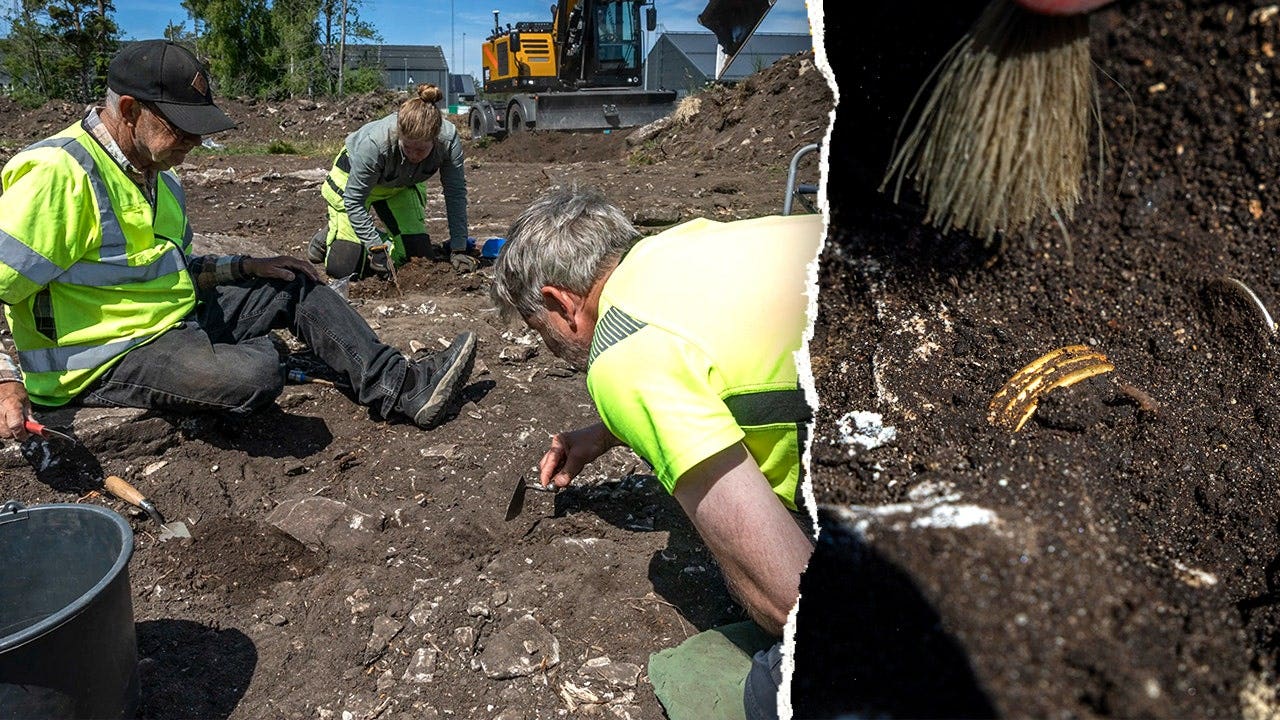
Archaeologists in Sweden recently made an unusual discovery.
asserted
Archaeologists → make → discovery
They found 45 ancient Roman silver coins, including two believed to be counterfeits.
asserted
They → find → two
The discovery was announced by the Swedish Armed Forces earlier this fall.
The coins were unearthed during archaeological excavations ahead of an expansion of Sweden's Gotland Regiment military base, according to officials.
"During one of the excavations, an unusual find was made — a silver treasure with Roman coins from the second century A.D.," the Swedish Armed Forces said in a translated statement.
uncertain
Forces → announce → statement
The discovery came as archaeologists were wrapping up an excavation of a farmhouse foundation dating to the Migration Period, which spanned roughly the fifth and sixth centuries A.D.
The archaeologists were making "one final sweep with the metal detector" before the discovery, according to officials.
uncertain
archaeologists → come → officials
"Then an insistent beeping indicated that something was in the ground near one of the foundation stones," the statement said.
"
asserted
statement → indicate → stones
They carefully dug a small silver coin out of the soil — and more finds would follow."
asserted
finds → dig → soil
When archaeologists brushed off the coin, they discovered a stamped portrait of Roman Emperor Antoninus Pius, who ruled from 138 to 161 A.D.
"
asserted
who → brush → A.D.
The metal detector's persistent beeping indicated that more objects were hidden near the same foundation stone," officials said.
asserted
officials → indicate → stone
"Before the workday was over, archaeologists had counted 45 coins and a gold finger ring.
asserted
archaeologists → count → coins
All the coins are Roman, minted during the second century for five emperors and four empresses."
The coins were identified by Lennart Lind, a Swedish expert on Roman coins.
asserted
coins → mint → coins
The coins feature five Roman emperors — Trajan, Hadrian, Antoninus Pius, Marcus Aurelius and Commodus — as well as four empresses: Vibia Sabina, Faustina I, Faustina II and Lucilla, according to officials.
uncertain
coins → feature → officials
Experts believe the coins arrived on Gotland during the fourth century and were used in trade for generations before being buried alongside the gold ring around 450 A.D.
"It looks like it was slowly abandoned, and some of the people might even have come back to this place to get more things back to a new settlement."
uncertain
some → believe → settlement
Two of the coins, however, were ancient counterfeits that may have originated in what is now Ukraine, according to archaeologists.
uncertain
what → originate → archaeologists
Elsewhere on the military grounds, archaeologists found nine graves believed to be around 2,000 years old, including one containing nearly 10 pounds of burned human bones, according to the release.
uncertain
archaeologists → find → release
The remains belonged to at least two individuals, including an adult man, officials said.
asserted
officials → belong → man
Archaeologists also discovered bronze fittings believed to have been attached to a sword suspension and a shield.
asserted
Archaeologists → discover → suspension
The coins may have been buried as part of a sacrifice, said Per Widerström, an archaeologist at Gotland Museum.
uncertain
Widerström → bury → Museum
Widerström told Fox News Digital the silver coins were largely what archaeologists would expect to uncover at such a site, but the gold ring was unusual.
asserted
ring → tell → site
Widerström also said newly received radiocarbon dating results indicated activity at the settlement from the fourth through sixth centuries, consistent with archaeologists' expectations.
asserted
results → say → expectations
"Perhaps it was abandoned around 540 when there was a low in human history in this part of the world because of natural disasters from 536 A.D. and on for 10 years," Widerström said.
asserted
Widerström → abandon → years
"Maybe that is the reason behind them leaving the farm."
asserted
them → leave → farm
The bigger surprise, he said, was the number of buildings identified at the site — six in total, apparently belonging to two neighboring farms.
asserted
he → say → farms
"It looks like it was slowly abandoned, and some of the people might even have come back to this place to get more things back to a new settlement," he said.
uncertain
he → look → settlement
Earlier this year, Swedish archaeologists discovered two rare Bronze Age neck rings believed to be more than 2,500 years old buried inside an ancient grave monument.
asserted
archaeologists → discover → monument
Last winter, Swedish officials announced the discovery of an exceptionally well-preserved, 5,000-year-old dog skeleton buried alongside a bone dagger near Stockholm.
asserted
officials → announce → Stockholm
 The Aporia