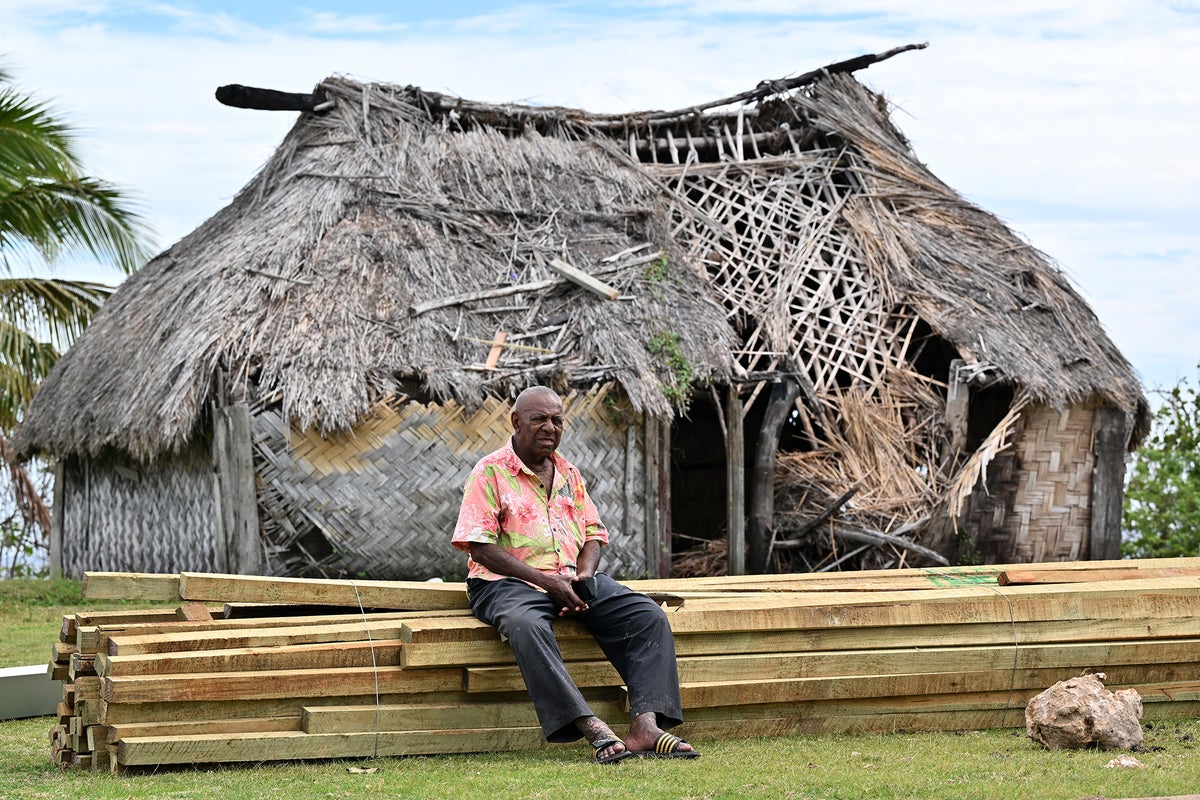
Pointing at the murky water of the Nadi River, Lessy Rokocoko remembers the four homes that her neighbours lost.
asserted
neighbours → point → that
“There was a big flood in the village and they were swept away,” the 31-year-old mother of two says, with a weariness in her voice.
asserted
mother → be → voice
The tranquility, with large mango and coconut trees swaying in the gentle sea breeze, can be deceiving: here lies the frontline of the climate crisis, where communities are fighting for their lives.
asserted
communities → sway → lives
Nearby, Lessy’s two-year-old daughter Joanna frolics in the shrubbery.
asserted
daughter → frolic → shrubbery
Her mother wonders what kind of future she can give her: “I don’t want her to see or experience what we experienced when we were growing up.
asserted
we → wonder → what
“We always have that feeling that maybe one day the flood will just take away my house.
asserted
flood → have → house
As she speaks, Lessy looks me dead in the eye: “In a bigger country like where you are from, you'll never see or feel real climate change compared to our smaller islands.
“
asserted
you → speak → islands
In reality, we are really facing climate change right now.”
asserted
we → face → change
Flooding is increasingly common in the low-lying coastal areas of Fiji – where 90 per cent of the population live – and across the 13 other Pacific Island nations.
asserted
cent → lie → nations
Despite contributing to just 0.02 per cent of global emissions, the Pacific faces the most existential climate threats: rising sea levels could wipe away coastal communities, massive storms can lead to devastating floods and increasing ocean temperatures are destroying local marine ecosystems.
uncertain
temperatures → contribute → ecosystems
The islands are now urgently calling on the world to take drastic measures to limit global warming ahead of November’s COP31 summit in Antalya.
asserted
islands → call → Antalya
Looming over the meetings is the UN’s recent warning that the world will significantly overshoot the 1.5C climate target necessary to prevent irreversible climate harm.
asserted
world → loom → harm
Under the current trajectory, the world could warm by up to 2.8C by the end of the century.
uncertain
world → warm → century
The islanders say that the funds provided for projects and initiatives to address the impacts of climate change are so far insufficient, with villages left to fend for themselves.
asserted
villages → say → themselves
“Not a day goes by when we are just living happily on our own,” Lessy adds.
asserted
Lessy → go → own
She ushers me into her home, a pale green wooden structure on stilts just metres from the riverbank with an simply-furnished open-plan living room.
asserted
She → usher → room
Rich smells fill the room; a traditional Fijian lunch of ota miti - a fresh coconut cream cooked with fern leaf sprouts - is being cooked by Lessy’s 59-year-old mother, Meri.
asserted
lunch → fill → mother
The family, including husband Kelevi, 35, and sister-in-law Maggie, explain the depth of their ties to the land and the devastation losing their home would cause.
asserted
losing → include → home
Meri moved to Yavusania around 30 years ago when she married Lessy’s father, Apete, who died last year.
asserted
who → move → father
For the villagers, the house is so much more than a physical structure: it symbolises vanua, their bond to the land and an unbroken link to their ancestry and identity.
asserted
it → symbolise → ancestry
Listening to her speak, the gulf in the threats that climate change poses between Fiji and the UK becomes increasingly apparent.
asserted
change → listen → Fiji
Last summer, Europe suffered its worst-ever wildfire season, burning swathes of France, Spain and Italy to the ground.
asserted
Europe → suffer → ground
But Fiji has been dealing with this existential threats for years – with far less attention.
asserted
Fiji → deal → attention
This sense of injustice is summarised by taxi driver Asaeli Moce as he heads to one of the large hotel chains hosting an event for the pre-COP31 climate summit in Nadi, the island’s main international gateway.
asserted
he → summarise → Nadi
The 52-year-old explains that his cousin’s home is frequently cut off from the rest of his village due to flooding, forcing him to wade through water each time he carries out any menial daily task.
asserted
he → explain → task
"Those countries overseas cause it," he says.
asserted
he → cause → it
We put very little into the atmosphere, but we are the ones being affected.
asserted
we → put → atmosphere
We are on the verge of losing our heritage."
asserted
We → lose → heritage
All 14 of the island nations that make up the Pacific, including Tuvalu, Kiribati and the Marshall Islands, are under threat.
asserted
that → make → threat
In Tuvalu, the situation is so critical that four years ago its government created the world’s first ‘digital nation’ to allow it to exist even if its land is lost.
asserted
land → create → nation
This involves a 3D-mapped virtual replica of its physical territory, a living archive of Tuvaluan heritage, language and music, and online governance - including voting and digital ID.
asserted
This → involve → voting
The Pacific Islands contribute 0.02-0.03 per cent of global emissions with just 0.16 per cent of the world’s population, according to the World Meteorological Association.
uncertain
Islands → contribute → Association
The US produces between 11 and 13 per cent of emissions, with 4 per cent of the population; while China accounts for around one third of emissions with around 17 per cent population.
asserted
China → produce → population
Nowhere is this threat of destruction more keenly illustrated than in a small corner of the Sabeto Valley, where a simple home is perched two metres away from a severely eroded riverbank, which lies on a steep three-metre drop down to the river below.
asserted
which → illustrate → river
Ben Qoro, the headman of the local village, is urging residents to move, but no one will listen.
asserted
one → urge → residents
“The landslide is eating the areas here,” he says, standing outside one of the threatened homes.
asserted
he → eat → homes
“I told them there is no warning.
asserted
I → tell → them
Once [a flood or landslide] comes, whether in a night or day, it will happen.
asserted
it → come → night
So I told them, please, for the time being, find somewhere safe.
asserted
I → tell → somewhere
Once a slide comes, there is no warning.
asserted
slide → come → ?
…and 23 more, not listed.
 The Aporia