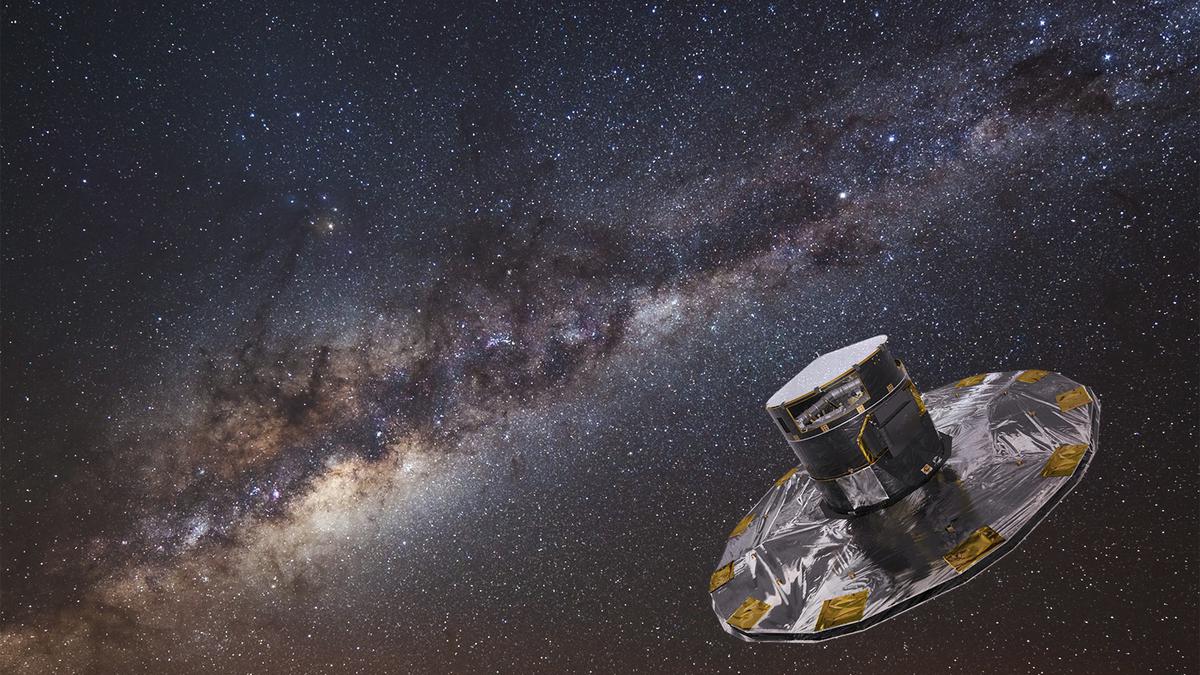
Photo via The Hindu

Explained | What is the Gaia space mission and what has it revealed about the Milky Way?

Read the original at The Hindu ↗
Cite

Munjal, D. (2026, November 1). Explained | What is the Gaia space mission and what has it revealed about the Milky Way? The Hindu. https://www.thehindu.com/sci-tech/science/explained-what-is-the-gaia-space-mission-and-what-has-it-revealed-about-the-milky-way/article65527518.ece

Dated from the outlet's own feed. Check the original for its byline.

The Hindu · collected 2026-11-01 · by Diksha Munjal

Quick Summary

The European Space Agency’s Gaia space mission recently released its third dataset, which includes detailed information on nearly 1.8 billion stars in the Milky Way. This release revealed unexpected "starquakes" and provided the largest chemical map of the galaxy, detailing properties like age, mass, and metal content for millions of stars. Additionally, the data offers insights into binary star systems, quasars, asteroids, and exoplanets.
Written by AI on 2026-11-01, from this article's own text only (the story summary below draws on all the coverage).

AI analysis

Story summary

The third dataset released by the European Space Agency’s Gaia probe on June 17, 2022, has revealed unexpected phenomena called starquakes in nearly 1.8 billion stars within the Milky Way galaxy. These starquakes are akin to earthquake-like movements but occur on stellar surfaces. The data also offers the largest chemical map of the Milky Way, detailing millions of stars' age, mass, composition, color, temperature, and metal content. Additionally, the dataset includes new findings about binary star systems, quasars, asteroids, and exoplanets.

Written for “Gaia Space Mission Reveals Milky Way Details” on 2026-11-01, grounded in this article and the 0 other(s) covering the same event.

Story

📰 Gaia Space Mission Reveals Milky Way Details
Science · 1 article(s) covering the same event.

Compared with similar articles

Nothing to compare against. No article is close enough to this one for the pipeline to have linked or judged the pair.
How this article was measured signals, leaning charts, publisher record, byline, topics and claims

Signals How these are calculated →

Claims extracted
3
sentences that state something as happening or true
Uncertain
0%
0 of 3 hedged ("reportedly", "may", "according to")
Leaning
not political
takes no side on a contested political question
Publisher signals
77/100
The Hindu's corrections and hedging, across everything collected from it. Not a measure of accuracy.
Outlets on this story
1
Science
Same framing elsewhere
1
articles that frame the event the way this one does
Analyzed 2026-11-01 · how these are computed

How this is being covered How these are calculated →

Article leaning vs. publisher reliability
Source leaning vs. consistency

Publisher

The Hindu · 762 article(s) · 2 correction(s) detected
Running correction rate · 2 correction(s)

Who wrote this

Diksha Munjal
1 article(s) here · 0 carrying a prediction
The only article under this byline in the corpus.

Topics

Gaia the European Space Agency’s

Subjects

the European Space Agency’s ORG · 1×

Narrative

The third dataset released by the European Space Agency’s star-mapping Gaia probe, covering almost 1.8 billion stars in the Milky Way galaxy, has revealed an unexpected phenomena called ‘starquakes’, which are similar to earthquake-like movements but on the surface of stars.
framing: assertive · carried by 1 article(s) · first seen 2026-11-01

Claims (3 extracted, 0 hedged)

The third dataset released by the European Space Agency’s star-mapping Gaia probe, covering almost 1.8 billion stars in the Milky Way galaxy, has revealed an unexpected phenomena called ‘starquakes’, which are similar to earthquake-like movements but on the surface of stars. asserted
which → release → stars
The data has also revealed the largest chemical map of the entire Milky Way, showing the DNA of millions of stars, which includes their age, mass, chemical composition, colour, temperature, and metal content. asserted
which → reveal → age
Besides, the new data has also made discoveries about binary star systems, quasars, asteroids, and exoplanets. asserted
data → make → systems
💬Give feedback
🕘History 🎫Support