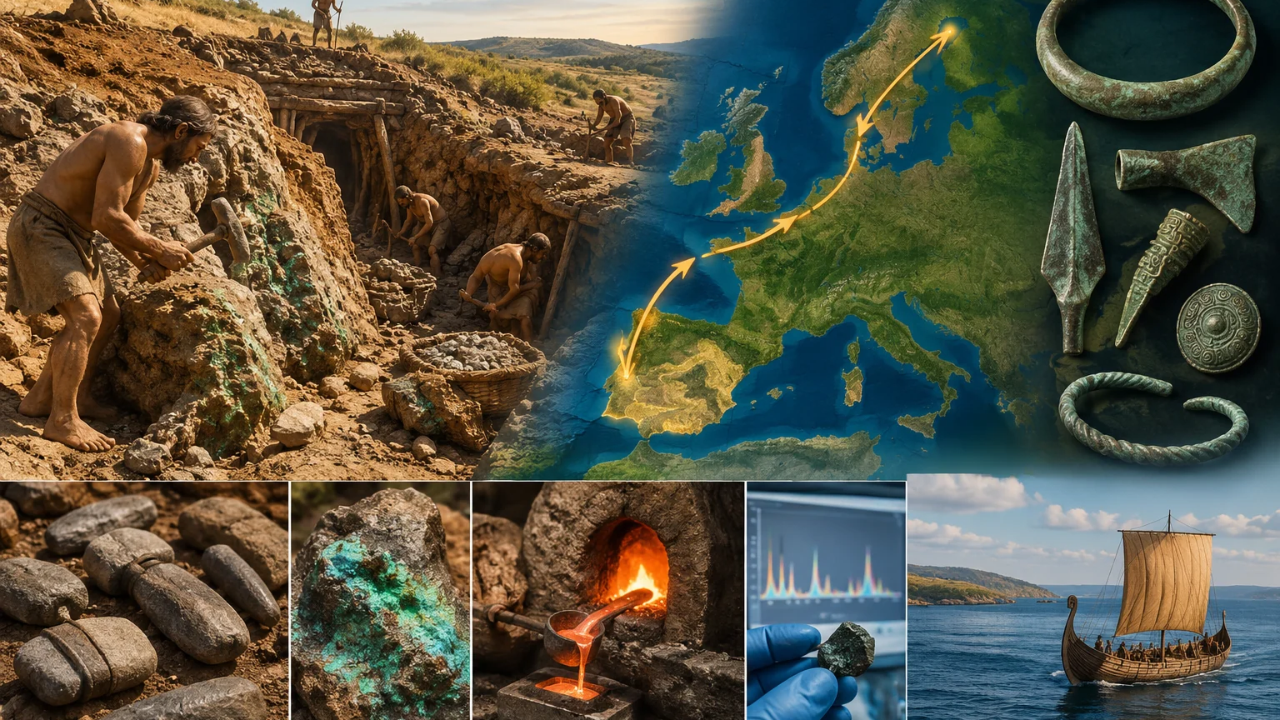
A mine in south-western Spain is offering new clues about how copper travelled across Bronze Age Europe, potentially linking miners in the Iberian Peninsula with communities in Scandinavia thousands of kilometres away.
asserted
copper → offer → kilometres
Around 1300 BC, people were extracting copper ore at Las Minillas, using stone tools to work deposits deep underground.
asserted
people → extract → deposits
Centuries later, bronze objects found in Scandinavia would preserve chemical signatures consistent with the metals produced at this Spanish site, offering evidence of connections that may have crossed much of Europe.
uncertain
that → find → Europe
A
study published on October 26, 2026, in the archaeological journal Antiquity, published by Cambridge University Press, examines the mining evidence and compares the site's ores and metal remains with more than 300 Late Bronze Age bronze objects from Scandinavia.
asserted
study → publish → Scandinavia
Researchers identified 11 objects whose chemical composition and lead isotope ratios were consistent with Las Minillas.
asserted
composition → identify → Minillas
The findings suggest that southern Iberia may have played a more important role in Europe's prehistoric copper supply than previously recognised, although the precise routes and mechanisms of exchange remain uncertain.
uncertain
routes → suggest → exchange
A major Bronze Age mining site emerges in Spain
Las Minillas is located near Granja de Torrehermosa in Badajoz, Extremadura, in south-western Spain.
asserted
Minillas → emerge → Spain
Although the Iberian Peninsula contains extensive copper deposits, the scale and chronology of prehistoric mining in the region have not been as thoroughly established as those of some other European mining districts.
asserted
scale → contain → districts
Fieldwork at Las Minillas, carried out since 2020, has changed that picture.
asserted
Fieldwork → carry → picture
Excavations in 2021 and 2023, supported by surface surveys, geophysical investigations and drilling, revealed extensive mining workings, areas used for habitation and evidence of metal production.
asserted
Excavations → support → production
Radiocarbon dating indicates that copper extraction took place at the site from approximately 1350 to 750 BC, covering much of the Late Bronze Age.
asserted
extraction → indicate → Age
The researchers identified mining trenches that followed the copper-bearing vein, reaching depths of 8.2 metres and widths of between two and four metres.
asserted
that → identify → metres
The team documented 892 stone tools, including 735 grooved stone hammers associated with mining.
asserted
team → document → mining
Charcoal deposits also suggest that miners used fire-setting, a technique in which rock is heated to make it easier to fracture.
asserted
it → suggest → which
Copper droplets, slag and a possible furnace provide evidence of smelting at the site.
asserted
droplets → provide → site
Together, these findings make Las Minillas the largest securely dated Late Bronze Age copper mine excavated in Iberia to date.
asserted
findings → make → date
Chemical evidence connects Spain with Scandinavian bronze
To investigate where copper from Las Minillas might have travelled, the researchers analysed lead isotope ratios and trace elements in samples from the mine, including ores, slags and metal droplets.
uncertain
researchers → connect → ores
Lead isotope analysis can help archaeologists compare metal objects with geological deposits because different ore sources can have distinctive isotopic signatures.
asserted
sources → help → signatures
Researchers also examine elements such as silver, antimony and nickel to assess whether objects share compositional characteristics with particular mining areas.
asserted
objects → examine → areas
The team compared the Las Minillas results with data from more than 300 Late Bronze Age bronze objects discovered at sites across Scandinavia.
asserted
team → compare → Scandinavia
Eleven objects, representing different artefact types, showed isotope ratios and chemical compositions consistent with the Spanish mining material.
asserted
objects → represent → material
The comparison was not based on a single measurement.
asserted
comparison → base → measurement
Similar ranges of silver and antimony concentrations strengthened the association, while nickel levels in the Scandinavian objects overlapped with some, though not all, of the samples from Las Minillas.
asserted
levels → strengthen → Minillas
The dates of the objects also offer useful context.
asserted
dates → offer → context
Seven were assigned to Period V of the Nordic Bronze Age, approximately 900-700 BC, which overlaps with the latest documented phase of mining at Las Minillas.
asserted
which → assign → Minillas
Two others belonged to Period VI, approximately 700-500 BC, and therefore post-dated the mine's final documented exploitation.
asserted
others → belong → exploitation
Southern Iberia may have supplied a wider European network
The findings have implications beyond a single mine.
uncertain
findings → supply → mine
Before this research, copper supplies from regions such as the Austrian Alps and Wales were known to have reached communities across northern Europe, including Scandinavia.
asserted
supplies → know → Scandinavia
However, production at some major mining districts, including Great Orme in Wales and Mitterberg in Austria, declined around the transition from the Middle to the Late Bronze Age.
asserted
production → include → Age
The researchers suggest that southern Iberia may have become a more important source as these established production centres waned.
uncertain
centres → suggest → ?
Archaeological surveys have identified dozens of potential prehistoric mining sites across south-western Iberia, although many still require more precise dating to establish whether they were active during the Late Bronze Age.
asserted
they → identify → Age
The study proposes that these sites may have formed part of a broader Southern Iberian Copper Mining Complex.
uncertain
sites → propose → Complex
Estimates of copper output at Las Minillas range from a minimum of 49 tonnes to a cautious estimate of 197 tonnes and an optimistic estimate of 738 tonnes, illustrating both the potential scale of production and the uncertainty surrounding its reconstruction.
asserted
Estimates → range → reconstruction
A trade connection, not yet a complete route map
The chemical matches do not establish exactly how the copper reached Scandinavia.
asserted
copper → establish → Scandinavia
The metal may have passed through several communities and trading centres before being fashioned into bronze objects, and the researchers cannot identify a single route from the evidence currently available.
uncertain
researchers → pass → evidence
Further dating, excavations and chemical analyses will be needed to determine how many other Iberian mines contributed to European metal supplies and how these networks operated.
asserted
networks → need → supplies
Nevertheless, the research adds southern Spain to the discussion of major Bronze Age copper-producing regions.
asserted
research → add → regions
The stone hammers, deep mining trenches and chemical signatures preserved at Las Minillas suggest that communities in Iberia were connected to a much wider world of metal production and exchange than the surviving archaeological evidence once indicated.
asserted
evidence → preserve → production
 The Aporia