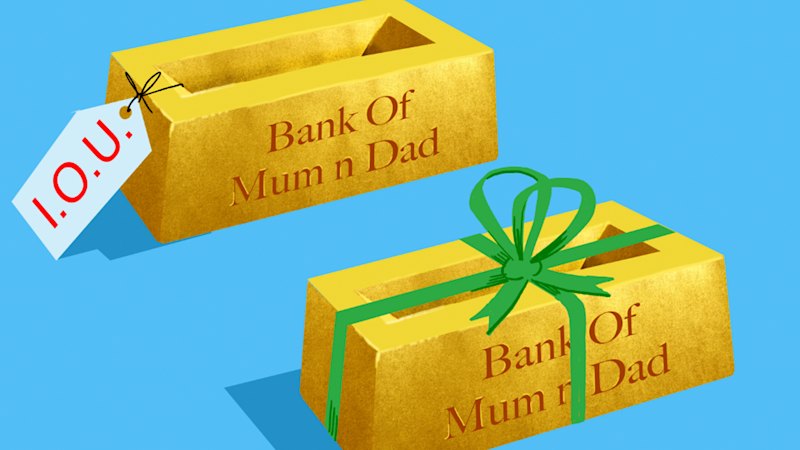
Fifteen years ago, we paid a 30 per cent deposit on a house for our daughter.
asserted
we → pay → daughter
In fairness to our other two kids, who had not received the same gift, we bought the house as “tenants in common” with our daughter.
asserted
we → receive → daughter
In other words, we own one-third and our daughter owns two-thirds.
asserted
daughter → own → thirds
We have since completely repaid her loan, and we now wish to transfer our one-third to our daughter.
asserted
we → repay → daughter
You can imagine our shock and disbelief when we discovered that we have to pay capital gains tax on the growth in our one-third.
asserted
we → imagine → third
We were under the impression that, by us completely paying out the loan, it would be added to our cost base for CGT purposes.
asserted
it → pay → purposes
Do you have any suggestions on how we should jump in this grossly unfair situation?
asserted
we → have → situation
It turned out to be a very expensive gift.
asserted
It → turn → ?
There is no easy answer here, but your example does show readers the importance of getting advice before entering into an irrevocable real estate transaction such as this.
asserted
example → be → this
Repaying the loan does not change the fact that you own one-third of the property, nor does it simply increase the cost base of that one-third.
asserted
it → repay → third
Transferring your share to your daughter is a disposal for CGT purposes, based on its market value, even if no money changes hands.
asserted
money → transfer → hands
The lesson for all parents who wish to help their children is to think very carefully before putting their own name on the title deed.
asserted
who → wish → deed
What looks like a sensible way to help a child and keep things fair between siblings can ultimately create substantial tax and transaction costs.
asserted
looks → look → costs
I’m hearing whispers that the new minimum 30 per cent tax applying after July 1, 2027 to capital gains accruing after that date cannot be reduced by making a concessional contribution to superannuation.
asserted
tax → hear → superannuation
If CGT is not a separate, standalone tax, but simply forms part of my taxable income, how can that be?
asserted
that → form → income
I’m becoming increasingly concerned about the possibility of a substantial market correction before the new CGT rules commence.
asserted
rules → become → correction
If that happens, it could reset the cost base of our shares at a much lower level.
uncertain
it → happen → level
Even if the market recovers quickly, we could then face significantly higher CGT liabilities on gains made from that depressed value after July 1, 2027.
uncertain
we → recover → July
And that’s on top of the minimum 30 per cent rate, which effectively taxes us as though we were in a much higher tax bracket.
asserted
we → ’ → bracket
I find the whole situation particularly frustrating, certainly not equitable and, above all, deserving of far more media attention than it is receiving.
asserted
it → find → attention
This is a bit complex, but in some cases a deductible contribution to super or a tax-deductible donation can reduce the overall CGT paid.
asserted
contribution → reduce → CGT
Suppose you earned $135,000 a year and made a taxable capital gain post-June 2027 of $50,000 after all indexation adjustments.
asserted
you → suppose → adjustments
The gain would be added to your taxable income in the year the sale document was signed and would push part of your income into the 37 per cent bracket.
asserted
document → add → bracket
If you then made a tax-deductible payment of some kind, such as a deductible contribution to super or a tax-deductible donation, you could reduce your overall taxable income back to $135,000 and save paying the excess tax between the 30 per cent bracket and the 37 per cent bracket.
uncertain
you → make → bracket
What you cannot do is use that deduction to reduce the minimum 30 per cent tax payable on the post-June 2027 capital gain itself.
asserted
do → use → gain
I partially retired at 57 and turned 60 last year with $650,000 in choice super.
asserted
I → retire → super
At 60, I am still playing around with a real estate portfolio and a small subdivision.
asserted
I → play → portfolio
While I had expected to have enough cash to complete the development, I was thrown a curve ball by many unexpected costs.
asserted
I → expect → costs
In short, I withdrew $200,000 from my super, dropping the balance to $450,000 and putting me back below the top-up threshold.
asserted
I → withdraw → threshold
Upon completion of the development, I would like to put the $200,000, plus another $300,000, back into my super.
asserted
I → like → super
Given my balance was originally $650,000, do you have a view on whether this would be possible if I still have catch-up contribution headroom?
asserted
I → give → headroom
I also borrowed $500,000 from a non-top-tier institution at around 10 per cent interest, with some hefty establishment fees.
asserted
I → borrow → fees
Can the cost of this type of borrowing, including the establishment fees, be added to the cost base when I sell?
asserted
I → include → base
It’s been 20 years since I have done this type of small development, and if the government would like to know why land is so expensive, it need only look at its development costs and fees.
asserted
it → do → costs
You are confusing the catch-up rules, which apply to concessional contributions, with the bring-forward rules for non-concessional contributions.
asserted
which → confuse → contributions
Your super balance is well below the relevant limit, so provided you meet the normal eligibility requirements and have not already triggered the bring-forward provisions, the simplest approach would be to use three years’ non-concessional contributions and contribute up to $390,000 immediately.
asserted
approach → provide → 390,000
You could then contribute the remaining $110,000 once that three-year bring-forward period has expired.
uncertain
period → contribute → 110,000
What looks like a sensible way to help a child and keep things fair between siblings can ultimately create substantial tax and transaction costs.
asserted
looks → look → costs
As for the development, borrowing costs such as interest and establishment fees may be deductible or may form part of the cost of the development for tax purposes, depending on the circumstances and how the development is treated for tax.
uncertain
development → form → tax
You cannot claim the same expense twice.
uncertain
You → claim → expense
…and 17 more, not listed.
 The Aporia