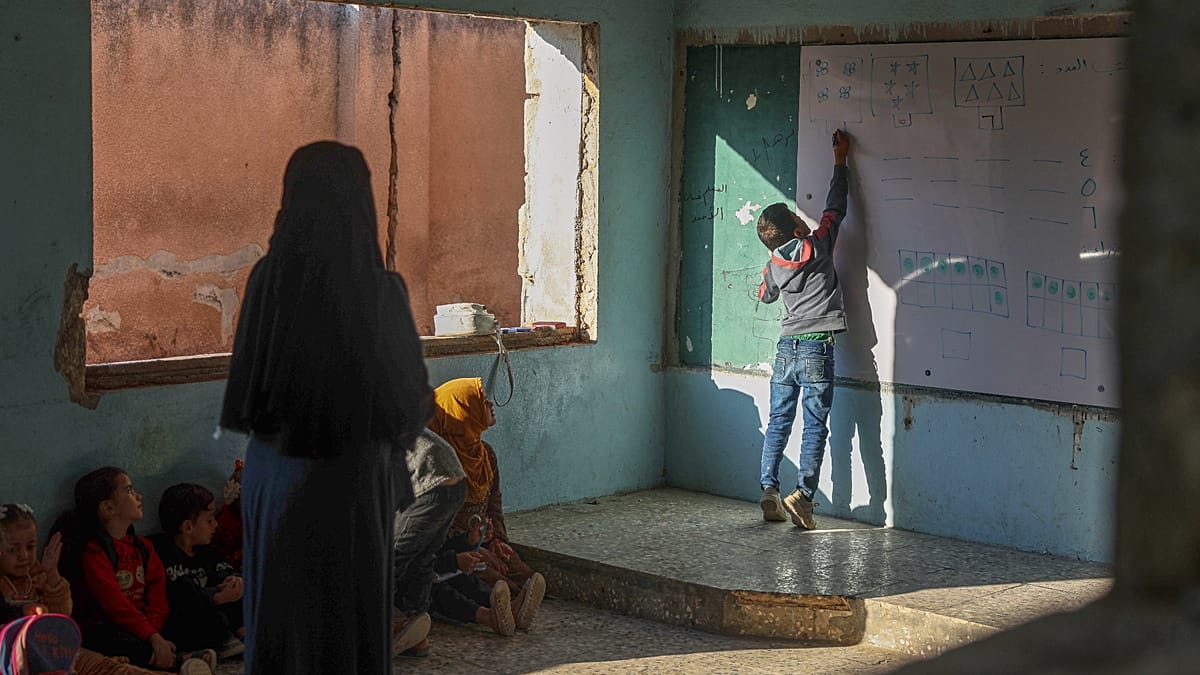
Changes were not limited to the texts; images and illustrations were also edited in Photoshop, adding hijabs or long robes to female figures, deleting women's photos, and covering or replacing statues, sculptures and artworks.
asserted
images → limit → statues
A set of changes made to a number of school textbooks in Syria has sparked a wave of criticism and reactions on social media, after they included alterations to pictures and artworks, among them adding the hijab to drawn female figures, removing images of women and children, covering statues and replacing paintings and works of art.
asserted
they → make → art
The revisions have also affected teaching content dealing with political life, citizenship, democratic participation, local administration and the media.
asserted
revisions → affect → life
These changes have reopened the debate over the standards used by the Ministry of Education when it reviews curricula, and how far they take into account Syria's social and cultural diversity, amid questions about the nature and aims of the amendments, and whether they fall simply within a review of content linked to the former regime or go further towards reshaping how society is represented in school books.
asserted
society → reopen → books
Changes to images, illustrations and educational content
Comparisons posted on social media between different editions of school textbooks show amendments to material for several grades, including the early years and seventh grade, as well as the sixth-grade primary textbook "Social Studies".
asserted
Comparisons → post → years
It emerges that this last book, reissued for the current academic year, originally dates back to the 2012–2013 school year, with changes added that include the removal of material linked to the former regime, alongside lessons on local administration, political life, citizenship, the media and democratic participation.
asserted
that → emerge → administration
The changes were not limited to texts; they also extended to images and illustrations using Photoshop.
asserted
they → limit → Photoshop
Hijabs were added – and in some cases long robes – to drawn female characters, entire pictures of women were deleted, statues were covered, and sculptures and artworks were removed or replaced with others.
asserted
sculptures → add → others
The visual alterations to paintings and expressive illustrations became a main focus of controversy, after committees removed the world-famous painting "Mona Lisa" and deleted a drawing showing a girl skipping rope beside two children in textbooks for early age groups.
The revisions also extended to historical figures and symbols.
asserted
revisions → become → figures
The Phoenician princess Elissar, founder of Carthage, was affected when a painting depicting her on a hunting trip was dropped and replaced with another portrait that had been digitally modified to cover the chin and neck – a step critics saw as imposing contemporary ideological standards on an ancient historical era.
asserted
critics → affect → era
One of the examples that provoked ridicule and debate was dressing a pharaonic statue in a striped shirt, which many users likened to prison uniforms.
asserted
users → provoke → uniforms
Accusations of "falsifying history" and erasing national symbols
A new batch of visual comparisons circulated on social media documented far-reaching changes introduced to the new Syrian school curricula in particular history books, with the new editions showing the removal of prominent national and pan-Arab figures and the alteration of the content of historical passages, amid sharp questions and concerns about systematic ideological and sectarian exclusion.
asserted
editions → falsify → exclusion
Activists highlighted information that caused widespread anger and was described as "a blatant falsification of history".
asserted
that → highlight → history
The updated curriculum contains passages portraying the "martyrs" executed on 6 May by the Ottoman governor Jamal Pasha, known as the Butcher, as "agents of Britain and France", instead of their historical description as symbols of the national movement resisting Ottoman colonial rule.
uncertain
curriculum → update → rule
The changes also include deleting the picture of Sultan Pasha al-Atrash and replacing it with that of Sheikh Saleh al-Ali, a move that raised fears of exclusion on sectarian grounds.
asserted
that → include → grounds
The alterations further removed a photograph of the late Egyptian president Gamal Abdel Nasser.
asserted
alterations → remove → president
The revisions reached school maps too, with the district of Iskenderun and the occupied Syrian Golan omitted from one of the maps, as well as the deletion of a paragraph on the role of Syrian women in resisting the French Mandate.
asserted
district → reach → Mandate
This has raised questions about the motives behind these changes and their impact on the historical narrative presented to pupils.
asserted
This → raise → pupils
The nature of these changes and how they were carried out unleashed a wave of sarcastic comments on social platforms, where many users felt some of the alterations were random and lacked unified artistic standards to ensure visual coherence within a single textbook.
asserted
some → carry → textbook
The most widely shared example in this context is a female doctor character in first-grade books who appears wearing a hijab on one page and without a hijab on another.
asserted
who → share → another
The comments did not stop at the artistic side, but also questioned the rationale for removing artworks and illustrated characters from school textbooks, and the criteria used to decide which images should be kept, modified or removed.
asserted
images → stop → textbooks
Parents criticise the changes and warn of their consequences
Among parents, objections went beyond the quality of the illustrations or the inconsistencies in modifying them, to the implications of these changes and their possible impact on how children view society and diversity.
asserted
children → criticise → society
Speaking to Euronews, Alia, the mother of a lower-secondary pupil, said she had not at first noticed the amendments because of the poor print quality and lack of detail in the drawings, pointing out that the heavy academic content and padding make it difficult for both parents and pupils to focus on visual details.
asserted
parents → speak → details
She argued that editing images of historical figures by adding a hijab raises questions about the purpose of such a step, and felt that replacing the pictures with new drawings would have been a more logical option than tampering with the original works.
asserted
replacing → argue → works
She warned that imposing a single pattern in the way women are depicted could shape how social diversity is presented to children, instead of promoting values of harmony and coexistence.
uncertain
diversity → warn → harmony
She added that priority should be given to developing the curricula and keeping pace with global shifts in education, rather than becoming preoccupied with cosmetic changes that add no clear educational value.
asserted
that → add → value
In her view, such practices risk deepening divisions and fuelling intolerance instead of reducing it.
asserted
practices → risk → it
Alia went on: "The highest priority in this critical phase should be to fundamentally develop the educational curricula and keep up with the latest global changes in the education sector", considering that focusing on superficial visual adjustments does not serve the learning process or offer pupils any clear educational benefit.
asserted
focusing → go → benefit
Concluding her remarks to Euronews, she warned that the persistence of such practices within educational institutions could produce the opposite effect, as they help to deepen ideological divisions in society and feed exclusionary and fanatical thinking rather than mitigating it and strengthening shared citizenship values.
uncertain
they → conclude → values
In the same vein, Jaber, the father of a primary-school girl, expressed even stronger concerns in his interview with Euronews, arguing that these visual changes cannot be separated from ideological orientations that risk being entrenched in society's consciousness through the education system.
asserted
that → express → system
Jaber called on international organisations concerned with children's rights to take urgent action to safeguard children's right to receive balanced and neutral education.
asserted
Jaber → call → education
He summed up his objection with a stark contrast between global technological progress and the regression of local curricula, saying: "While the world has reached leaps forward in developing artificial intelligence, we in Syria are still drowning in sterile arguments over covering women's images and deleting artworks from school textbooks".
asserted
we → sum → textbooks
From satire to accusations of trying to impose an ideology
On the other hand, reactions went beyond mockery of how the changes were implemented and raised deeper questions about their cultural and social dimensions.
asserted
changes → try → dimensions
Critics and observers accused the ministry of seeking to impose a specific ideology through the education system, arguing that changing the visual appearance of female characters and removing elements of global artistic heritage reflects a deliberate effort to reshape children's perceptions and build a new social identity.
asserted
changing → accuse → identity
Some believe these concerns are particularly sensitive in a country such as Syria, marked by religious, cultural and social diversity.
asserted
concerns → believe → diversity
Their fear is that, if adopted as a lasting approach, such changes could entrench a one-sided view of Syrian society and sideline its historical pluralism and the natural differences in ways of life that distinguish it.
uncertain
that → adopt → it
Part of the controversy centres on the distinction between two separate steps: the first involves removing content linked to the former regime, and the second relates to altering artistic illustrations or deleting educational topics on citizenship, political life and democratic participation.
asserted
second → centre → citizenship
While some see purging the curricula of the previous era's legacy as part of a normal modernisation process, the other changes raise questions about the educational and cultural foundations that govern how content is selected and directed.
asserted
content → see → foundations
Others argue that the published amendments alone are not enough to conclusively prove the existence of a coherent policy to impose a specific ideology.
asserted
amendments → argue → ideology
To reach an objective assessment of this accusation, they say, it is essential to see the official standards adopted, define the real scope of the changes and their causes, and compare them with the broader orientations the new curricula will adopt in the coming phases.
asserted
curricula → reach → phases
…and 14 more, not listed.
 The Aporia