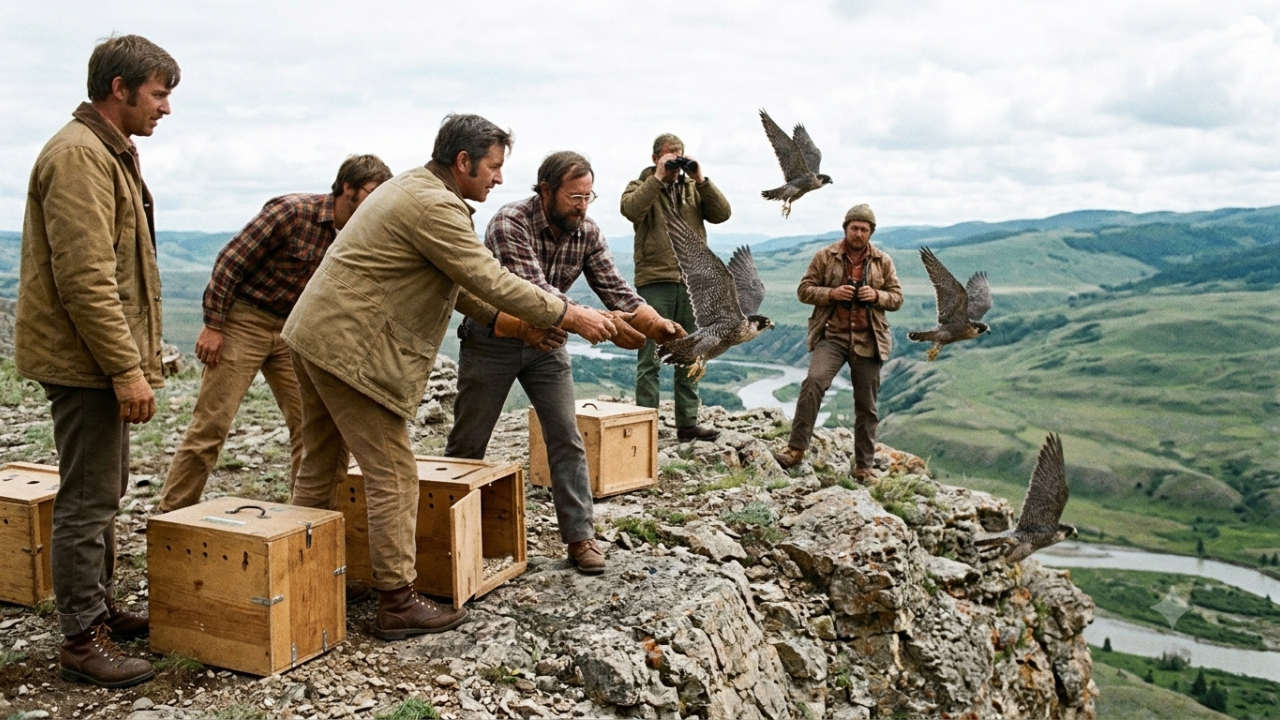
In the early 1974s, American peregrine falcons were struggling to survive in parts of North America.
asserted
falcons → struggle → America
Years of DDT use had left many eggs with thin shells that could crack during incubation, leaving fewer chicks to hatch.
uncertain
that → leave → chicks
Conservationists responded by breeding the birds in captivity and releasing them into the wild.
asserted
Conservationists → respond → wild
According to the National Park Service (NPS), more than 6,000 American peregrines were released through recovery programmes.
uncertain
peregrines → accord → programmes
Restrictions on DDT and legal protection also played a part in the comeback.
asserted
Restrictions → play → comeback
Along Alaska’s rivers, long-term surveys later recorded a rise in nesting pairs.
asserted
surveys → record → pairs
The American peregrine falcon was removed from the US federal endangered and threatened species list in 1999.
asserted
falcon → remove → 1999
Peregrine falcon subspecies faced different levels of pesticide risk
The decline of peregrine falcons was closely associated with the use of DDT, an insecticide that became widespread during the mid-20th century.
asserted
that → face → century
As the chemical passed through food chains, residues accumulated in birds of prey.
asserted
residues → pass → prey
Its breakdown product, DDE, interfered with eggshell formation, leaving eggs too fragile to withstand the weight of an incubating adult.
asserted
product → interfere → adult
Fewer chicks survived to hatch, putting pressure on populations that were already struggling.
asserted
that → survive → populations
By 1970, the American and Arctic subspecies of peregrine falcon had been listed as endangered under the Endangered Species Conservation Act of 1969.
asserted
subspecies → list → 1969
Peale's peregrines, found along parts of the Pacific coast, were not listed because their breeding populations had remained comparatively stable and exposure to DDT was limited.
asserted
exposure → find → DDT
Restrictions on DDT changed the course of recovery
asserted
Restrictions → change → recovery
The United States Environmental Protection Agency (EPA) banned DDT for most uses in the country in 1972, using powers granted under the Federal Insecticide, Fungicide, and Rodenticide Act.
asserted
Agency → ban → Act
The restriction followed growing evidence of the damage the chemical was causing to wildlife, particularly birds whose survival depended on successful breeding.
asserted
survival → follow → breeding
The change did not remove every source of exposure.
asserted
change → remove → exposure
DDE residues continued to be detected in some areas, while peregrines travelling to wintering grounds in Latin America could encounter pesticides that remained in use there.
uncertain
that → continue → use
Even so, reducing DDT use in the United States helped create better conditions for the birds to reproduce.
asserted
birds → reduce → conditions
Legal protection and pesticide restrictions were accompanied by a coordinated recovery programme.
asserted
protection → accompany → programme
The US Fish and Wildlife Service brought together federal and state agencies, independent biologists and conservation organisations to identify measures that could restore declining populations.
uncertain
that → bring → populations
Captive-bred birds helped rebuild depleted populations
Scientists at Cornell University developed successful methods for breeding and raising peregrine falcons in captivity.
asserted
Scientists → breed → captivity
The young birds could then be introduced into suitable habitats through a technique known as hacking, which gives them time to adjust to their surroundings before becoming independent.
uncertain
which → introduce → surroundings
For the releases, young falcons were placed in specially designed boxes positioned on towers or cliff ledges.
asserted
falcons → place → towers
Food was supplied through a chute during the early stages, limiting the birds' contact with people.
asserted
Food → supply → people
Once they were old enough, the boxes were opened and the young falcons could begin exploring the area and exercising their wings.
uncertain
falcons → open → wings
Food was gradually reduced as the birds developed their flying and hunting abilities.
asserted
birds → reduce → abilities
The intention was to give them a chance to establish themselves in the wild rather than remain dependent on human care.
asserted
intention → give → care
The programme involved the US Fish and Wildlife Service, state wildlife agencies, The Peregrine Fund, the Santa Cruz Predatory Bird Research Group and the Midwestern Peregrine Falcon Restoration Project.
asserted
programme → involve → Service
Together, these efforts resulted in the release of more than 6,000 American peregrines from 1974 onwards.
asserted
efforts → result → 1974
Arctic peregrines recovered without captive releases
asserted
peregrines → recover → releases
The Arctic peregrine population had fallen by as much as 80%, but enough birds survived that captive-bred releases were not considered necessary for its recovery.
asserted
releases → fall → recovery
Restrictions on DDT and protection under the Endangered Species Act helped numbers increase.
asserted
numbers → help → Act
In 1984, the Arctic subspecies was moved from endangered to threatened status, reflecting an improvement in its prospects.
asserted
subspecies → move → prospects
A decade later, in October 1994, the US Fish and Wildlife Service announced that the population had recovered sufficiently for the subspecies to be removed from the federal list of threatened and endangered species.
asserted
subspecies → announce → species
Thousands of Arctic peregrines now occur across North America.
asserted
Thousands → occur → America
Their recovery also demonstrated that populations could rebound when the pressures responsible for their decline were reduced, even without the extensive release programmes used for American peregrines.
uncertain
pressures → demonstrate → peregrines
Surveys along Alaska's rivers track the return
In Alaska's Yukon-Charley Rivers National Preserve, biologists have monitored peregrine falcons since the mid-1970s.
asserted
biologists → track → mid-1970s
During an early survey in 1975, they recorded 11 nesting pairs.
asserted
they → record → pairs
More recent surveys in comparable areas have documented more than 50 to 60 pairs, providing a long-term indication of how the population has changed.
asserted
population → document → indication
…and 9 more, not listed.
 The Aporia