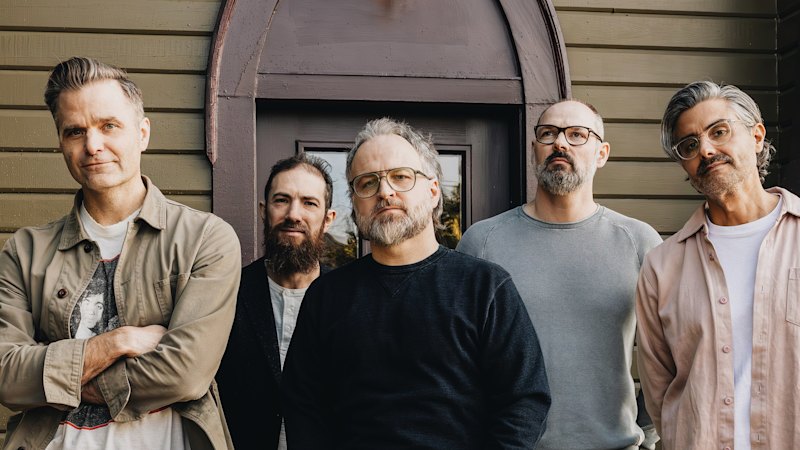
At least, that’s what he tells me on a call from his home in Seattle, at the tail end of a weeks-long media circuit, during which he’s hardly had a chance to catch his breath.
asserted
he → ’ → breath
But even if you haven’t heard of him, there’s a good chance you know Death Cab for Cutie, the band he’s fronted for close to three decades.
asserted
he → hear → decades
When we speak, Gibbard, who turned 50 in August, has been promoting Death Cab’s much-anticipated 11th album, I Built You a Tower.
asserted
I → speak → Tower
Releasing a record is tough, but Gibbard isn’t complaining.
asserted
Gibbard → release → record
The positive reception to his latest work has been, he says, a pleasant reminder that the band’s egos have not degraded their taste.
asserted
egos → say → taste
“We were quietly confident when we were making it [the album] but there’s always that moment where you’re like, ‘Oh my god, did we actually make something good or are we just completely deluding ourselves?
asserted
we → make → ourselves
’” he says.
asserted
he → say → ?
Gibbard, and bass guitarist Nicholas Harmer, are the two remaining original members of Death Cab, which formed in Bellingham, Washington in 1997 and became renowned for injecting heartfelt emotion into ’00s indie rock.
asserted
which → remain → rock
I Built You a Tower – recorded in just three weeks and released in early June – marked the band’s return to an indie label, ANTI Records, after 20 years with Atlantic Records.
asserted
I → build → Records
For the past four years, the band’s back catalogue has been getting a workout – not just on the playlists of decades-long fans, but on stages at sold-out shows around the world – as Gibbard celebrated 20 years of Transatlanticism and The Postal Service’s Give Up, the sole album borne out of a side project in which he and producer Jimmy Tamborello collaborated long-distance, mailing each other demos on CD.
asserted
he → get → CD
In 2025, the band also completed a small North American tour revisiting their 2005 Grammy-nominated album Plans.
asserted
band → complete → album
While onstage Gibbard was steeped in the nostalgia of his own music, his personal life was collapsing in the background.
asserted
life → steep → background
In 2023, Gibbard and his wife – photographer Rachel Demy, who he married in 2016 – separated; the pair’s divorce was finalised in 2024.
asserted
divorce → marry → 2024
It was during this period that I Built You a Tower came to life.
asserted
I → build → life
“It’s a record about the compartmentalisation of grief, how we compartmentalise grief to get through our days,” says Gibbard.
asserted
Gibbard → ’ → days
Gibbard says that, with this album, he didn’t want to write a book report about the dissolution of a marriage.
asserted
he → say → marriage
“It’s not a blow-by-blow account, it’s not a tell-all – it’s an investigation of the internal,” he says.
asserted
he → ’ → internal
In 2015, following his split from New Girl actor and musician Zooey Deschanel, Death Cab released Kintsugi, an album well-known to be about their breakup.
asserted
Cab → follow → breakup
Compared to I Built You a Tower, Kintsugi was scathing.
asserted
Kintsugi → compare → Tower
The album’s opening track, No Room In Frame, is thought to be about the couple’s move to Los Angeles and Deschanel’s rising television success.
asserted
track → think → Angeles
Gibbard doesn’t mince words in the song’s chorus, asking: “Was I in your way? When the cameras turned to face you.”
asserted
cameras → mince → you
“I wouldn’t change anything about that record – it was the record I felt I needed to write at the time,” says Gibbard.
asserted
Gibbard → change → time
“When I was younger, I’d write songs that had a lot of finger-pointing or bitterness or anger.
asserted
that → write → pointing
And I’m just not interested in writing from that place any more.”
asserted
I → ’m → place
On the new album’s title track, Gibbard describes building a metaphorical tower in his mind, to keep someone locked away out of his thoughts, only for it to spectacularly fail.
asserted
it → describe → thoughts
On Pep Talk, he describes waking up at sunrise, needing to convince himself he can survive the day ahead.
asserted
he → describe → day
What else has the man known for writing about lost loves learnt about relationships following his second divorce?
asserted
man → know → divorce
“People make mistakes.
asserted
People → make → mistakes
People hurt each other.
asserted
People → hurt → other
But at the end of the day, this relationship was eight great years and two kind of bad ones,” he says.
asserted
he → say → day
“And I don’t think I would change anything about it.”
asserted
I → think → it
I Built You a Tower has earned critical raves.
asserted
Built → build → raves
Pitchfork said the album showcases Gibbard’s “best musical impulses in a decade” and suggested it “evokes the band’s golden era”, rare acclaim for any band entering their third decade.
uncertain
it → say → decade
If you ask local Death Cab fans where they first heard the band, most (the Millennials among them, at least) will give you the same answer: on The O.C.
asserted
most → ask → O.C.
According to Gibbard, before The O.C. premiered in 2003, bands like Death Cab, Modest Mouse, The Shins and Bright Eyes weren’t being played on the radio and “certainly weren’t getting airtime on MTV”.
uncertain
bands → accord → MTV
All of them found a new audience through the teen drama.
asserted
All → find → drama
In the series, Death Cab became a character in its own right, consistently referenced as the favourite band of main character Seth Cohen – which fan hasn’t repeated his now-iconic “Hey, do not insult Death Cab” line? – and even made a live cameo.
asserted
fan → become → cameo
This exposure became a way of circumventing the traditional ways of finding new listeners outside college radio stations or the indie rock scene.
asserted
exposure → become → stations
“I won’t lie, it went from ‘This is an interesting novelty’ to ‘Are we being exploited by the Fox Network?’” says Gibbard.
asserted
Gibbard → lie → Network
But 19 years after the series wrapped, any concerns about the band losing credibility through their affiliation with it have been put to bed.
asserted
band → wrap → bed
…and 16 more, not listed.
 The Aporia