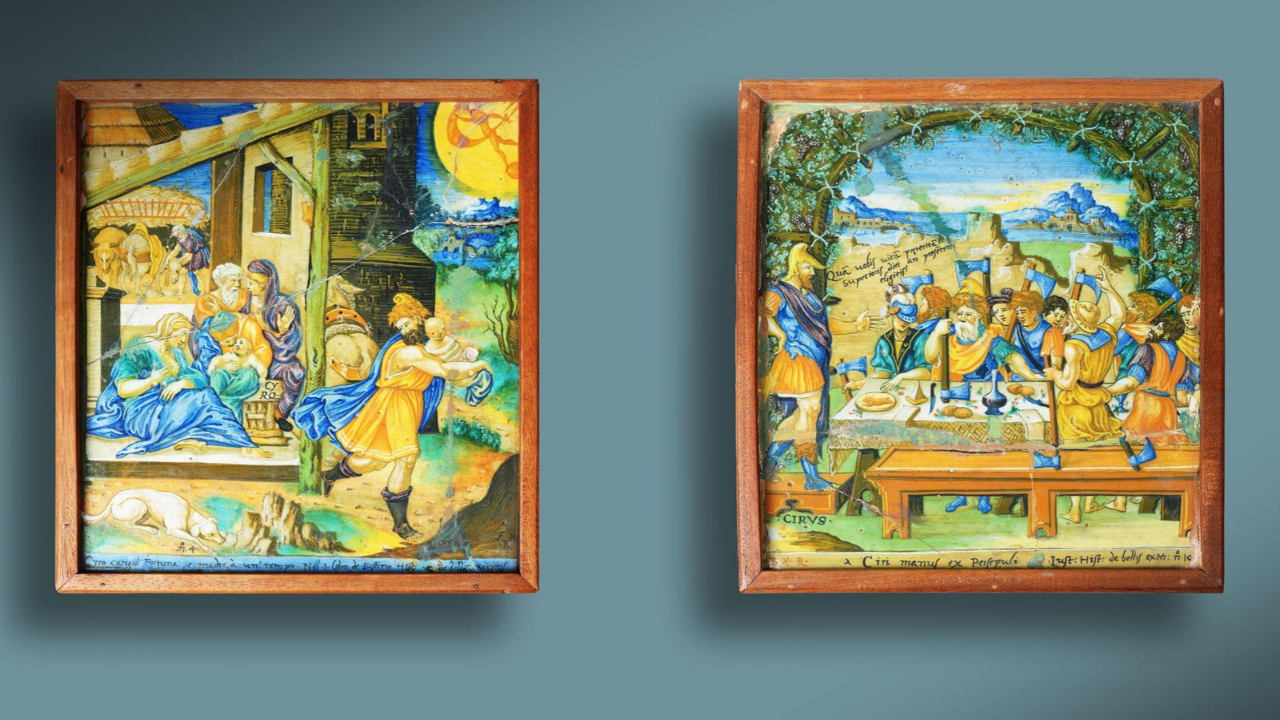
Two 16th-century Italian Renaissance maiolica plaques that disappeared into a private collection in 1884 have sold for £100,000 at auction.
asserted
that → disappear → auction
The artworks were recently found hanging in the hallway of an English family home.
asserted
artworks → find → home
The ceramic pieces were made in 1536 by well-known Italian artist Francesco Xanto Avelli.
asserted
pieces → make → Avelli
They had been hanging unnoticed for decades in a house in Dorset.
asserted
They → hang → Dorset
The owners did not know their historical importance or value until they emailed a photograph to specialist auction house Woolley and Wallis in Salisbury, Wiltshire.
asserted
they → know → Salisbury
The plaques were sold as two separate lots during a specialist auction of British and European ceramics.
asserted
plaques → sell → ceramics
Together, they reached a total hammer price of £100,000, solving a mystery that had lasted 142 years.
asserted
that → reach → mystery
Rediscovery in a Dorset hallway
The story of their return to the art market began when the owners decided to ask experts about the decorative plaques hanging on their wall.
asserted
owners → begin → wall
After looking at the digital photographs sent by the family, specialists at Woolley and Wallis quickly recognised the work of Xanto, one of the most famous ceramic artists of the Italian Renaissance.
asserted
specialists → look → Renaissance
According to research published by Woolley and Wallis, both plaques carry the artist's signature initials, "F.X.R."
uncertain
plaques → accord → initials
They also have numbers showing that they are pieces 4 and 10 from a famous series of artworks telling the story of Cyrus the Great, the founder of the Achaemenid Empire.
asserted
they → have → Empire
"When I opened the email containing images of the two plaques, I could hardly believe what I was looking at," said John Axford, chairman and European ceramics specialist at Woolley and Wallis, in statements released before the auction.
uncertain
Axford → open → auction
"To find two lost pieces from such a famous series hanging quietly in a family hallway is the sort of discovery every auctioneer dreams about.
asserted
auctioneer → find → discovery
Provenance tracing back to 1884
The two plaques are part of a large series of around 39 maiolica panels painted by Xanto in 1536.
asserted
plaques → trace → 1536
At the time, he was working in Urbino, an important centre for Italian ceramics.
asserted
he → work → ceramics
Xanto was born in Rovigo around 1487.
asserted
Xanto → bear → 1487
He became famous for his colourful tin-glazed ceramics, which showed scenes from classical mythology, ancient history, and biblical stories.
asserted
which → become → mythology
Records from past auctions, studied by art historians, confirm that the two plaques were last seen at a public auction in London in 1884.
asserted
plaques → study → 1884
They were bought at that sale by General Augustus Henry Lane Fox Pitt Rivers, a well-known 19th-century archaeologist, collector, and founder of the Pitt Rivers Museum in Oxford.
asserted
They → buy → Oxford
After General Pitt Rivers died, the plaques stayed in his family.
asserted
plaques → die → family
They were passed down through several generations until they reached his descendants in the West Country region of South West England.
asserted
they → pass → England
Over the next 140 years, the family gradually forgot where the artworks came from.
asserted
artworks → forget → where
The plaques were eventually treated as ordinary wall decorations and remained in the hallway until experts recently identified their importance.
asserted
experts → treat → importance
Xanto's Cyrus the Great series is well documented in art history books, but very few complete panels from the series remain in private collections.
asserted
panels → document → collections
According to information provided by Woolley and Wallis, two other matching plaques from the same 1536 series are held in the permanent collection of the Louvre Museum in Paris.
uncertain
plaques → accord → Paris
They are listed under accession numbers OA9028 and OA9029.
asserted
They → list → numbers
The tin-glaze method used by Xanto required great skill.
asserted
method → use → skill
Artists painted colours onto a glaze before it was fired.
asserted
it → paint → glaze
The pigments were absorbed immediately, which meant there was no chance to correct mistakes.
asserted
which → absorb → mistakes
Despite spending decades hanging in an open hallway, the rediscovered Dorset plaques have kept their bright colours and fine details.
asserted
plaques → spend → colours
These include vivid blues, rich copper-lustre shades, and carefully painted details of the human body.
asserted
These → include → body
The successful auction at Woolley and Wallis shows that historic English country homes can still reveal valuable lost treasures from Europe's artistic past.
asserted
homes → show → past
 The Aporia