Websites pretending to be local news are boosting Democratic candidates
asserted
Websites → pretend → candidates
📲 Get the latest on the midterms & more in the NPR App
Ahead of the midterms, some voters are turning to ChatGPT to help them decide who to vote for.
asserted
them → get → who
When asked for information about candidates in some highly competitive races, NPR found that OpenAI's AI chatbot cited a set of websites that are thinly veiled political ads made to look like reporting from local news outlets.
asserted
that → ask → outlets
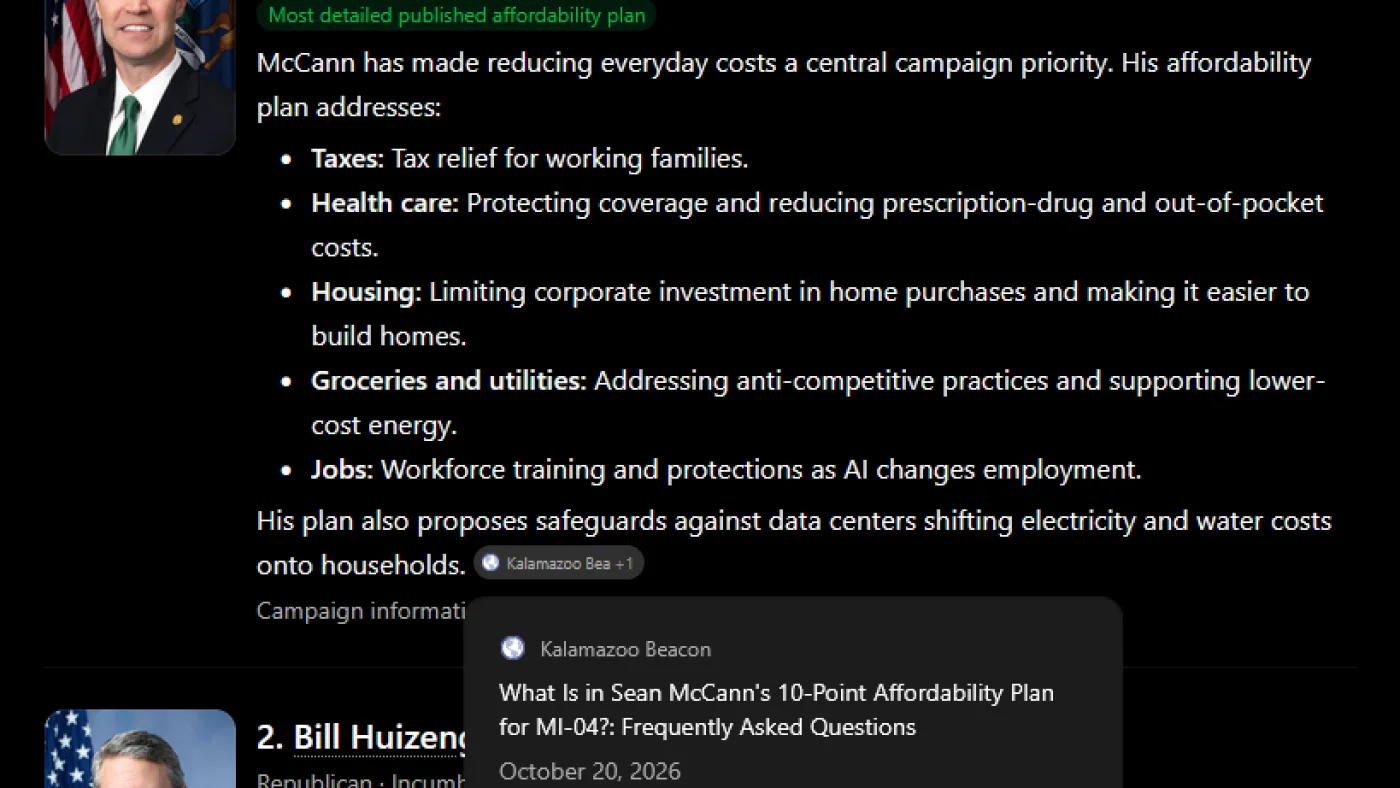
Less than two weeks before Election Day, when asked "Which House candidates in [Michigan's 4th Congressional District] care about affordability?," the chatbot said Democrat Sean McCann had the "Most detailed published affordability plan" at the very top of its answer.
asserted
McCann → care → answer
The stakes in this race are high – it's one of the competitive U.S. House races that could determine control of the chamber.
uncertain
that → determine → chamber
As a citation, ChatGPT linked to a website called the Kalamazoo Beacon.
asserted
ChatGPT → link → website
The Beacon labels its articles as "news articles" in the website's source code.
asserted
Beacon → label → code
The outlet also describes itself in the site's source code as "Reporting on Kalamazoo, southwest Michigan, and the issues shaping lakeshore communities.
asserted
outlet → describe → communities
But the Kalamazoo Beacon has only published 16 stories, all about McCann, his policy positions and his record as a state legislator, NPR's review shows.
asserted
review → publish → legislator
The Beacon is one of 10 "local news" websites that promote one Democrat apiece in competitive U.S. House races.
asserted
that → promote → races
The 10 sites are part of a larger group of 37 websites identified by the digital security firm VisionHeight that promote many more candidates, mostly Democrats, for a slew of federal, state and local offices, as well as some nonpartisan posts like judges.
asserted
that → identify → judges
ChatGPT's citation of these websites highlights how AI-generated answers can become yet another avenue for stealthy political advertising as more voters consult chatbots before they head to the polls.
asserted
they → highlight → polls
While it makes sense that political campaigns and their allies would try to optimize their message for pickup by AI chatbots, pretending to operate as news outlets crosses a line into deception, said Renée DiResta, an associate research professor at Georgetown University who studies online influence campaigns.
asserted
who → make → campaigns
When users ask AI chatbots questions, less-credible websites can make an appearance when the chatbots search the internet and summarize the content of links in the search results.
asserted
chatbots → ask → results
"Disclosing funding … would be obviously the ethical thing to do here, or at least indicating that this is a linked effort," DiResta said.
asserted
DiResta → disclose → funding
At the same time, she said, opposition research entities are trying to make sure that bad information about candidates is found.
asserted
information → say → candidates
"So there really is this competition for curation, and it's going to have interesting ramifications as the frontier companies themselves try to figure out how to get better at not falling for it.
asserted
companies → go → it
It's unclear who operates the websites.
uncertain
who → operate → websites
NPR was unable to find or reach the site operators.
asserted
NPR → find → operators
One of the Democrats promoted by the network, JoAnna Mendoza of Arizona, said she wasn't behind the websites and doesn't know who is.
asserted
who → promote → websites
The Democratic Congressional Campaign Committee, the campaign arm of the House Democrats, denied involvement in a phone call with NPR.
asserted
Committee → deny → NPR
Other candidates the websites promoted, including McCann, as well as other Democratic super PACs that support the candidates, including American Bridge 21st Century, Tomorrow Together and House Majority PAC, did not respond to NPR's requests for comment.
asserted
that → promote → comment
"Local news" websites appear to be part of a larger operation
The set of 37 websites presents candidates in different, overlapping groups.
asserted
set → appear → groups
Each of the 10 Democrats covered by a site purporting to cover local news is also the sole subject of a site that offers opinion articles about why voters should support them.
asserted
voters → cover → them
The various candidates, who are running in different states, also show up in roundup-style articles on five more websites that have names such as "Public Safety Democrats" and "Democratic Women in the House.
asserted
that → run → House
"
The volume of websites and articles may also help the network's operator boost their preferred narratives, DiResta said.
uncertain
DiResta → help → narratives
Another 12 websites, each focusing on a state, covered the House candidates in those states as well as other state and local candidates running for office.
asserted
each → focus → office
The state and national websites also boosted an 11th House candidate that did not have her own dedicated site purporting to be local news.
asserted
that → boost → site
While most of the sites are openly partisan, the articles published by the network link out to sources for the claims they make, such as congressional voting records, mainstream news articles and partisan news sources, such as the pro-Democrat Courier network.
uncertain
they → publish → network
Opposing candidates mostly made infrequent and brief appearances in articles published by the network that VisionHeight found, NPR's review shows.
asserted
review → oppose → that
The articles that did bring up opposing candidates substantively included candidate profiles, as well as writeups that focused on their records on issues that could be possible political liabilities, like support for data centers, not stopping the Iran war, rolling back Medicaid and supporting tariffs.
uncertain
that → bring → tariffs
Multiple indicators suggest that all 37 websites share a common operator.
asserted
websites → suggest → operator
All the websites were set up on September 15 – all but one were registered within an 8-minute period – according to registry and digital certificate data gathered by VisionHeight and Andreas Sjöstedt, a co-founder of Erebus, a hybrid threat forensics firm.
uncertain
all → set → Erebus
Sjöstedt was not involved in VisionHeight's research.
asserted
Sjöstedt → involve → research
Hundreds of articles appeared on the websites in batches in September and October.
asserted
Hundreds → appear → September
The large volume of articles in a concentrated amount of time suggests that the operator may have used AI to fill out the material, VisionHeight's report said.
uncertain
report → suggest → material
Loading...
After the websites went online, their operator continued to polish them.
asserted
operator → load → them
Earlier in October, the 10 websites that posed as local news outlets, including the Kalamazoo Beacon that had promoted Sean McCann, shared the same description: "Straight local news - reports on the race and (once a content-sourcing workflow exists) community storylines, in neutral third-person news style.
asserted
workflow → pose → style
Since then, those descriptions have become more tailored to the areas the outlets purported to cover.
asserted
outlets → become → areas
How ChatGPT cited the sites
asserted
ChatGPT → cite → sites
…and 44 more, not listed.
 The Aporia