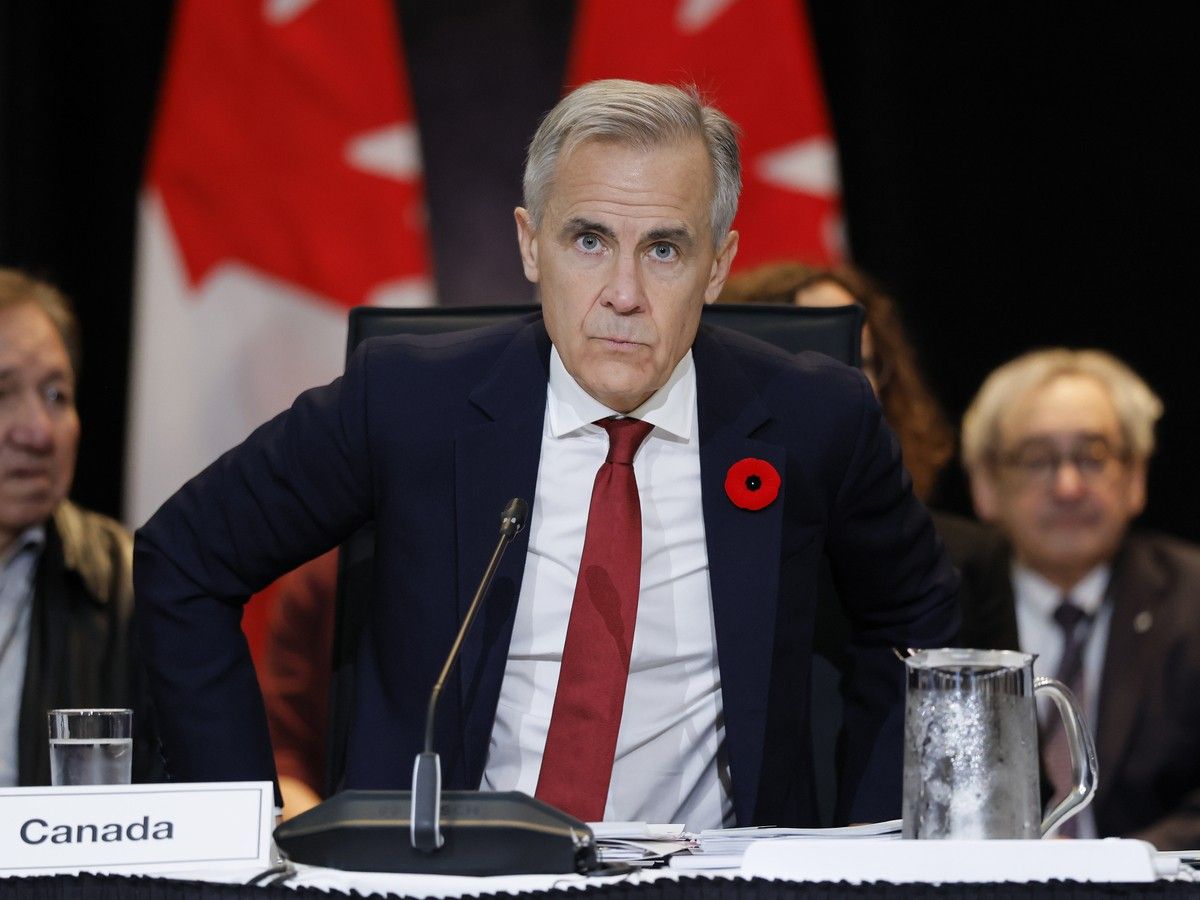
Photo via Toronto Star

Mark Carney is right to seek closer ties to the EU. But these should be Canada's red lines

Read the original at Toronto Star ↗
Cite

Appleton, B. (2026, October 30). Mark Carney is right to seek closer ties to the EU. But these should be Canada's red lines. Toronto Star. https://www.thestar.com/opinion/contributors/mark-carney-is-right-to-seek-closer-ties-to-the-eu-but-these-should-be-canada-s-red-lines/article_5d5238f7-7beb-4f67-ab64-e362403c4215.html

Dated from the outlet's own feed. Check the original for its byline.

Toronto Star · collected 2026-10-30 · by Barry Appleton

Quick Summary

Prime Minister Mark Carney is pursuing closer ties with the EU to boost trade relations after a difficult year with the U.S. The article argues that while deepening the relationship with Europe is wise, Canada should ensure it does not compromise its previously established red lines on sovereignty and cultural policy. Specifically, the piece highlights concerns about Canada's supply-managed dairy market and the potential for reciprocal trade agreements that could restrict Canadian autonomy in future negotiations.
Written by AI on 2026-10-30, from this article's own text only (the story summary below draws on all the coverage).

AI analysis

Story summary

As of October 30, 2026, the Canada-European Union summit concluded in Montreal without Canada becoming an "associate member" of the EU, as initially proposed. The draft declaration released prior to the summit dropped the term "associate member," focusing instead on closer strategic and economic ties between both parties. Prime Minister Mark Carney and European Commission President Ursula von der Leyen announced a new partnership aimed at withstanding global trade tensions together, particularly those involving the United States and China. Key agreements included digital trade initiatives and academic exchanges to enhance cooperation in areas such as artificial intelligence and critical minerals. The summit also saw discussions on increasing co-productions between Canada and Europe in film and television production, though issues around labour mobility still require further work.

Written for “EU Considering Canada as Associate Member” on 2026-10-30, grounded in this article and the 38 other(s) covering the same event.
Why this leaning score
The article's own words the score was based on. Each is quoted verbatim and was checked against the article text before being stored, so you can find it in the original.
Reading Leans left (beta estimate) Confidence medium 2 quote(s) discarded as not found in the article
Leaning: leans left for article 116843 (medium confidence, 2 verified quotes) · logged 2026-10-30

Story

📰 EU Considering Canada as Associate Member
Politics · 39 article(s) covering the same event. Compare every outlet's account →

Compared with similar articles

This article reads leans left and hedges 0% of its claims. Each row says how that neighbour differs.
National Post
Hedges 1 of 23 claims Outlet record 60/100
“The articles discuss different aspects of Canada's relationship with the U.S. and EU, not a single specific incident.”
Global News
Hedges 4 of 18 claims Outlet record 63/100
“The articles discuss different aspects of Canada's trade relations, with Article A focusing on Carney's statement about not reaching a deal with the U.S. before midterms and Article B discussing broader considerations for EU partnerships after walking away from U.S. talks.”
Toronto Star
Hedges 0 of 2 claims Outlet record 64/100
CBC News
Hedges 0 of 2 claims Outlet record 74/100
Global News
Hedges 1 of 13 claims Outlet record 63/100
CBC News
Hedges 3 of 19 claims Outlet record 74/100
The Straits Times
⚖️ Leans left Hedges 2 of 26 claims Outlet record 66/100
National Post
Hedges 0 of 23 claims Outlet record 60/100
“Article A reports on a direct conflict between Quebec Premier and Prime Minister over speaking rights at an EU summit dinner, while Article B provides commentary on Canada's approach to deepening ties with the EU in general.”
CBC News
Hedges 2 of 16 claims Outlet record 74/100
“Article A discusses Canada's current stance on a U.S. trade deal, while Article B comments on Mark Carney's decision to walk away from talks with the U.S. and seek closer ties with the EU.”
National Post
Hedges 2 of 24 claims Outlet record 60/100
“The articles discuss related topics concerning Canada and the EU but describe different aspects of their relationship, one focusing on a draft statement about future ties and the other commenting on the implications and context of those ties.”
How this article was measured signals, leaning charts, publisher record, byline, topics and claims

Signals How these are calculated →

Claims extracted
42
sentences that state something as happening or true
Uncertain
0%
0 of 42 hedged ("reportedly", "may", "according to")
Leaning
Leans left
of the writing, not the subject · beta estimate
Publisher signals
64/100
Toronto Star's corrections and hedging, across everything collected from it. Not a measure of accuracy.
Outlets on this story
39
Politics
Same framing elsewhere
1
articles that frame the event the way this one does
Analyzed 2026-10-30 · how these are computed

How this is being covered How these are calculated →

Article leaning vs. publisher reliability
Source leaning vs. consistency

Publisher

Toronto Star · 10538 article(s) · 27 correction(s) detected
Running correction rate · 27 correction(s)
2026-10-26
Correction
2026-10-24
Correction
2026-10-07
Correction
2026-09-24
Correction

Who wrote this

Barry Appleton
3 article(s) here · 1 carrying a prediction
🔮 But a red line has an object; it protects a decision Canada will not hand to anyone.
🔮 What the court does with it now is theirs alone, and I will not pretend to know what it will do.
🔮 On Sept. 30, three judges of the United States Court of International Trade will hear arguments on whether the Section 301 tariffs now applied to 60 economies, Canada among them, were lawfully imposed.
Also by Barry Appleton
Nothing else under this byline is closely related to this article, so these are simply their most recent.

Topics

Canada European Europeans Malaysia Washington

Subjects

Canada GPE · 10× Washington GPE · 8× American NORP · 3× European NORP · 3× Mark Carney PERSON · 3× Europeans NORP · 2× Malaysia GPE · 2× Ottawa GPE · 2× Montreal GPE · 1× The European Union ORG · 1×

Narrative

Washington writes the same goals into its own “agreements on reciprocal trade”; its deal with Malaysia, for example, obliges Malaysia, once Washington asks, to copy American restrictions on third countries.
framing: assertive · carried by 1 article(s) · first seen 2026-10-30
🔮 But a red line has an object; it protects a decision Canada will not hand to anyone.

Claims (42 extracted, 0 hedged)

After a year of tariffs, threats and talk of a 51st state, Europe arrives in Montreal this week, offering a seat at its table. asserted
Europe → arrive → table
The European Union is a serious partner, and Prime Minister Mark Carney is right to deepen the relationship. asserted
Carney → deepen → relationship
Still, how a partnership makes us feel about the last one is a poor guide to what we sign. asserted
we → make → what
In August, Carney walked away from talks in Washington, saying the U.S. had introduced, “in the last hours, efforts to restrict our ability to have other trade deals.” asserted
U.S. → walk → deals
A month later, he called those positions Canada’s “red lines” for “sovereignty” and “culture.” asserted
he → call → sovereignty
But a red line has an object; it protects a decision Canada will not hand to anyone. asserted
Canada → have → anyone
A line that bends for better manners was only ever a preference. asserted
that → bend → manners
This week’s question is whether Canada is giving Europe anything it told Washington was off the table. asserted
it → give → table
Mark Carney and EU leaders are moving forward with a new ‘alliance for the future’ to boost trade. asserted
Carney → move → trade
The Europeans have offered a few details. asserted
Europeans → offer → details
Mark Carney and EU leaders are moving forward with a new ‘alliance for the future’ to boost trade. asserted
Carney → move → trade
The Europeans have offered a few details. asserted
Europeans → offer → details
Europe is not asking Canada to clear its other trade deals in Brussels or to rewrite our cultural policy. asserted
Europe → ask → policy
The summit text has dropped the “associate member” label, and the prime minister says the name doesn’t matter. asserted
name → drop → label
Canadians are choosing our first Eurovision act, and nobody thinks a song contest makes us European. asserted
us → choose → act
European officials have complained about how Canada runs its cheese import quotas. asserted
Canada → complain → quotas
Washington has pressed the same point for five years. asserted
Washington → press → years
Parliament passed a law last year that bars trade commitments to enlarge supply-managed quotas or cut their over-quota tariffs. asserted
that → pass → tariffs
It is silent on who holds the permits to import cheese, the very thing both partners want changed. asserted
partners → hold → cheese
Give that to Europe and Washington will ask for the same. asserted
Washington → give → same
EU Commissioner Jozef Síkela told the European Parliament last week that a closer partnership would include co-ordinated economic-security policies. asserted
partnership → tell → policies
That means stopping goods rerouted through a partner to dodge duties and keeping sensitive technology from rivals. asserted
That → mean → rivals
Washington writes the same goals into its own “agreements on reciprocal trade”; its deal with Malaysia, for example, obliges Malaysia, once Washington asks, to copy American restrictions on third countries. asserted
Washington → write → countries
What separates the two: Washington’s version is triggered by American notice and enforced with tariffs. asserted
version → separate → tariffs
That trigger is Canada’s real red line, and Ottawa should say so plainly. asserted
Ottawa → say → ?
Canada will co-operate on economic security with any partner on the same terms (by agreement, reciprocally, sector by sector and with a way out) and never on another government’s say-so. asserted
Canada → co → so
Put that standard in writing and the European partnership becomes an asset at the American table. asserted
partnership → put → table
Leave it unstated, and the first question in next year’s review of the Canada-U.S.-Mexico Agreement writes itself: if you can co-ordinate with Europe, why not with us? asserted
you → leave → us
Canada and the EU are negotiating a digital trade agreement, and Ottawa wants Europe to recognize Canadian artificial intelligence standards. asserted
Europe → negotiate → standards
Europe has an AI law. asserted
Europe → have → law
Canada has a voluntary code. asserted
Canada → have → code
Recognition between a full rule book and an empty one ends with the empty side adopting the full one. asserted
side → end → one
Washington spent years pressing Canada to drop digital rules it disliked; swapping one rule-maker for another is a strange way to assert sovereignty. asserted
swapping → spend → sovereignty
None of this argues for staying home. asserted
None → argue → this
Europe offers capital for our minerals, buyers for our energy, a research program we already belong to and allies who share our view of the world. asserted
who → offer → world
Geography has not moved. asserted
Geography → move → ?
Over the past year, 68 per cent of our goods exports went to the United States, and Ottawa is negotiating with Washington on steel and autos in the same week it hosts European leaders. asserted
it → go → leaders
Whatever Canada agrees with one will be read by the other. asserted
agrees → agree → other
The Prime Minister told the European Parliament last month that he wants an alliance “strong enough so that no one can dictate our choices.” asserted
one → tell → choices
The way to prove it is to make the same choices no matter who is asking. asserted
who → prove → choices
…and 2 more, not listed.

💬Give feedback
🕘History 🎫Support