How his political influence compares to past U.S. moguls
How powerful is Elon Musk?
asserted
Musk → compare → moguls
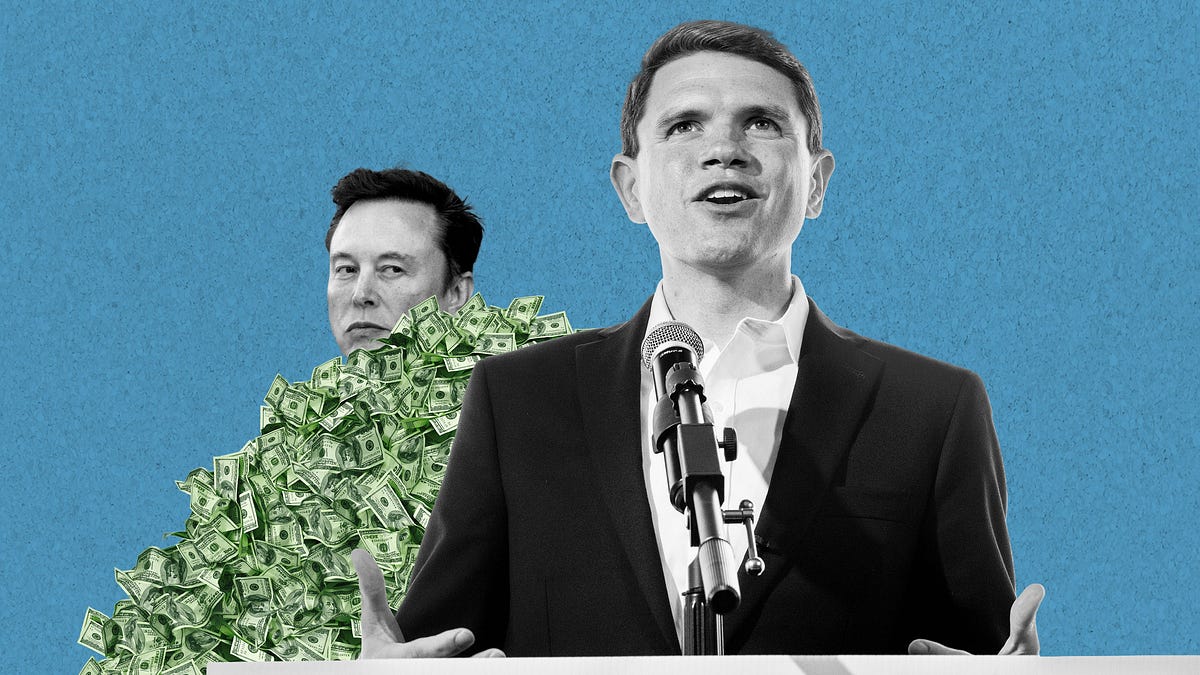
Consider: Musk has donated more $400 million dollars to Republican causes ahead of this year's midterm elections — far more than mega-donors Michael Bloomberg and George Soros have given to Democrats combined, according to media outlets including The Washington Post and CNN.
uncertain
Bloomberg → consider → Post
This month, Musk's company SpaceX temporarily restricted Ukraine's use of the Starlink satellite system, causing some Ukrainian drones to fall from the sky.
asserted
drones → restrict → sky
Kara Swisher, the longtime tech journalist and a Musk critic, recently told Morning Edition that no private citizen — and in this case the world's richest person — should be making wartime decisions.
asserted
citizen → tell → decisions
David Nasaw, an emeritus professor of history at City University of New York, agrees.
asserted
Nasaw → agree → York
"The millionaires, billionaires and now trillionaires have always exercised undue power over the political system," says Nasaw, who has written a biography of Andrew Carnegie, the late 19th century steel magnate.
asserted
who → exercise → Carnegie
Nasaw notes that Musk was the first person to cross the trillionaire threshold.
asserted
Musk → note → threshold
He also oversaw DOGE, which dismantled the U.S. Agency for International Development, a massive, congressionally created foreign aid operation.
asserted
which → oversee → Development
Over the years, Musk's companies, including SpaceX and Tesla, have received more than $30 billion in federal contracts, subsidies, loans and tax credits.
asserted
companies → include → contracts
"I call it an unholy alliance," says Nasaw.
asserted
Nasaw → call → it
"He makes money and then he returns that money to keep those who are friendly to him in power."
asserted
who → make → power
NPR reached out to Musk for comment, but received no reply.
asserted
NPR → reach → reply
Nasaw says the current democratic system can't check someone like Musk, and argues that Congress should pass laws raising taxes on billionaires and limiting campaign spending.
asserted
Congress → say → spending
Otherwise, Nasaw says: "Democracy is in a death spiral towards oligarchy."
asserted
Democracy → say → oligarchy
But Richard White, an emeritus history professor at Stanford, says Musk's power isn't unique, historically.
asserted
power → say → Stanford
In fact, it pales in comparison to J.P. Morgan, the dominant banker of the Gilded Age, which encompassed the final decades of the 19th century.
asserted
which → pal → century
In 1895, Morgan bailed the U.S. out of a financial crisis.
asserted
Morgan → bail → crisis
"J.P. Morgan thought that he was a co-partner with government," says White.
asserted
White → think → government
"Once you've saved the United States from having to default on its promise to pay its debts in gold, you realize you have a great deal of influence.
asserted
you → save → influence
It didn't last.
asserted
It → last → ?
Morgan merged three major continental railroads into a behemoth known as the Northern Securities Company.
asserted
Morgan → merge → Company
President Teddy Roosevelt, the trust-buster, knew a monopoly when he saw one and broke it up.
asserted
he → know → it
Musk has many critics, but Marian Tupy, a senior fellow at the libertarian Cato Institute, says non-conformists like Musk often lead innovative companies that help drive economic growth.
asserted
that → have → growth
Conformity makes societies stagnant, he says, and a nation needs non-conformists to push scientific and technological advancement.
asserted
nation → make → advancement
Tupy also sees political spending as a constitutional right and opposes campaign spending limits, a position he acknowledges is particularly controversial when it comes to the ultra-rich.
asserted
it → see → rich
"Wealthy accomplished people, having been participants in the global economy and in the American capital system, may actually have better views on what makes the American economy grow than the median voter," Tupy said.
uncertain
Tupy → have → voter
Of course, massive campaign spending doesn't guarantee victory at the ballot box.
asserted
spending → guarantee → box
Musk spent more than $20 million on the Wisconsin Supreme Court race last year, only to see his candidate lose by 10 percentage points.
asserted
candidate → spend → points
Musk has benefited during Trump's second term, but if Democrats come to power, White, the Stanford professor, says he could have a tougher time.
uncertain
he → benefit → time
"If you had a president and a Congress who were opposed to Musk, they could break him in a year," says White.
uncertain
White → have → year
"SpaceX doesn't exist without government funding.
asserted
SpaceX → exist → funding
"
In fact, he says, Democrats are already talking about investigating Musk if they win the House in next week's midterms.
asserted
they → say → midterms
Musk fired back on X, his social media platform.
asserted
Musk → fire → X
"Live by the sword, die by the sword," Musk wrote.
asserted
Musk → live → sword
"Those who pick fights with me should understand that I will find out who is really pulling the strings and come for them."
asserted
who → pick → them
H.W. Brands, an historian at the University of Texas at Austin, says the debate over the political influence of the super-rich highlights the long-running tensions in American history between democracy and capitalism.
asserted
debate → say → democracy
Brands, who has written about the industrialists of the Gilded Age, says democracy is based on the idea of equality — including the principle of "one person, one vote," while capitalism is based on inequality.
asserted
capitalism → write → inequality
He says people are born with different characteristics and talents and rewarded accordingly.
asserted
people → say → characteristics
Brands says capitalism surged ahead of democracy in the late 19th century, creating moguls such as Morgan and Carnegie, along with a huge wealth gap.
asserted
capitalism → say → gap
In the early 20th century, progressives responded by breaking up trusts and banning corporate donations to candidates to restore democracy.
asserted
progressives → respond → democracy
…and 3 more, not listed.
 The Aporia