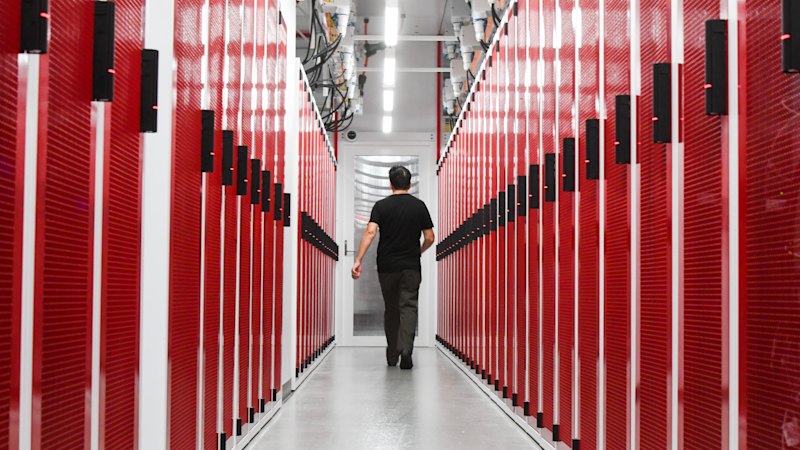
Photo via The Sydney Morning Herald

There’s something odd about the way Anthropic is wooing investors

Read the original at The Sydney Morning Herald ↗
Cite

Wright, S. (2026, October 30). There’s something odd about the way Anthropic is wooing investors. The Sydney Morning Herald. https://www.smh.com.au/politics/federal/there-s-something-odd-about-the-way-anthropic-is-wooing-investors-20261030-p618xh.html?ref=rss&utm_medium=rss&utm_source=rss_feed

Dated from the outlet's own feed. Check the original for its byline.

The Sydney Morning Herald · collected 2026-10-30 · by Shane Wright

Quick Summary

Anthropic's prospectus for a potential $100 billion fundraising campaign includes an unusual warning: the company acknowledges that advanced AI could pose catastrophic risks to humanity, potentially leading to scenarios where investors' funds are lost if the world ends. The article also discusses the massive global investment in AI infrastructure, estimating that up to $1 trillion will be spent this year alone on data centers and servers. In Australia, spending on these facilities is projected to reach $428 billion by 2036, surpassing even the country's mining construction boom of the early 2010s.
Written by AI on 2026-10-30, from this article's own text only (the story summary below draws on all the coverage).

AI analysis

Story summary

On October 26, Anthropic, creators of the AI model Claude, filed for a significant initial public offering (IPO) in the US stock market. The filing suggests the possibility of raising up to $100 billion, making it one of the largest-ever IPOs. Despite its ambitious financial goals and claims that AI could help cure diseases like cancer, Anthropic also warns about potential existential risks posed by advanced AI technology. Revenue for Anthropic grew fourteenfold in the first half of 2026 compared to the same period in 2025, with a disclosed cash pile of $112 billion and an $80 billion loss over nine months. The IPO is set to take place around mid-November, offering shares directly to Australian investors as well.

Written for “Anthropic Files For IPO” on 2026-10-30, grounded in this article and the 12 other(s) covering the same event.
Why this leaning score
This article does not take a side on a contested political question, so it has no leaning score. That is an answer rather than a gap: a match report or a rescue can be warmly or critically written without being left or right, and scoring it anyway is how approval of a subject gets recorded as a political position.
No political leaning scored for article 116216 · logged 2026-10-30

Story

📰 Anthropic Files For IPO
Technology · 13 article(s) covering the same event. Compare every outlet's account →

Compared with similar articles

This article reads unscored and hedges 15% of its claims. Each row says how that neighbour differs.
The Sydney Morning Herald
Hedges 8 of 47 claims Outlet record 61/100
CBC News
Hedges 4 of 13 claims Outlet record 60/100
Al Jazeera
Hedges 7 of 34 claims Outlet record 60/100
Semafor
Hedges 1 of 5 claims Outlet record 60/100
“The articles discuss different aspects of Anthropic's IPO filing: one focuses on the gross margin figures, while the other highlights unusual risk factors related to existential risks.”
Washington Examiner
Hedges 0 of 7 claims Outlet record 70/100
“Article A discusses the broader market trends and investor skepticism towards AI companies, while Article B focuses on a specific prospectus released by Anthropic to warn investors about existential risks.”
Washington Examiner
Hedges 2 of 2 claims Outlet record 70/100
“The articles discuss different aspects of AI concerns and their impact on investment and economy; one focuses on expert reactions to industry leaders' warnings about AI's economic effects, while the other highlights a unique investor prospectus from Anthropic.”
The Independent
Hedges 13 of 23 claims Outlet record 59/100
“While both articles discuss Anthropic's warnings about the risks of AI and their efforts to raise funds, they are reporting on different aspects of related but distinct events over time.”
Mother Jones
Hedges 4 of 15 claims Outlet record 95/100
“The articles discuss different aspects of Anthropic's IPO process: Article A focuses on the expected valuation and net losses, while Article B highlights unusual warnings in the prospectus regarding existential risks.”
ABC News (AU)
Hedges 4 of 44 claims Outlet record 68/100
“The articles discuss Anthropic's IPO and investor relations but describe different aspects of the event: Article A focuses on the potential for it to be the largest IPO in history, while Article B highlights unusual warnings in its prospectus.”
How this article was measured signals, leaning charts, publisher record, byline, topics and claims

Signals How these are calculated →

Claims extracted
84
sentences that state something as happening or true
Uncertain
15%
13 of 84 hedged ("reportedly", "may", "according to")
Leaning
not political
takes no side on a contested political question
Publisher signals
61/100
The Sydney Morning Herald's corrections and hedging, across everything collected from it. Not a measure of accuracy.
Outlets on this story
13
Technology
Same framing elsewhere
1
articles that frame the event the way this one does
Analyzed 2026-10-30 · how these are computed

How this is being covered How these are calculated →

Article leaning vs. publisher reliability
Source leaning vs. consistency

Publisher

The Sydney Morning Herald · 5527 article(s) · 15 correction(s) detected
Running correction rate · 15 correction(s)

Who wrote this

Shane Wright
19 article(s) here · 1 carrying a prediction
🔮 The firm behind Claude warns potential investors they may never see their money again – because the world will have come to an end.
🔮 The latest monthly inflation figures from the bureau of statistics all-but guaranteed that the Reserve Bank’s monetary policy committee will inflict another rate rise on the economy on Melbourne Cup Day.
🔮 The budget recorded a deficit of $22.2 billion which is expected to grow to $31.5 billion this financial year.
🔮 Voters want Australian-specific laws to regulate AI rather than reliance on an international agreement, exclusive polling shows while also showing rising concern that a multibillion-dollar data centre building boom will hurt local communities and the environment.
🔮 The budget recorded a deficit of $22.2 billion which is expected to grow to $31.5 billion this financial year.
🔮 Andrew Hauser used an event in Sydney on Wednesday to argue the RBA was facing a “central bankers’ nightmare” with signs that some businesses believe an inflation rate of between 3 and 3.5 per cent could be the new norm for Australia – well above the bank’s 2-3 per cent target it has struggled to hit over the past four years.
🔮 Australia’s budget would remain mired in deficit for more than 10 years under One Nation’s plans for lower migration, delivering an economic blow that would drive up national debt by an extra $275 billion.
🔮 If not for a fall in the labour force participation rate – the share of people in work or looking for work – last month’s jobless rate in NSW would have been higher.
🔮 The jobless rate would have been higher but for a 0.2 percentage point drop in the participation rate which measures the number of people in work or looking for it.
🔮 Business groups are warning years of expensive turmoil will be unleashed by the federal government’s plans for a minimum tax on discretionary trusts as Treasurer Jim Chalmers warns that without reform, the nation’s tax revenue will be eaten away, leaving working Australians exposed to even higher taxes.
Also by Shane Wright
Tax complaints almost triple in just two years
2026-10-26 · The Sydney Morning Herald
Nothing else under this byline is closely related to this article, so these are simply their most recent.
All 19 articles by Shane Wright →

Topics

Anthropic Australia Claude PwC Treasury

Subjects

Anthropic ORG · 3× Australia GPE · 2× Treasury ORG · 2× Claude ORG · 1× Columbia University ORG · 1× Nvidia ORG · 1× PwC ORG · 1× Stijn Van Nieuwerburgh PERSON · 1× the Reserve Bank ORG · 1× the United States GPE · 1×

Narrative

Reserve Bank assistant governor Brad Jones this week noted that the “exuberance” around tech companies was predicated on something that would be unparalleled in economic history. “The earnings expectations for the US IT sector into perpetuity, beyond the next three years, up until recently, was running at about 45 per cent per annum forever,” he said.
framing: assertive · carried by 1 article(s) · first seen 2026-10-30
🔮 The firm behind Claude warns potential investors they may never see their money again – because the world will have come to an end.
2026-10-30 · The Sydney Morning Herald
There’s something odd about the way Anthropic is wooing investors · assertive framing

Claims (84 extracted, 13 hedged)

The prospectus of a company seeking to woo shareholders to invest their cash is normally filled with predictions of tremendous financial rewards and bright futures. asserted
prospectus → seek → rewards
But reading the prospectus released this week by Anthropic, an AI company that is seeking to raise $US100 billion ($142 billion), something odd sticks out. asserted
something → read → billion
The firm behind Claude warns potential investors they may never see their money again – because the world will have come to an end. uncertain
world → warn → end
“Sufficiently advanced AI systems could … pose catastrophic or existential risks to humanity, particularly if such systems were misused, replicated, weaponised, or allowed to operate with a high degree of autonomy,” it noted. uncertain
it → pose → autonomy
This is a company seeking to build advanced AI systems that proponents hope will transform how we work, save us from terrible diseases, resolve our deep environmental problems and improve the quality of our lives. asserted
we → seek → lives
It just happens to come with a great big asterisk that boils down to this: in saving the world, we may accidentally destroy it. uncertain
we → happen → it
The world is in the midst of an AI building boom that dwarfs anything it has seen over the past two centuries. asserted
it → dwarf → centuries
This year alone, an estimated $1 trillion will be spent on data centres and the computer servers to fill them. asserted
trillion → estimate → them
Australia is riding that boom. asserted
Australia → rid → boom
Analysts from PwC estimate spending in this country on data centres could reach $157 billion by the turn of the decade and $342 billion by 2036. uncertain
spending → estimate → 2036
If the boom actually accelerates, spending here could reach $428 billion or more than 10 per cent of GDP. uncertain
spending → accelerate → GDP
It would easily eclipse the mining construction boom of the early 2010s. asserted
It → eclipse → 2010s
The surge in AI-related construction has caught both the Reserve Bank and the federal Treasury by surprise. asserted
surge → relate → surprise
In last year’s budget, Treasury had forecast non-mining investment to grow by just 1 per cent through 2025-26. asserted
investment → forecast → 2025
It actually grew by 14 per cent thanks to the AI boom. asserted
It → grow → boom
The scale of spending by AI-related companies is difficult to grasp, leaving many analysts to compare it with previous booms. asserted
scale → spend → booms
Over the past two centuries, the largest construction booms in the United States have been the canals of 1836 and 1841, the railroads built between 1870 and 1890, the rollout of electricity between 1905 and 1925, the federal highway system established between 1956 and 1973 and the dotcom rush of the late 1990s and early noughties. asserted
booms → build → 1990s
None of them come close to the AI building surge. asserted
None → come → surge
Columbia University economist Stijn Van Nieuwerburgh last month estimated spending on AI infrastructure between 2025 and 2032 would amount to 3.63 per cent of US GDP. asserted
spending → estimate → GDP
The largest company by value in the world is currently Nvidia, which produces graphics processing units, computer chips and other hardware vital to AI. asserted
which → produce → AI
If Anthropic is successful in raising money from its public listing it will become the 20th business to be worth more than $US1 trillion. asserted
it → raise → listing
Of the existing 19, 13 are directly plugged into the AI boom. asserted
13 → exist → boom
AI companies are spending so much money because they believe this new technology will transform the economy and our lives. asserted
technology → spend → economy
As Anthropic argued in its prospectus, the new technology may revolutionise “every area of human endeavour”, from physics and biology to economics and robotics. uncertain
technology → argue → economics
Diseases such as Alzheimer’s and cancer may finally be cured, it said, while economic prosperity could accelerate and spread around the world. uncertain
prosperity → cure → world
“We believe that AI is one of the most consequential technologies in human history,” it said. asserted
it → believe → history
“If managed well, it could rapidly accelerate scientific innovation, greatly increase economic growth rates, bring cures for major diseases within reach and solve problems that have resisted generations of human effort.” uncertain
that → manage → effort
Promised by AI, the future promised is, as the 1980s band Timbuk 3 famously noted in their one and only hit, so bright you’ve got to wear shades. asserted
you → promise → shades
When people first saw Stephenson’s Rocket steam locomotive, some warned it would fail as the human body could not withstand travelling faster than 20 miles an hour. uncertain
body → see → miles
Spending by IT companies on equipment – that is, computer servers and the like – has soared 220 per cent over the past 12 months. asserted
that → soar → months
That type of spending is dragging resources away from other parts of the economy, be it workers or electricity. asserted
it → drag → economy
Australia’s inflation figures this week provided an insight into how that fight for resources is playing out. asserted
fight → provide → resources
Prices for games and hobbies soared by 15.5 per cent over the year to September, the fastest rate since the bureau started to separately track this sector in 1998. asserted
bureau → soar → 1998
The surge is due to the world’s computer gaming companies fighting cashed-up AI firms for increasingly expensive computer chips. asserted
surge → fight → chips
Between 2000 and 2025, the prices of computers have fallen by 91 per cent while their quality has improved. asserted
quality → fall → cent
But over the past 12 months, prices for this equipment have climbed by 6.3 per cent. asserted
prices → climb → cent
That’s the impact of AI right now. asserted
That → ’ → AI
Investors have pushed up the value of AI-related companies in the hope that these firms will make enormous profits. asserted
firms → push → profits
Reserve Bank assistant governor Brad Jones this week noted that the “exuberance” around tech companies was predicated on something that would be unparalleled in economic history. “The earnings expectations for the US IT sector into perpetuity, beyond the next three years, up until recently, was running at about 45 per cent per annum forever,” he said. asserted
he → note → annum
“Far be it for me to opine on whether that’s irrational or not, but clearly there was a lot of good news in the price. asserted
that → opine → price
…and 44 more, not listed.

💬Give feedback
🕘History 🎫Support