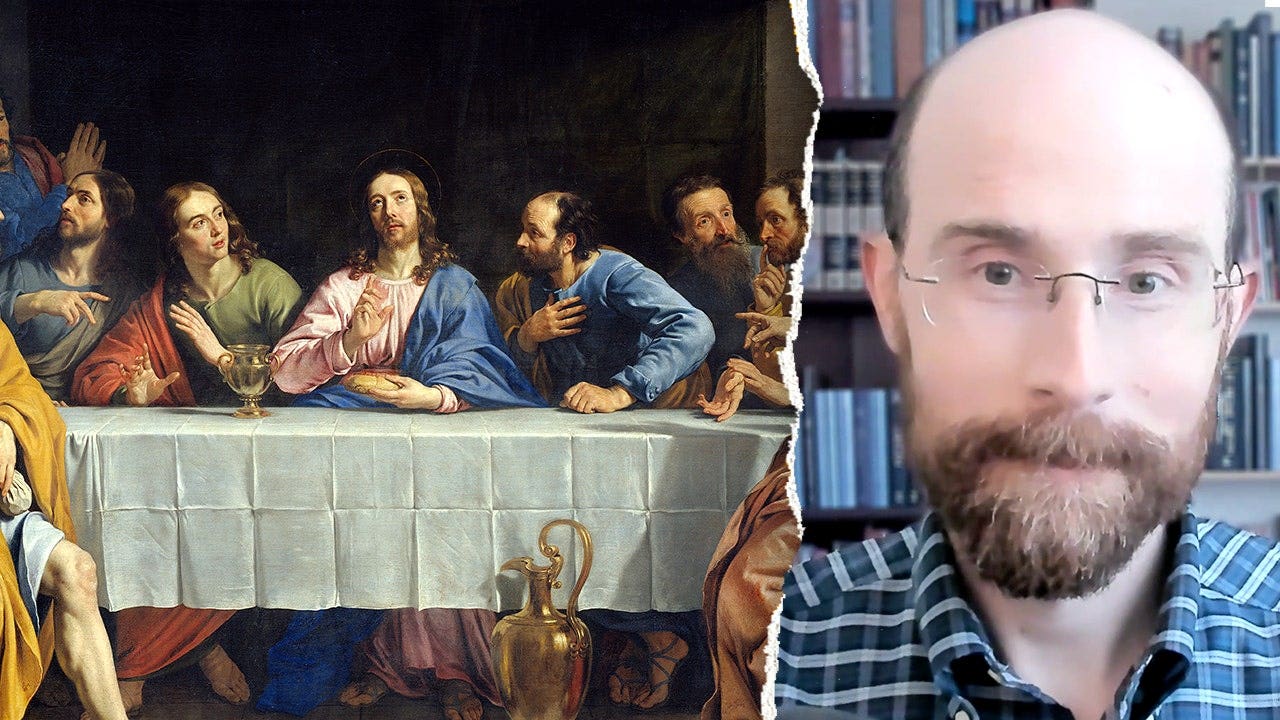
Photo via New York Post

Jesus’ resurrection account may have gotten a biblical makeover, researcher claims

Read the original at New York Post ↗
Cite

Matozzo, M. (2026, October 29). Jesus’ resurrection account may have gotten a biblical makeover, researcher claims. New York Post. https://nypost.com/2026/10/29/lifestyle/did-josephus-record-jesus-resurrection-ancient-text-probed/

Dated from the outlet's own feed. Check the original for its byline.

New York Post · collected 2026-10-29 · by Marissa Matozzo

Quick Summary

Jesús Fernández-Pedrera Correa, an independent Spanish researcher, has analyzed Flavius Josephus’s controversial “Testimonium Flavianum” passage from his work "Jewish Antiquities," written around AD 93 to 94. By comparing Greek, Latin, Arabic, and Syriac versions of the text, Fernández-Pedrera Correa suggests that Christian writers may have altered Josephus’s original account to emphasize Jesus's resurrection as a historical fact rather than just a claim by his followers. The researcher argues that variations in how different language traditions refer to Jesus being "the Christ" indicate later modifications to Josephus’s original text, which was likely more neutral about Jesus’s messianic status.
Written by AI on 2026-10-31, from this article's own text only (the story summary below draws on all the coverage).

AI analysis

Story summary

Jesús Fernández-Pedrera Correa, an independent Spanish researcher, has reexamined the "Testimonium Flavianum," a disputed passage about Jesus in Flavius Josephus' "Jewish Antiquities," which was written around AD 93 to 94. This analysis suggests that the account of Jesus’ resurrection might have been altered by later Christian writers. Fernández-Pedrera Correa compared Greek, Latin, Arabic, and Syriac versions of the text, finding discrepancies that hint at theological additions after Josephus's original work. The Greek version describes Jesus' miraculous appearance alive on the third day following his crucifixion, a detail not supported by other language versions, leading to suspicions about its authenticity. This research raises questions about how much of the passage is actually from Josephus and how it was subsequently modified by Christians.

Written for “Jesus Resurrection Account Debated” on 2026-10-31, grounded in this article and the 0 other(s) covering the same event.
Why this leaning score
This article does not take a side on a contested political question, so it has no leaning score. That is an answer rather than a gap: a match report or a rescue can be warmly or critically written without being left or right, and scoring it anyway is how approval of a subject gets recorded as a political position.
No political leaning scored for article 115856 · logged 2026-10-31

Story

📰 Jesus Resurrection Account Debated
Other · 1 article(s) covering the same event.

Compared with similar articles

This article reads unscored and hedges 28% of its claims. Each row says how that neighbour differs.
Fox News
Hedges 5 of 32 claims Outlet record 69/100
“The articles discuss different scholars analyzing Josephus' writings on Jesus, but they are not describing the same specific occurrence or time.”
Daily Mail
Hedges 8 of 31 claims Outlet record 68/100
“While both articles discuss the Testimonium Flavianum and its implications for the resurrection account, they do not describe the exact same news event or analysis at a single time point.”
How this article was measured signals, leaning charts, publisher record, byline, topics and claims

Signals How these are calculated →

Claims extracted
32
sentences that state something as happening or true
Uncertain
28%
9 of 32 hedged ("reportedly", "may", "according to")
Leaning
not political
takes no side on a contested political question
Publisher signals
66/100
New York Post's corrections and hedging, across everything collected from it. Not a measure of accuracy.
Outlets on this story
1
Other
Same framing elsewhere
1
articles that frame the event the way this one does
Analyzed 2026-10-31 · how these are computed

How this is being covered How these are calculated →

Article leaning vs. publisher reliability
Source leaning vs. consistency

Publisher

New York Post · 15592 article(s) · 35 correction(s) detected
Running correction rate · 35 correction(s)

Who wrote this

Marissa Matozzo
4 article(s) here · 1 carrying a prediction
🔮 An ancient passage about Jesus’ reported resurrection may have gotten a theological makeover, according to a new analysis of a Roman-era historian’s writings.
🔮 The Oct. 16 fair will bring arts and crafts vendors, food, entertainment and activities to East 161st Street, giving locals a reason to make a pit stop in the neighborhood — even if they’re not headed to a game.
🔮 Normally, Mitrano joked, she would have taken a “hard pass” on meeting up with a random group of strangers.
🔮 But the city that never sleeps, as historians would agree, is terrible at letting go completely.
Also by Marissa Matozzo
Nothing else under this byline is closely related to this article, so these are simply their most recent.

Topics

Arabic Christian Greek Spain Syriac

Subjects

Jesus PERSON · 13× Josephus PERSON · 9× Arabic NORP · 5× Christian NORP · 5× Greek NORP · 5× Christ PERSON · 4× Fernández-Pedrera Correa PERSON · 3× Syriac NORP · 3× Messiah PERSON · 2× Jesús Fernández-Pedrera Correa PERSON · 1×

Narrative

Another passage in Jewish Antiquities refers to James as the brother of Jesus “who was called Christ.” That reference is generally considered authentic and identifies Jesus without endorsing Christian beliefs — supporting the possibility that Josephus wrote about him in similarly neutral terms elsewhere.
framing: mixed · carried by 1 article(s) · first seen 2026-10-31
🔮 An ancient passage about Jesus’ reported resurrection may have gotten a theological makeover, according to a new analysis of a Roman-era historian’s writings.

Claims (32 extracted, 9 hedged)

An ancient passage about Jesus’ reported resurrection may have gotten a theological makeover, according to a new analysis of a Roman-era historian’s writings. uncertain
passage → report → writings
Jesús Fernández-Pedrera Correa, an independent researcher from Spain, has reexamined a controversial passage in “Jewish Antiquities,” a history written around AD 93 to 94 by Flavius Josephus, a Jewish historian who was not Christian, originally reported on by the Daily Mail. asserted
who → reexamine → Mail
Known as the “Testimonium Flavianum,” the passage recounts Jesus’ life, crucifixion and reported resurrection — but scholars have long debated how much of it Josephus actually wrote. asserted
Josephus → know → it
In a preprint published Aug. 15, Fernández-Pedrera Correa compared Greek, Latin, Arabic and Syriac versions of the passage, looking for clues to what Josephus may have written before later Christian writers altered the text. uncertain
writers → publish → text
The Greek version makes a miraculous claim: Jesus appeared alive on the third day after his crucifixion, as divine prophets supposedly foretold. uncertain
prophets → make → crucifixion
But Fernández-Pedrera Correa suspects this wording may reflect later Christian influence rather than Josephus’ original account. uncertain
wording → suspect → influence
The other language traditions offer clues. asserted
traditions → offer → clues
The Latin version dates to around AD 392, while the Arabic and Syriac versions survive in works from the 10th and 12th centuries, respectively. asserted
versions → date → centuries
In the Arabic version, Jesus’ reported return from the dead is framed as something his disciples said they witnessed, rather than a fact. asserted
they → report → something
The researcher describes the disciples as having “reported that he appeared to them” alive three days after the crucifixion. asserted
he → describe → crucifixion
That distinction is central to his argument: Josephus may have been reporting what Jesus’ followers claimed, rather than affirming the Resurrection himself. uncertain
followers → report → Resurrection
Another clue lies in three deceptively small words: “was the Christ.” asserted
clue → lie → words
The Greek version states it outright. asserted
version → state → it
The Latin, Arabic and Syriac traditions are more cautious, describing Jesus as someone who was believed or thought to be the Messiah. asserted
who → describe → someone
The Arabic version hedges even further, suggesting that perhaps he was the Messiah. asserted
he → hedge → ?
Fernández-Pedrera Correa argues that these variations suggest the passage was modified over time, particularly its declaration of Jesus’ messianic status. asserted
passage → argue → status
Although the surviving Greek manuscripts are remarkably consistent, that doesn’t mean every word is original. asserted
word → survive → ?
The researcher also points to Origen, an early Christian writer who said in the third century that Josephus did not accept Jesus as the Christ. asserted
Josephus → point → Christ
That statement lends support to the argument that the Greek passage’s emphatic declaration may not be Josephus’ original wording. uncertain
declaration → lend → argument
Another passage in Jewish Antiquities refers to James as the brother of Jesus “who was called Christ.” That reference is generally considered authentic and identifies Jesus without endorsing Christian beliefs — supporting the possibility that Josephus wrote about him in similarly neutral terms elsewhere. asserted
Josephus → refer → terms
What can the ancient text actually tell us? asserted
text → tell → us
The researcher considers the declaration that Jesus “was the Christ” the clearest example of a likely alteration. asserted
Jesus → consider → alteration
The Arabic version supports the possibility that Josephus originally described what Jesus’ followers reported, rather than stating that the Resurrection happened as fact. asserted
Resurrection → support → fact
But the surviving texts cannot establish exactly how much of the account came from the first-century historian. asserted
much → survive → historian
Nor can the researcher reconstruct the precise original wording or conclusively identify who made the changes. For now, the analysis offers a glimpse of how one of history’s most consequential stories may have been transmitted and reshaped over generations — without settling whether Josephus himself wrote about Jesus rising from the dead. uncertain
Jesus → reconstruct → dead
That mystery, it seems, is still very much alive. asserted
it → seem → ?
In other Bible-related news, the hunt for Noah’s Ark may have hit another intriguing — if unconfirmed — milestone. uncertain
hunt → relate → milestone
As previously reported by The Post, researchers say they’ve recovered pieces of charred and uncharred wood nearly 30 feet beneath Turkey’s Durupınar Formation, a roughly 538-foot-long, boat-shaped geological structure near Mount Ararat. asserted
they → report → Ararat
The material is now undergoing testing, but researchers have yet to establish its age or whether it has any connection to the biblical vessel. asserted
it → undergo → vessel
First identified in 1959, it has captivated Ark hunters for years thanks to its ship-like shape and proximity to Mount Ararat, where the Bible says Noah’s legendary vessel came to rest after a catastrophic flood some 4,300 years ago. asserted
vessel → identify → flood
The team believes its latest findings could bolster the case that the formation is more than a geological oddity. uncertain
formation → believe → oddity
But until the lab results are in, the search for the Ark — much like the mystery surrounding Josephus’ account of Jesus — remains a work in progress. asserted
search → surround → progress

💬Give feedback
🕘History 🎫Support