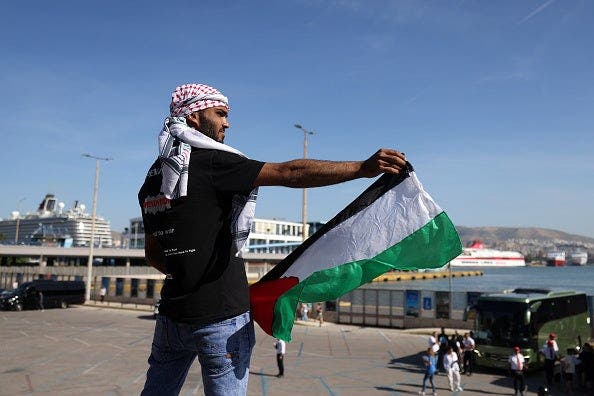
In a global labor action of record scale, dockworkers in 22 countries will strike on Friday to protest the use of their ports for arms exports.
asserted
dockworkers → strike → exports
Organizers say that the strike, organized by an international coalition of dockworkers’ unions, could disrupt as much as 40 percent of marine cargo moving through the Mediterranean and bring more than $2 billion worth of freight to a standstill.
uncertain
strike → say → standstill
The strike, planned since May, has its epicenter in the Mediterranean: It was originally called for by unions in Italy, France, Greece, Spain’s Basque Country, Turkey, and Morocco.
uncertain
It → plan → Italy
Since then, port workers in Germany, Ireland, Portugal, Denmark, Sweden, and Australia have joined, supported by the Palestinian General Federation of Trade Unions.
asserted
workers → join → Unions
No national US-based unions have signed on to the strike, but groups of dockworkers in Oakland and San Francisco plan to participate.
asserted
groups → base → Oakland
The dockworkers’ demands, according to a statement released in May, include “an immediate end to the genocide of the Palestinian people and recognition of an independent Palestinian state,” and an end to the US-Israeli war on Iran.
uncertain
demands → accord → Iran
“Ports must not be used for the transport of arms, ammunition, military equipment or troops destined for war zones,” the unions wrote.
asserted
unions → use → zones
At an October 15 press conference, representatives of participating unions estimated that even a single day’s shipping delay could result in $43 million in lost profit.
uncertain
delay → participate → profit
The people who load and unload cargo ships make up a class of workers with unusual power over foreign affairs and trade.
asserted
who → load → affairs
Ships carry some 80 percent of all international trade by volume, and wars cannot continue without raw material—bullets, armaments, bombs, and fuel.
asserted
wars → carry → material
Much of that cargo moves by sea, as it can be dangerous to ship by air, as analyst Francesco Vignarca of the Italian Peace and Disarmament Network told the Spanish publication El Diario this week.
asserted
Vignarca → move → publication
Europe has invested heavily in weapons over the past five years, and now imports a third of the world’s arms.
asserted
Europe → invest → arms
But, Vignarca said, “There is also a heightened awareness among workers—dockworkers, and others—which has led to more frequent protests, blockades, and a clear desire to put an end to this phenomenon.”
asserted
which → say → phenomenon
The history of dockworkers’ strikes is long, and studded with strikes like this one, which at times aim not only to increase workers’ wages or decrease their working hours, but to end wars.
asserted
which → stud → wars
Past dockworkers’ strikes in the United States have won bread-and-butter gains, like the 1913 longshoremen’s strike in Philadelphia, which shut down one of the busiest ports in the United States and won wage increases and better working conditions.
asserted
which → win → increases
Other strikes have disrupted the supply chains of war.
asserted
strikes → disrupt → war
In 1984, dockworkers in San Francisco refused to unload cargo originating from apartheid South Africa.
asserted
dockworkers → refuse → Africa
And in 2008, 25,000 unionized longshoremen and warehouse workers shut down shipping along the West Coast of the United States as a protest against the war in Iraq.
asserted
longshoremen → shut → Iraq
Though activists in the United States have also attempted to target ports and stop weapons shipments since Israel began bombarding Gaza in October 2023, those efforts—which rarely involve the people who work in those shipping hubs—have seen limited success.
asserted
who → attempt → success
But internationally, port truckers, metalworkers, and dockworkers have found some strategies to stop arms shipments.
asserted
truckers → find → shipments
Workers across Europe successfully coordinated actions to stop weapons shipments to Saudi Arabia in 2019, as that country was bombing Yemen; in 2024, dockworkers in Greece’s port of Piraeus stopped a shipment carrying arms to Israel.
asserted
dockworkers → coordinate → Israel
“We will not let the port become an outpost of the US, NATO or the EU,” Markos Bekris, president of the Greek port’s container handling workers’ union, said at the time.
asserted
Bekris → let → time
“Our goal is to block the unloading in practice and prevent the transport of this deadly cargo.
asserted
goal → block → cargo
We will not stain our hands with blood.”
asserted
We → stain → blood
 The Aporia