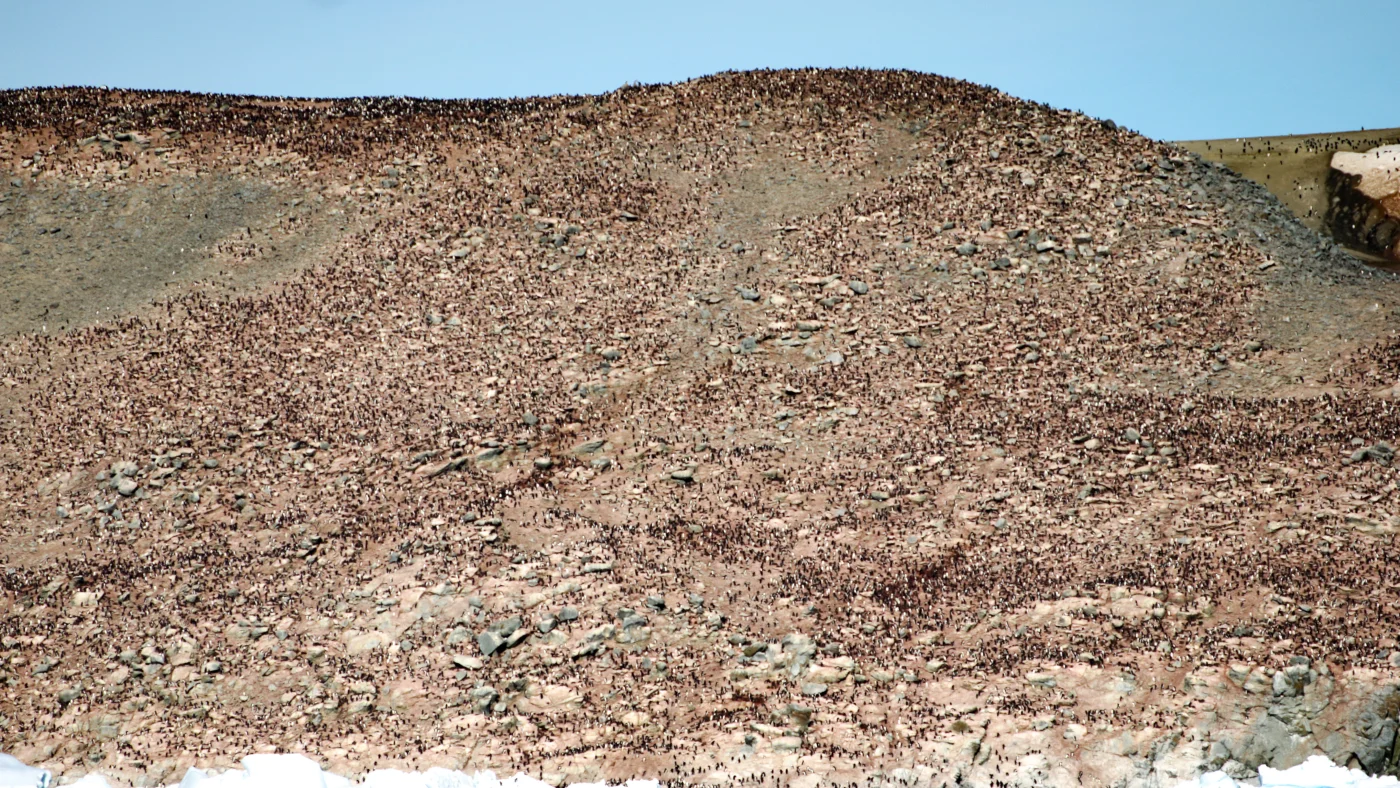
What killed 500-plus penguins?
asserted
What → kill → penguins
How scientists solved the mystery
Sailing toward the Danger Islands, Dr. Ralph Vanstreels had a good idea of what he might find: A lot of dead Adélie penguins.
uncertain
he → solve → penguins
It was March 2024 and a virus had been sweeping through the area, leaving deceased birds in its wake.
asserted
virus → sweep → wake
Vanstreels got the crime right but the culprit wrong.
asserted
culprit → get → ?
There were dead penguins but a virus was not to blame.
asserted
virus → be → ?
As his vessel pulled up to a landing ramp on one of the islands — located just off the Antarctic Peninsula — Vanstreels and his fellow researchers immediately noticed bumps in the snow.
asserted
Vanstreels → pull → snow
We had to do quite a bit of intensive searching [through the snow]," says Vanstreels, who is based in Argentina and is a wildlife veterinarian with the University of California, Davis.
asserted
who → have → California
The team ultimately found more than 537 penguin carcasses on just the ramp, which he estimates was about the size of an airport runway.
asserted
he → find → runway
There were many more carcasses elsewhere on the Danger Islands, which are home to two mega colonies for penguins.
asserted
which → be → penguins
The researchers estimate there were thousands of dead Adélie penguins and other species of birds.
asserted
researchers → estimate → birds
But they had to work quickly and couldn't do a complete count, Vanstreels says.
asserted
Vanstreels → have → count
"You cannot stay there very long because you might be locked down with an iceberg blocking your way out," he says.
uncertain
he → stay → way
As the team has pieced together this tragic penguin mystery, Vanstreels says, the case holds broader lessons for tracking the spread of diseases globally.
asserted
case → piece → diseases
The only continent to dodge the virus — until now
Now let's time jump to Australia a few months ago for another bird disease conundrum.
asserted
's → dodge → conundrum
In June, H5N1 — high pathogenicity avian influenza also known as bird flu — arrived in mainland Australia.
asserted
H5N1 → know → Australia
Up until that point, Australia had been the only continent to dodge the virus which has traversed the globe, leaving a trail of carcasses in its path.
asserted
which → dodge → path
Since late 2021, the virus has led to the death of nearly 300 million poultry birds.
asserted
virus → lead → birds
Either the virus killed them or they were culled as a preventive measure to stop the spread of the disease, according to the World Animal Health Information System.
uncertain
they → kill → System
Further, bird flu is estimated to have killed millions of wild animals and marine mammals, although it's hard to get an exact figure.
asserted
it → estimate → figure
Researchers were amazed that Australia could stay bird-flu-free for six years.
uncertain
Australia → stay → years
And the virus didn't take the path that scientists expected.
asserted
scientists → take → that
"We have a lot of migration of birds between Australia and Southeast Asia, so for the first few years, we're like: That's where the virus is coming from," says Dr. Amandine Gamble, an assistant professor at Cornell University in the Department of Public and Ecosystem Health.
asserted
Gamble → have → Health
The way bird flu eventually got there was from the other direction.
asserted
flu → get → direction
It came from Antarctica likely via migrating birds.
asserted
It → come → birds
"This is a virus that's not assisted by airplanes," Michelle Wille, senior research fellow at the Center for Pathogen Genomics at the University of Melbourne, told NPR in 2025.
asserted
Wille → assist → 2025
"This is a virus that's traveling by mass mortality after mass mortality after mass mortality after mass mortality."
asserted
that → travel → mortality
So when Vanstreels set sail to check on the penguins, he assumed bird flu would be the culprit.
asserted
flu → set → penguins
Bird flu arrived in Antarctica in late 2023 and early 2024.
asserted
flu → arrive → 2023
Vanstreels and his colleagues rapidly arranged for a trip to try to figure out exactly what was happening.
asserted
what → arrange → trip
"The expedition was initially fully set up to look for bird flu because that was the panic," he explains, adding that ongoing fear of a continuing global panzootic — or pandemic among animals — is justified.
asserted
fear → set → animals
In several layers of warm clothes covered by protective gear — double gloves, coveralls, glasses and masks — Vanstreels and the team started taking samples of the penguin corpses they found.
asserted
they → cover → corpses
"We looked a little bit stiff when walking — like a penguin walking almost — because of all the gear," he says.
asserted
he → look → gear
"We had very strict biosafety standards."
asserted
We → have → standards
They brought samples from the deceased penguins back to a mini-lab on their boat.
asserted
They → bring → boat
By evening, they had early results.
asserted
they → have → results
But not the results they expected.
asserted
they → expect → ?
"There is bird flu here, but the virus loads are low," he recalls.
asserted
he → be → ?
The carcasses were not very old, so Vanstreels would have expected to find far more bird flu virus if that had killed the birds.
asserted
that → expect → birds
"We were unsure what was happening," he recalls.
asserted
he → happen → ?
What the microscope revealed
So what killed the 500-plus penguins on the landing ramp and the many others on the island?
asserted
what → reveal → island
…and 23 more, not listed.
 The Aporia