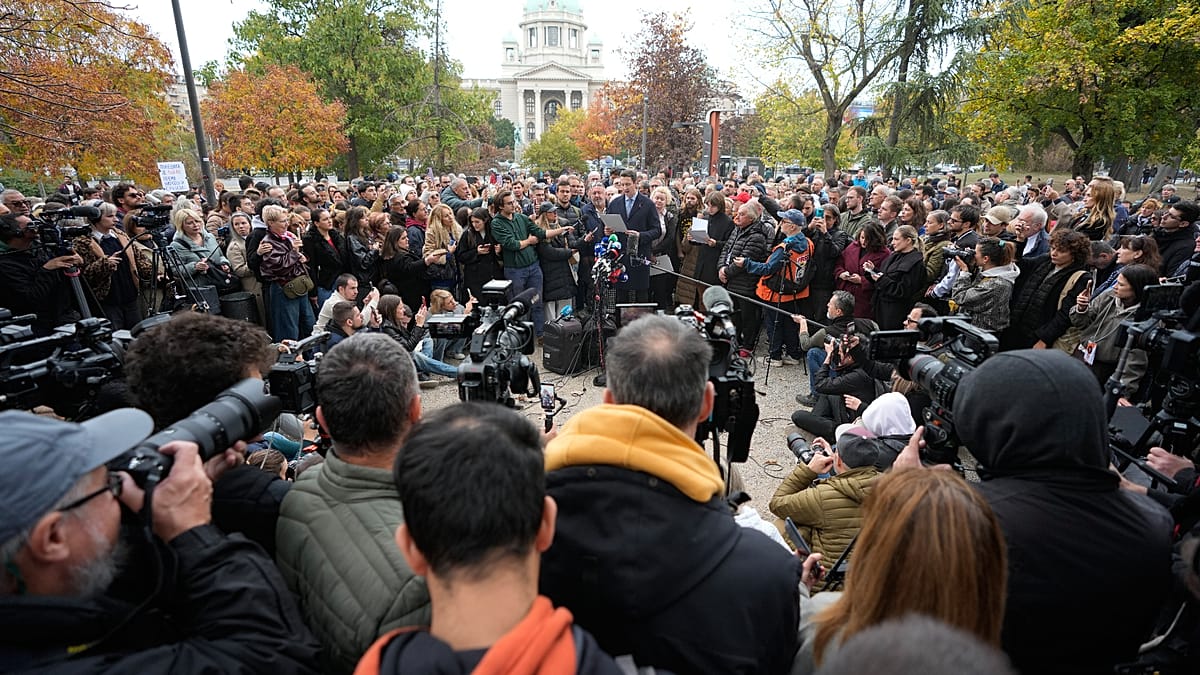
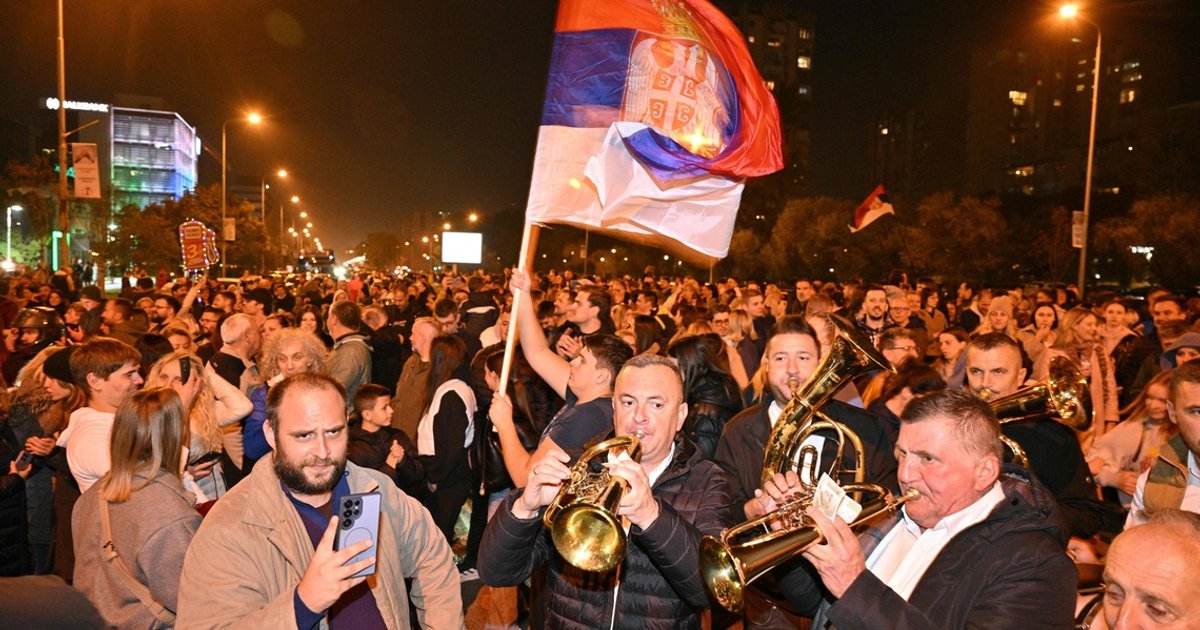
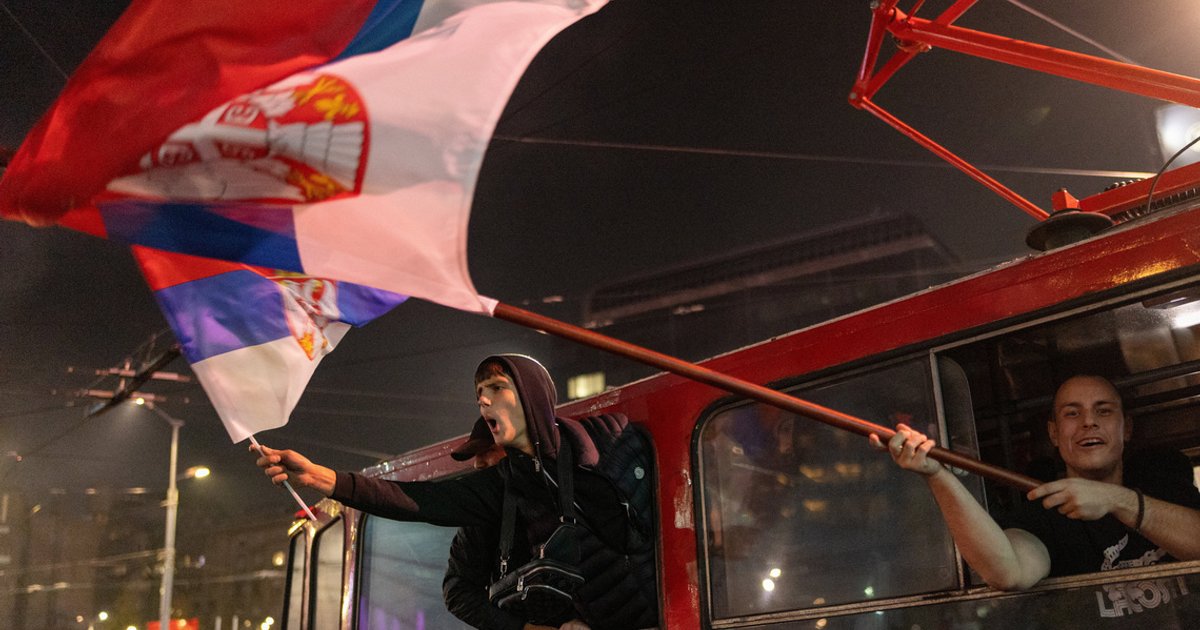
The victory of Serbia’s Student List has fundamentally changed the country’s political landscape.
asserted
victory → change → landscape
But winning the election may prove to have been the easier part.
uncertain
winning → win → election
The movement that emerged from two years of student protests won the elections without a conventional party structure, without a clearly identifiable leader and, for much of the campaign, without revealing who would actually run the country if it won.
asserted
it → emerge → country
Now, however, the same ambiguity may become a problem.
uncertain
ambiguity → become → ?
One of the things that the region, Brussels, Moscow and China will be watching is how the new government positions itself.
asserted
government → watch → itself
Russia: No sanctions, but what comes next?
asserted
what → come → ?
One of the clearest positions to emerge so far concerns Russia.
asserted
One → emerge → Russia
Jovo Bakić, sociologist and one of the most prominent figures on the Student List, has explicitly said that a new government would not impose sanctions on Moscow.
asserted
government → say → Moscow
He described Russia as a historically important partner for Serbia, arguing that sanctions imposed by a small country such as Serbia would have little practical effect while carrying considerable symbolic consequences.
asserted
sanctions → describe → consequences
Academician of the Serbian Academy of Sciences and Arts and professor at the University of Belgrade’s Faculty of Chemistry, Radomir Saičić, told RIA Novosti that the Students’ List does not plan to impose sanctions on Russia.
“As we stated in our programme, the Students’ List does not advocate imposing sanctions against Russia,” Saičić said.
asserted
Saičić → tell → Russia
He noted that Serbia itself had been subjected to sanctions and argued that such measures do not solve problems.
“Problems should be resolved through dialogue, negotiations and agreements, not sanctions,” Saičić said.
asserted
Saičić → note → dialogue
Dejan Šoškić, a candidate on the “Students Win” list, and posible new prime minister said that Serbia must develop good-neighbourly relations with Croatia, while noting that there would probably continue to be significant differences in the general perception of what happened in the 1990s, and that the Students’ List does not concern itself with that issue.
asserted
List → say → issue
In an interview with Index.hr, Šoškić announced better relations with Croatia and the European Union, while he did not answer a question about the new government’s position towards Russia.
asserted
he → announce → Russia
“The Students’ List advocates full respect for the legal framework in Serbia, including international law.
asserted
List → advocate → law
The legal framework in Serbia is therefore quite clear, because the Constitution states that Kosovo and Metohija is an autonomous province of Serbia.
asserted
Kosovo → state → Serbia
On the other hand, key documents of the international legal framework, such as United Nations Security Council Resolution 1244, also affirm this,” Šoškić said.
asserted
Šoškić → affirm → this
“I believe that Serbia will certainly be in a position to fulfil the EU criteria much more easily and quickly.
asserted
Serbia → believe → criteria
Whether it will join the European Union at some point after fulfilling all the conditions will depend, among other things, on whether the European Union offers Serbia full membership, as well as on whether, in a referendum at the end of that process, the citizens of Serbia decide in favour of that option,” Šoškić added.
asserted
Šoškić → join → option
Marta Kos’s message to the future government
It is already clear that when it comes to Serbia’s relations with Russia, the new government, just like the previous one, has no intention of aligning itself with Brussels’ policy.
asserted
government → come → policy
European Commissioner for Enlargement Marta Kos spoke with Ilija Srdanović, the lead candidate of the Students’ List, and immediately stressed that a change of government in Belgrade does not remove the obligation to align with the EU’s foreign and security policy.
asserted
change → speak → policy
Brussels has indicated that it will assess the future government’s concrete actions, including on the basis of its relations with Moscow.
asserted
it → indicate → Moscow
Marta Kos said that “Serbia will not be able to make significant progress towards EU accession unless it aligns its foreign and security policy with Brussels, including its position on Russia and the sanctions imposed on Moscow over the war in Ukraine.”
asserted
it → say → Ukraine
The European Commissioner, responding to a question about whether Serbia could become an EU member without joining sanctions against Russia, said that it would be very difficult for a country that does not share the EU’s strategic foreign-policy positions to make progress.
uncertain
that → respond → progress
“It will probably not be possible for a country that does not align with us on strategic interests — namely foreign and security policy, or our joint opposition to Russia, particularly in the context of Russia’s war in Ukraine — to make progress.
asserted
that → align → progress
It will be very, very difficult,” Kos said.
asserted
Kos → say → ?
The official postition of the Student's list contradicts one of former President Aleksandar Vučić’s central warnings during the campaign: that a Student List victory would eventually mean a dramatic change in Serbia’s policy towards Moscow in terms of imposing sanctions.
asserted
victory → contradict → sanctions
For now, there is no indication that sanctions against Russia are about to become part of Serbia’s foreign policy.
asserted
sanctions → be → policy
Given the response from the new authorities, we can conclude that it will be business as usual.
asserted
it → give → authorities
The Student List’s programme also retains Serbia’s policy of military neutrality and rejects NATO membership.
asserted
programme → retain → membership
Its position on Kosovo remains firmly opposed to Kosovo’s unilateral declaration of independence and to its membership of international organisations.
asserted
position → remain → organisations
You could search with a magnifying glass for any difference in policy towards Kosovo between old and new power in Belgrade, and you would not find one.
uncertain
you → search → one
That elephant will therefore remain in the room when it comes to Serbia’s diplomatic relations with the West.
asserted
it → remain → West
We can expect tensions to ease, along with a shift away from harsh rhetoric and threats, but there will be no fundamental change.
asserted
tensions → expect → rhetoric
This means that the arrival of new government in Belgrade should not automatically be interpreted as a geopolitical realignment in the traditional sense.
asserted
arrival → mean → sense
Professor Radomir Saičić on Kosovo said:
"For us, Kosovo is a temporarily occupied territory.
asserted
Kosovo → say → us
Russia has done more to defend Serbia’s territorial integrity in Kosovo and Metohija than this regime has.
asserted
regime → do → Kosovo
Fake patriots accuse the students of lacking patriotism, but it was not the students who signed the Brussels and Washington Agreements, nor did they accept the Franco-German plan."
A pro-European movement — but a suspicious one
The student movement is essentially a “big tent” movement, bringing together people with very different worldviews who were united by their opposition to the rule of Aleksandar Vučić and their criticism of the nature of his government, rather than an ideologically clearly defined alliance.
asserted
who → accuse → government
The more likely scenario is a complicated balancing act: closer political and economic cooperation with the European Union, while maintaining military neutrality, avoiding sanctions against Russia and preserving existing energy and diplomatic links with Moscow.
asserted
scenario → maintain → Moscow
The EU is Serbia’s largest economic partner, while Russia remains important because of energy and, above all, its position on Kosovo.
asserted
Russia → remain → Kosovo
The Student List will therefore have to reconcile two realities that have often been presented as mutually exclusive in Serbian politics.
asserted
that → have → politics
…and 88 more, not listed.
 The Aporia