Researchers have conducted a structural analysis of the Roman Empire’s road network, which spans about 300,000km across Europe, the Middle East, and North Africa. Contrary to the saying "all roads lead to Rome," the study found that Constantinople was better connected via these routes. The research highlights how Roman roads facilitated military movements, trade, and cultural exchanges but also notes that everyday traffic consisted mainly of people and animals traveling short distances between farms and markets.
Written by the local model on 2026-09-16,
using this article's own text rather than the other coverage of the
same event (that is the story summary below).
‘Not all roads lead to Rome’: Study shows marvels of the Roman Empire’s road network
Augustus, ancient Rome’s first emperor, placed a gilded monument called the Milliarium Aureum, or Golden Milestone, in the Roman Forum in 20BC to mark the symbolic starting point for all roads in the sprawling empire.
asserted
Augustus → lead → empire
Now, researchers have conducted a detailed structural analysis of the empire’s road network, spanning roughly 300,000km of routes crisscrossing Europe, the Middle East and North Africa.
asserted
researchers → conduct → Europe
The study showed the old adage “all roads lead to Rome” was not exactly true, and the empire’s later imperial capital Constantinople – present-day Istanbul – was a better fit for that maxim.
asserted
capital → show → maxim
While the Romans preferred building straight roads, difficult terrain sometimes frustrated that goal, it found.
asserted
it → prefer → goal
The researchers also documented a correlation in many regions between the old Roman roads and modern highways.
asserted
researchers → document → roads
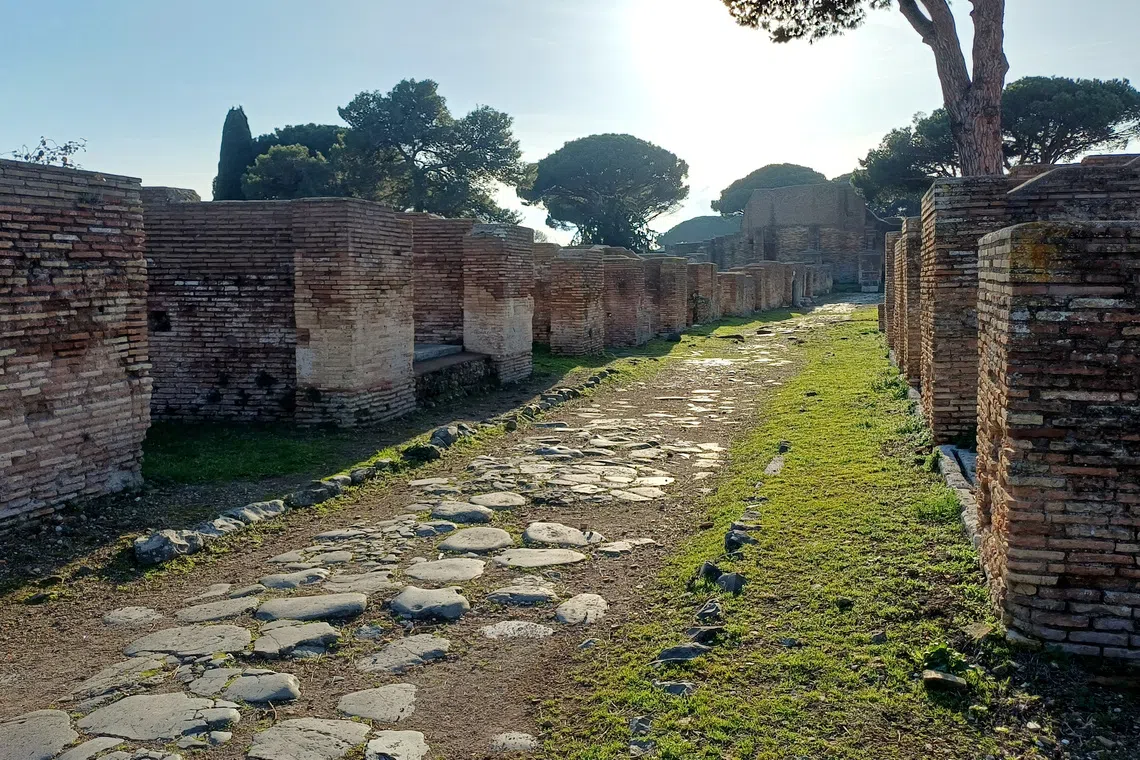
The Romans, master engineers and builders, constructed roads stretching from the Moroccan and Arabian deserts in the south and east, all the way to Scotland and the Atlantic Ocean in the north and west.
asserted
Romans → construct → north
These roads were linked to navigable rivers and sea lanes to form a comprehensive transportation web.
“This infrastructure meant that a vast region became more tightly integrated: it provided a continent-sized platform for people, animals, pathogens, goods and ideas to spread,” said classical archaeologist Tom Brughmans of Aarhus University in Denmark, who helped lead the study published on Sept 15 in the journal Nature Communications.
asserted
who → link → journal
“The Roman legions marched over roads to respond to threats, relieve colleagues and colonise new territories.
asserted
legions → march → territories
Radical new ideas like early Christianity moved with people over land and sea.
asserted
ideas → move → land
But the roads themselves were most used for the frequent commutes between farm and field, or to local markets for selling produce,” Brughmans said.
asserted
Brughmans → use → produce
Some roads were very durable, constructed with a combination of materials including crushed stone, lime cement, gravel and paving stones.
asserted
roads → construct → stone
Traffic consisted mostly of people walking and riding on animals including horses, donkeys, mules and camels, as well as pack animals and animal-drawn carts and carriages.
asserted
Traffic → consist → horses
Road distances from Rome were measured from the Milliarium Aureum.
asserted
distances → measure → Aureum
“All roads lead to Rome?
asserted
roads → lead → Rome
Not really,” Brughmans said.
asserted
Brughmans → say → ?
“Rome is centrally located for Mediterranean shipping, but not particularly central in the Roman road system.
asserted
Rome → locate → system
We found that provincial capitals were exceptionally well located on the roads in their province, facilitating effective provincial administration and tax collection.”
asserted
capitals → find → administration
Some of these provincial capitals included Ankara in Turkey, London in Britain and Corinth in Greece.
asserted
Some → include → Greece
“Rome itself was centrally located on the roads on the Tyrrhenian coast of Italy.
asserted
Rome → locate → Italy
But when we consider all movement within the entire Italian peninsula, we were shocked to discover that the most central road actually follows the opposite Adriatic coastline, bypassing Rome altogether,” Brughmans said.
asserted
Brughmans → consider → Rome
In the early fourth century AD, the Emperor Constantine moved the capital to Constantinople.
asserted
Constantine → move → Constantinople
“This new capital was strategically located where Europe and Asia meet, and our research has revealed that it was exceptionally central for empire-wide overland travel – way more so than Rome,” Brughmans said.
asserted
Brughmans → locate → Rome
“It’s on the Bosporus, and we know of ferries that crossed this strait in antiquity, effectively connecting European and Asian road traffic.”
asserted
that → ’ → traffic
Roman engineers used tools and techniques to make roads as straight as possible, with the Via Appia south of Rome a prime example.
“
asserted
Appia → use → Rome
But even the Romans had to bow to nature.
asserted
Romans → have → nature
We found that Roman roads tend to be straight only if the local topography allows for it, such as in the rather flat areas of Belgium, northern France or the Po Valley in Italy.
asserted
topography → find → Italy
On the whole, they did not move mountains just to build a road,” Brughmans said.
asserted
Brughmans → move → road
These ancient roads structured interactions among hundreds of millions of people for more than two millennia, given the continued use of many long after the Western Roman Empire fell in 476AD and the Eastern Roman Empire, also called the Byzantine Empire, succumbed in 1453.
asserted
Empire → structure → 1453
“The persistency of the Roman road network can be demonstrated for many regions, from Britain to the Near East,” said Adam Pazout, a postdoctoral fellow at the Autonomous University of Barcelona who helped lead the study.
asserted
who → demonstrate → study
“And these roads in many places served as the main communications throughout the medieval period until development of the railroads in the 19th century and highways in the 20th century.”
asserted
roads → serve → century
Many modern highways trace ancient roads.
asserted
highways → trace → roads
“A great example is the Via Augusta, which goes from Cadiz in the south of Spain to the Pyrenees.
asserted
which → go → Pyrenees
The road passes under a triumphal arch called the Arc de Bera between Tarragona and Barcelona, where you can clearly see it has the same course as the modern N-340 motorway,” Brughmans said.
asserted
Brughmans → pass → motorway
 The Aporia