Claims extracted
21
sentences that state something as happening or true
Uncertain
5%
1 of 21 hedged
("reportedly", "may", "according to")
Leaning
not political
takes no side on a contested political question
Publisher signals
60/100
CBC News's corrections and
hedging, across everything collected from it. Not a measure of accuracy.
Outlets on this story
3
Science
Same framing elsewhere
1
articles that frame the event the way this one does
New Vera C. Rubin telescope spots possible new dwarf planet beyond Pluto
More observations are needed to confirm the discovery
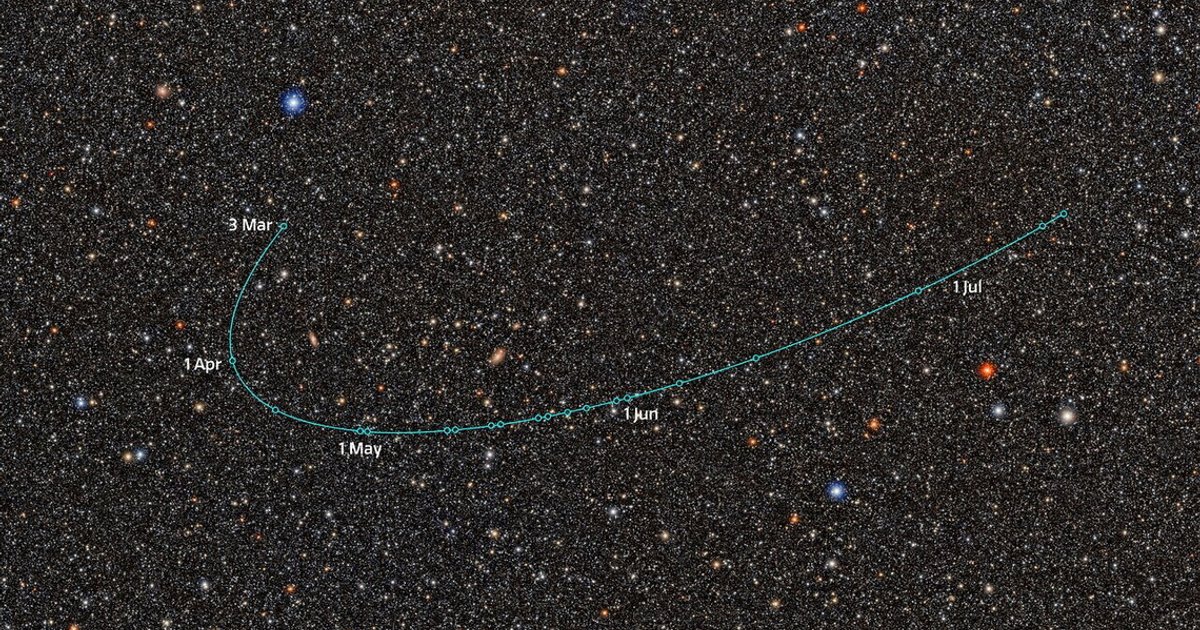
Scientists using a Chile-based telescope have identified an icy object orbiting beyond Pluto that may join our solar system's small roster of dwarf planets.
uncertain
that → spot → planets
Researchers said the candidate, named 2026 ED138, has a diameter estimated at between roughly 600 and 1,500 kilometres and is orbiting about 46 times farther from the sun than Earth.
asserted
candidate → say → Earth
By way of comparison, Pluto orbits at an average of about 40 times farther from the sun than Earth.
asserted
Pluto → orbit → Earth
The object was spotted using the new Vera C. Rubin Observatory, on the summit of the Cerro Pachón mountain in central Chile.
asserted
object → spot → Chile
Further observations are needed to confirm that the object is a dwarf planet.
asserted
object → need → ?
If confirmed, 2026 ED138 would join five other dwarf planets recognized by the International Astronomical Union, the global authority on classifying celestial bodies.
asserted
ED138 → confirm → bodies
Those are Pluto, Eris, Haumea and Makemake, all of which orbit beyond the outermost planet Neptune, and Ceres, located in the main asteroid belt between Mars and Jupiter.
asserted
all → locate → Mars
Based on the current data, 2026 ED138 would be among the largest of the dwarf planets.
asserted
ED138 → base → planets
"For me, what this demonstrates is that many exciting discoveries remain to be made with the Rubin Observatory and other telescopes," said astrophysicist Matt Holman of the Center for Astrophysics, Harvard & Smithsonian, who first spotted 2026 ED138.
asserted
who → demonstrate → ED138
NASA is launching the Nancy Grace Roman Space Telescope.
asserted
NASA → launch → Telescope
Here are just a few of the wonders it will reveal
New giant telescope reveals its 1st images of our universe
Pluto long was considered the solar system's ninth and outermost planet, but was reclassified by the International Astronomical Union as a dwarf planet in 2006 because it did not meet the organization's formal definition of a planet.
asserted
it → reveal → planet
Pluto and the new dwarf planet candidate reside in a frigid region of the solar system populated by various icy bodies.
asserted
Pluto → reside → bodies
Questions remain
asserted
Questions → remain → ?
To be considered a dwarf planet, an object must possess sufficient mass for its own gravity to pull it into a round shape.
asserted
gravity → consider → shape
2026 ED138 appears to have sufficient mass for that, but more observations are needed.
asserted
observations → appear → that
"The main thing we need to do is to establish the physical size of 2026 ED138," Holman said.
asserted
Holman → need → ED138
"When we observe with Rubin, we are seeing the sun's light reflected from the object," Holman said.
asserted
Holman → observe → object
"A smaller, more reflective object would show the same amount of light as a larger, less reflective object.
asserted
object → show → object
Fortunately, by looking at longer wavelengths, with an observatory like ALMA, we can detect the light emitted by the object itself," which is helpful in measuring an object's size.
asserted
which → look → size
ALMA, or the Atacama Large Millimeter/submillimeter Array, is a powerful telescope also based in Chile.
asserted
ALMA → base → Chile
The discovery was announced at a scientific meeting in Spokane, Wash.
asserted
discovery → announce → Spokane
 The Aporia