Japan’s US$6 billion port plan aims to revive Bangladesh’s bruised economy

Read the original at South China Morning Post ↗
Cite

Mukherji, B. (2026, October 28). Japan’s US$6 billion port plan aims to revive Bangladesh’s bruised economy. South China Morning Post. https://www.scmp.com/week-asia/politics/article/3372449/japans-us6-billion-port-plan-aims-revive-bangladeshs-bruised-economy

Dated from the outlet's own feed. Check the original for its byline.

South China Morning Post · collected 2026-10-28 · by Biman Mukherji

Quick Summary

Japan has pledged $6 billion over five years to develop Bangladesh's Matarbari deep-sea port, aiming to boost the country’s economy which has been struggling due to energy shortages and reliance on garment exports. This initiative was announced during Bangladeshi Prime Minister Tarique Rahman's visit to Japan this week and is expected to enhance regional trade by connecting South Asia with Southeast Asia and other parts of the Indo-Pacific region.
Written locally by qwen2.5:14b on 2026-10-28, using this article's own text rather than the other coverage of the same event (that is the story summary below).

AI analysis runs on qwen2.5:14b, locally

Story summary

Japan has pledged US$6 billion over the next five years to support Bangladesh's economic growth through industrial and port cooperation. This initiative, announced during Bangladeshi Prime Minister Tarique Rahman’s visit to Tokyo, includes a plan for the Matarbari deep-sea port aimed at transforming Bangladesh into a regional trade gateway connecting Southeast Asia with the wider Indo-Pacific region. The investment is intended to diversify Dhaka's economic ties and alleviate the impact of energy shortages in Bangladesh. Japanese Prime Minister Sanae Takaichi welcomed the initiative, stating it would foster shared prosperity between the two nations.

Written for “Japan's Port Plan For Bangladesh” on 2026-10-28, grounded in this article and the 0 other(s) covering the same event.
Why this leaning score
This article does not take a side on a contested political question, so it has no leaning score. That is an answer rather than a gap: a match report or a rescue can be warmly or critically written without being left or right, and scoring it anyway is how approval of a subject gets recorded as a political position.
No political leaning scored for article 111594 · logged 2026-10-28

Story

📰 Japan's Port Plan For Bangladesh
Economy/Business · 1 article(s) covering the same event.

Compared with similar articles

Nothing to compare against. No article is close enough to this one for the pipeline to have linked or judged the pair.
How this article was measured signals, leaning charts, publisher record, byline, topics and claims

Signals How these are calculated →

Claims extracted
5
sentences that state something as happening or true
Uncertain
40%
2 of 5 hedged ("reportedly", "may", "according to")
Leaning
not political
takes no side on a contested political question
Publisher signals
64/100
South China Morning Post's corrections and hedging, across everything collected from it. Not a measure of accuracy.
Outlets on this story
1
Economy/Business
Same framing elsewhere
1
articles that frame the event the way this one does
Analyzed 2026-10-28 · how these are computed

How this is being covered How these are calculated →

Article leaning vs. publisher reliability
Source leaning vs. consistency

Publisher

South China Morning Post · 3272 article(s) · 6 correction(s) detected
Running correction rate · 6 correction(s)

Who wrote this

Biman Mukherji
16 article(s) here · 1 carrying a prediction
🔮 Japan’s push to expand industrial and port cooperation with Bangladesh could transform the South Asian country into a regional trade gateway, analysts say, connecting markets in Southeast Asia and the wider Indo-Pacific while diversifying Dhaka’s economic ties.
🔮 “We need to induct two fighter squadrons every year,” Singh said on October 3, noting that “between 36 and 40 aircraft” would need to be produced annually to meet India’s target of having 42 fighter squadrons in service.
🔮 India’s proposed social media ban for under-18s wins parents’ backing Lawyers, however, advise against a sweeping ban, saying children could benefit from access to online educational content Digangana Mukherjee, a mother of a six-year-old girl and a 10-year-old boy, has banned television at her home in the Indian city of Mysore because she does not want her children to become addicted to watching content on screen.
🔮 Is Ambani the real boss of India?” he wrote, suggesting Reliance Group chairman Mukesh Ambani – one of India’s wealthiest tycoons whose sprawling conglomerate has a major footprint across the economy – might wield undue influence over the licensing process.
🔮 The victim, 23, who later died from her injuries, was dubbed Nirbhaya – the fearless one – as she could not be named under Indian law.
🔮 India’s Modi faces dual pressure from ‘cockroach’ movement, opposition parties The two groups’ objection to the revised voter rolls has fuelled speculation that they could become a new potent political force Leaders of around 20 parties in the opposition India National Developmental Inclusive Alliance, or INDIA, rallied against the Election Commission’s revised voter rolls, which critics say have potentially removed millions of eligible voters from the electoral register.
🔮 The new iPhones might not make sense financially in India, but the desire for one is not always rational, analysts say The iPhone 18 Pro starts at 164,900 rupees (US$1,700) and goes up to 179,000 rupees, while the iPhone 18 Pro Max starts at 179,900 rupees and maxes out at 329,900 rupees.
🔮 Leaders of the Cockroach Janata Party (CJP) on Thursday demanded the resignation of Chief Election Commissioner Gyanesh Kumar, after a local newspaper reported allegations that his handling of voter-list revisions could disenfranchise eligible voters and undermine confidence in India’s electoral process.
🔮 Saudi oil pipeline closure puts Asia’s economic resilience to the test Experts say the loss will hit Asian refiners first before feeding through to inflation, currencies and economic growth across the region Asian economies heavily dependent on imported energy are facing an even sharper squeeze after the shutdown of Saudi Arabia’s East-West pipeline removed a key escape route from the disruption in the Strait of Hormuz, deepening an energy shock that has already pushed crude oil above US$100 a barrel. Analysts said the loss of that bypass would hit Asian refiners first before feeding through to inflation, currencies and economic growth across the region.
🔮 India and Vietnam aim to turn ‘China plus one’ rivalry into trade gains New Delhi and Hanoi are looking to join market scale with manufacturing capacity to build new trade links, analysts say Such a shift could deepen both nations’ roles in global production networks across high-value industries – from electronics and pharmaceuticals to renewable energy – while giving companies reliable alternatives as they diversify supply chains beyond China. The idea has gained momentum after Vietnamese Prime Minister Le Minh Hung called for closer economic integration with India, including new economic corridors and supply chains and a potential bilateral free-trade agreement.
Also by Biman Mukherji
Nothing else under this byline is closely related to this article, so these are simply their most recent.

All 16 articles by Biman Mukherji →

Topics

Bangladesh Dhaka Japan Select Tokyo

Subjects

Japan GPE · 3× Tokyo GPE · 3× Bangladesh GPE · 2× Dhaka GPE · 2× Rahman PERSON · 2× Bangladeshi NORP · 1× Japanese NORP · 1× Sanae Takaichi PERSON · 1× South Asian NORP · 1× Tarique Rahman PERSON · 1×

Narrative

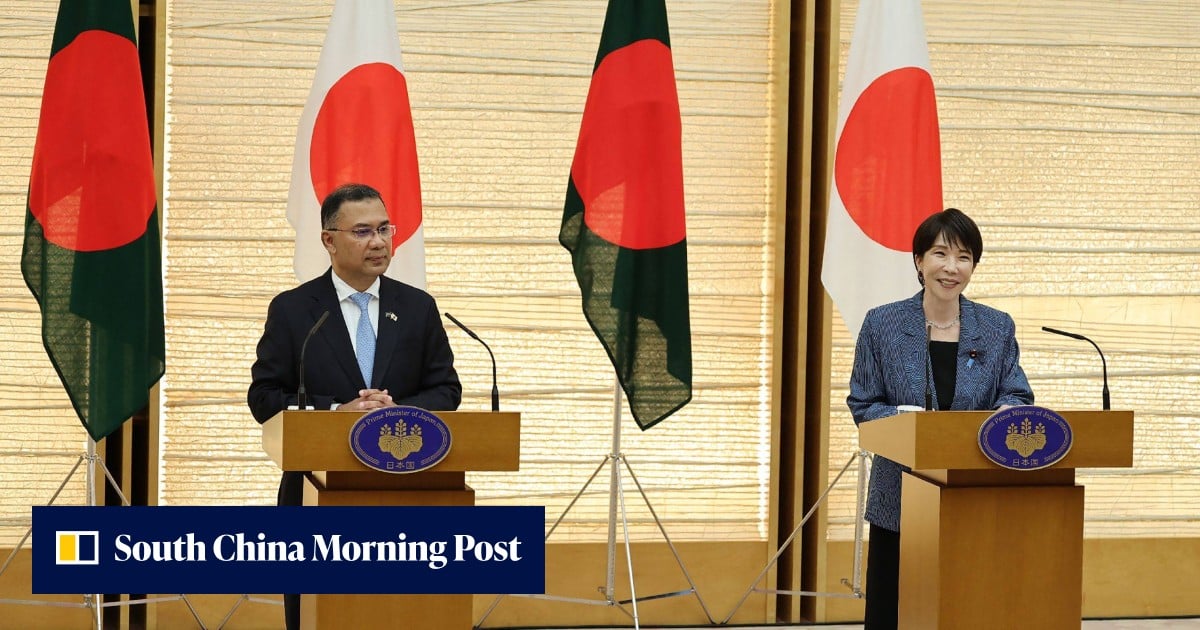
“Our ambition is clear: to turn this friendship between our two nations into a powerful engine of economic growth, opportunity and shared prosperity,” Rahman said on Tuesday at a joint press conference in Tokyo with Japanese Prime Minister Sanae Takaichi. Select Voice Select Speed 1x AI-generated voice
framing: mixed · carried by 1 article(s) · first seen 2026-10-28
🔮 Japan’s push to expand industrial and port cooperation with Bangladesh could transform the South Asian country into a regional trade gateway, analysts say, connecting markets in Southeast Asia and the wider Indo-Pacific while diversifying Dhaka’s economic ties.
2026-10-28 · South China Morning Post
Japan’s US$6 billion port plan aims to revive Bangladesh’s bruised economy · mixed framing

Claims (5 extracted, 2 hedged)

Japan’s US$6 billion port plan aims to revive Bangladesh’s bruised economy Tokyo’s backing for the Matarbari deep-sea port offers Dhaka economic breathing room and promises to reshape Indo-Pacific trade routes asserted
backing → aim → routes
Japan’s push to expand industrial and port cooperation with Bangladesh could transform the South Asian country into a regional trade gateway, analysts say, connecting markets in Southeast Asia and the wider Indo-Pacific while diversifying Dhaka’s economic ties. uncertain
analysts → expand → ties
The plan was announced during Bangladeshi Prime Minister Tarique Rahman’s official visit to Japan this week. asserted
plan → announce → Japan
Rahman welcomed Tokyo’s pledge of US$6 billion in investment over the next five years, which could help revive an economy hit by energy shortages and reduce its heavy reliance on garment exports. uncertain
which → welcome → exports
“Our ambition is clear: to turn this friendship between our two nations into a powerful engine of economic growth, opportunity and shared prosperity,” Rahman said on Tuesday at a joint press conference in Tokyo with Japanese Prime Minister Sanae Takaichi. Select Voice Select Speed 1x AI-generated voice asserted
Rahman → turn → voice
💬Give feedback
🕘History 🎫Support