- Published
Whether through technique or toil, Stan Wawrinka has always been able to whip fans into a frenzy.
asserted
Wawrinka → publish → frenzy
The ability to stir the emotions of a crowd never left him - even in what proved to be the final tour-level match of the 41-year-old Swiss star's glorious career.
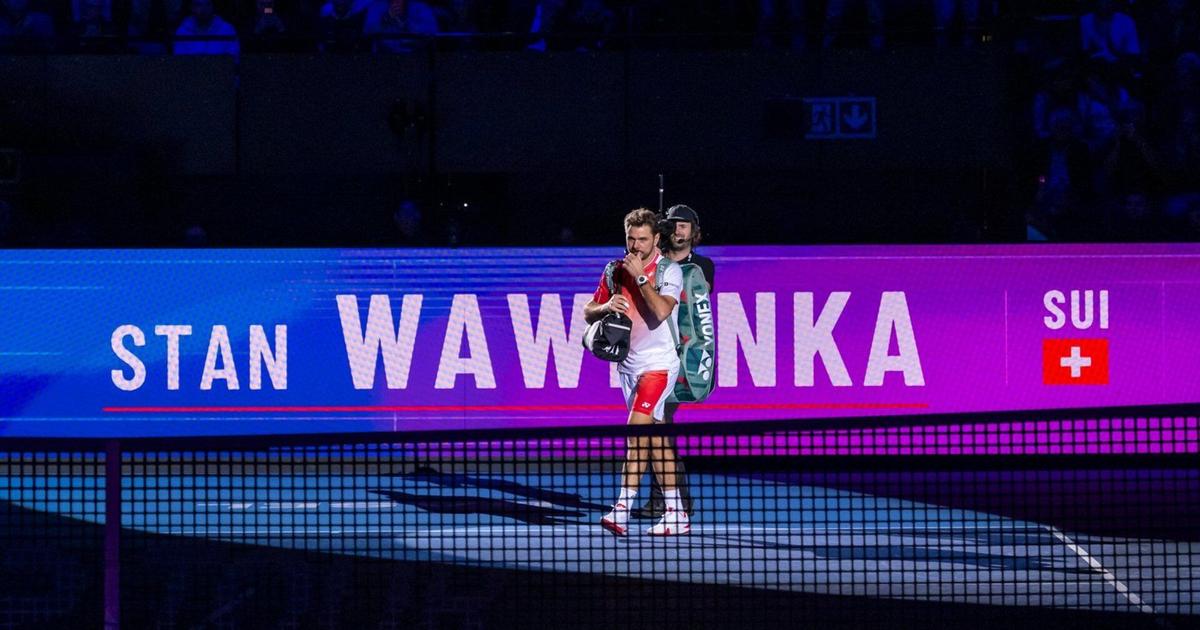
Former world number three Wawrinka might have lost to Czech opponent Jiri Lehecka in front of passionate home support in Basel on Tuesday, but he did not wave farewell without showing the hallmarks of a stunning career that exceeded expectations.
uncertain
that → stir → expectations
The finger pointing to the temple.
asserted
finger → point → temple
The roar of "Allez!" after winning a point he probably should not have won.
asserted
he → win → point
The temptation to snap his racquet over his knee after missing a shot he felt he should have made.
asserted
he → snap → shot
Wawrinka, his family, and his team were dabbing their eyes once the reality of an honourable 7-5 7-6 (7-2) defeat dawned.
asserted
reality → dab → defeat
It meant a professional career spanning 23 years, 985 matches and three Grand Slam titles was over.
"All I wanted in my career was to give everything, have no regrets, to always fight, to always give 100% in every match - out of respect for myself, the opponent, the tournament, the fans, for everybody," Wawrinka told the ATP website.
asserted
Wawrinka → mean → everybody
external
"That was always the most important thing for more than 20 years, and the only way you can leave the sport - without any regrets."
Wawrinka is loved by millions of fans because he is relatable - an everyman personality who reached the pinnacle of his sport by pushing himself to the limit.
So many talented players of his generation lamented the presence of Roger Federer, Rafael Nadal and Novak Djokovic, believing the 'Big Three' to be a blockade preventing them from becoming a Grand Slam champion.
It did not stop Wawrinka.
asserted
It → leave → Wawrinka
With explosive shot-making, relentless endurance and indomitable spirit, he barrelled past the trio of superstars on his way to winning his trio of majors.
asserted
he → barrel → majors
Wawrinka had been a player whose career was ticking along steadily, rather than spectacularly, until he lifted one of the sport's biggest prizes at the age of 28.
Seeded eighth at the 2014 Australian Open, he saw off Djokovic in the quarter-finals before completing an unforeseen triumph against top seed Nadal.
"I never expected to win a Grand Slam because, for me, I was not good enough to beat those guys," Wawrinka admitted as he clutched the trophy in Melbourne.
asserted
he → tick → Melbourne
In fact, he was more than good enough - proving it again and again.
asserted
he → prove → it
At the 2015 French Open, Wawrinka brushed past Swiss compatriot Federer in the quarter-finals, then demolished Djokovic in the final with a display of unrelenting power - a performance which must be ranked among the greatest of his era.
asserted
which → brush → era
His last major title arrived at the 2016 US Open, when he escaped from match point down against Britain's Dan Evans in the third round and went on to beat Djokovic for the title.
asserted
he → arrive → title
It is little wonder that 24-time major champion Djokovic - considered by many the greatest player of all-time - described Wawrinka as a "legend".
asserted
Djokovic → consider → legend
"Stan's had an incredible career.
asserted
Stan → have → career
The competitor he is on court, talent, strength, power, precision - he had it all," said the 39-year-old Serb, who practised with Wawrinka in Basel.
asserted
who → have → Basel
Wawrinka was good enough to win majors, but he wasn't as consistently good as his illustrious rivals.
asserted
he → win → rivals
The 'Big Three' is often expanded to a 'Big Four' featuring Britain's three-time major champion Andy Murray, who soared to world number one, won two Olympic singles gold medals and lifted the ATP Finals trophy.
asserted
who → expand → trophy
Wawrinka recognises he was "really far" from creating a 'Big Five' - and the evidence underlines that.
asserted
evidence → recognise → that
Spending 267 weeks in the top 10, winning one Masters 1,000 tournament and claiming 15 other tour-level titles is well below Federer, Nadal, Djokovic and Murray, but it is also more than most players can dream of achieving.
asserted
players → spend → Federer
The Grand Slam triumphs are what really set Wawrinka apart from most peers - and, coupled with his commendable attitude, is why 'Stan the Man' will be remembered for emerging as a great himself in a golden generation where others came up short.
asserted
others → set → generation
 The Aporia