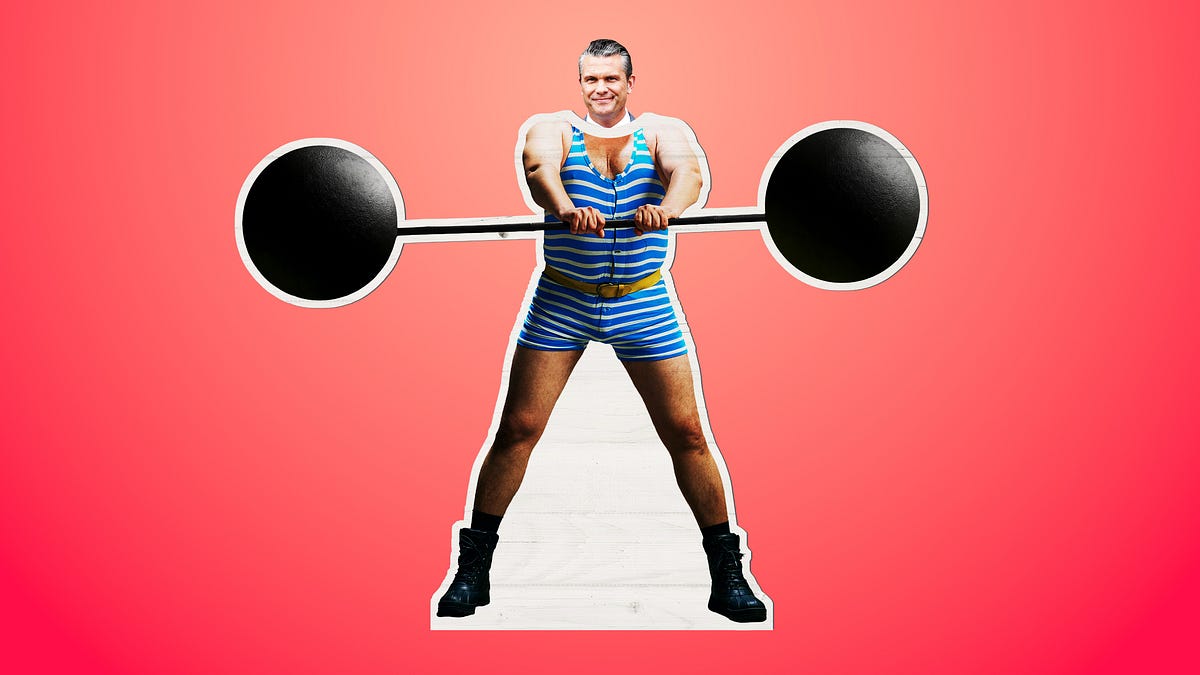
SECRETARY OF DEFENSE PETE HEGSETH obviously sees himself as a paragon of masculinity.
asserted
HEGSETH → see → masculinity
He insists on calling his department by the tough-guy nickname Department of War.
asserted
He → insist → War
He has mandated testosterone-deficiency screenings for military personnel.
asserted
He → mandate → personnel
He regularly showcases himself working out with troops.
asserted
himself → showcase → troops
He frequently expresses disdain for people who are overweight (whom he mocks as “fatties”).
asserted
he → express → fatties
With the amount of effort the secretary puts into demonstrating his manhood, you’d think he’d be seen as a kind of model for young men who are struggling academically, socially, professionally, and emotionally in today’s world.
asserted
who → put → world
But a new national survey conducted by The Bulwark and Pablo Torre Finds Out shows it’s exactly the opposite.
asserted
it → conduct → Bulwark
Only 28 percent of American adults said they viewed Hegseth as a strong role model for American men, compared with 39 percent who didn’t.
asserted
who → say → percent
Looking at just 18-to-29-year-olds, only 18 percent viewed Hegseth as a strong role model compared to the 34 percent who did not.
asserted
who → look → percent
The findings show the limitations of Hegseth’s alpha male preening.
asserted
findings → show → preening
But if there is a silver lining in these findings for the ex–weekend talk show cohost, it’s that he fared only second-worst among the nine men from politics, sports, and Hollywood we asked about.1
The person who finished at the bottom of the male-role-model rankings was his boss, Donald Trump, with 55 percent of respondents saying he was not a strong male role model, and 37 percent saying he was (creating a negative 18-point margin).
asserted
he → be → margin
By contrast, the strongest male role models we polled included Matthew McConaughey (net +33), Barack Obama (+28), and LeBron James (+25).
asserted
we → poll → McConaughey
Of those three, Obama was most likely to be rated a strong male role model, with 59 percent of adults viewing the former president as a strong male role model (a number that includes 28 percent of those who voted for Trump).
asserted
who → rat → Trump
But not all Democrats polled so well.
asserted
Democrats → poll → ?
California Governor Gavin Newsom came in with a -2 male-role-model rating, with 35 percent saying he is a strong male role model and 37 percent disagreeing.
asserted
percent → come → rating
Those results are just a sampling of the insights from the new poll investigating how the public views the intersection of sports and politics and the figures that dominate both fields.
asserted
that → investigate → fields
Respondents were also asked their thoughts on sports commentators, sports betting and prediction markets, and transgender athletes.
asserted
Respondents → ask → commentators
Our findings suggest that sports are one of the last venues in which Americans come together and put aside their differences.
asserted
Americans → suggest → differences
But they also show growing ambivalence about the future of athletics—including a significant appetite for greater regulation of the prediction markets that have enveloped much of sports.
asserted
that → show → sports
GIVEN THE PROLIFERATION of sports betting over the past decade, the survey asked Americans how often, if ever, they bet money on sporting events.
asserted
they → give → events
Sixty-eight percent said they never bet on sports, while 6 percent said they do so often and 27 percent said they do so occasionally.
asserted
they → say → sports
By a 14-point margin, men were more likely to report that they often or occasionally bet on sports than women.
asserted
they → report → women
And 42 percent of those who voted for Trump reported that they bet on sports compared to just 30 percent of Kamala Harris voters.
asserted
they → vote → voters
But across most demographic groups,2 a plurality of Americans believes that legalized sports gambling has had a negative effect on sports (44 percent).
asserted
gambling → believe → percent
This includes 54 percent of Harris voters and 47 percent of those who backed Trump.
asserted
who → include → Trump
Only 7 percent of Americans see the legalization of sports betting as having a positive impact on sports, compared to 34 percent who said it has had neither a positive nor negative effect.
asserted
it → see → effect
Part of this pessimistic attitude toward sports betting might be explained by the fact that more than half of Americans believe that professional athletes often or sometimes alter the way they play to help sports gamblers win bets—a view held by about half of both Harris and Trump voters.
uncertain
gamblers → explain → voters
The poll showed only 11 percent of respondents thought prediction markets should be banned, while a plurality showed support for regulating prediction markets more (36 percent of adults compared to 19 percent who say they are adequately regulated and 3 percent who say they should be less regulated; 30 percent weren’t sure).
asserted
percent → show → percent
There was a partisan split on regulating prediction markets: Forty-five percent of Harris voters, compared with 33 percent of those who supported Trump, say these markets should be regulated more.
asserted
markets → be → Trump
WE ALSO DUG INTO people’s feelings about transgender athletes’ participation in competitive sports, given how prominent the issue has become in recent years.
asserted
issue → dug → years
The results show that 15 percent of American adults think that between 1 and 5 percent of NCAA athletes are transgender, and 14 percent of Americans think between 6 and 25 percent of student athletes are trans.
asserted
percent → show → athletes
Those numbers are wildly inaccurate: In December 2024, NCAA President Charlie Baker told Congress that fewer than 10 of the NCAA’s more than 500,000 athletes were transgender—and the following February the NCAA restricted women’s competitions to athletes born as women.
asserted
NCAA → tell → women
In a statement to Pablo Torre Finds Out, an NCAA spokesperson confirmed that the current number of student-athletes competing in women’s sports who identify as transgender is effectively zero, in accordance with the Trump administration’s executive order forbidding their participation.
asserted
who → confirm → participation
Despite this clear reality, only 31 percent of adults said none or less than 1 percent of student athletes are transgender.
asserted
none → say → athletes
Still, the survey found that a majority of Americans oppose transgender student athletes playing on sports teams that match their gender identity, rather than their birth sex—with 51 percent of American adults opposing it strongly.
asserted
percent → find → it
At the same time, a plurality of Americans disapprove of Turkish-American former NBA player Enes Kanter Freedom’s recent stunt of declaring for the 2027 Women’s National Basketball Association draft.
asserted
plurality → disapprove → draft
This includes a majority of Harris voters (60 percent) and a plurality of independents (45 percent) and self-described moderates (42 percent).
asserted
This → include → independents
People who voted for Trump in 2024—who were less likely to answer “Not Sure” to this question than any other group except for those “Very Interested” in sports—narrowly approved of Kanter Freedom’s decision by a 6-point margin.
asserted
who → vote → margin
Earlier this month, WNBA Commissioner Cathy Engelbert told Republican lawmakers that neither Kanter Freedom nor the former NBA player and failed Senate candidate Royce White is eligible for the WNBA draft.
asserted
Freedom → tell → draft
And last Wednesday, Kanter Freedom claimed he was denied entry to Game 3 of the WNBA Finals—after he declined to use a private suite the Atlanta Dream assigned to him as a safety precaution.
asserted
Dream → claim → precaution
…and 31 more, not listed.
 The Aporia