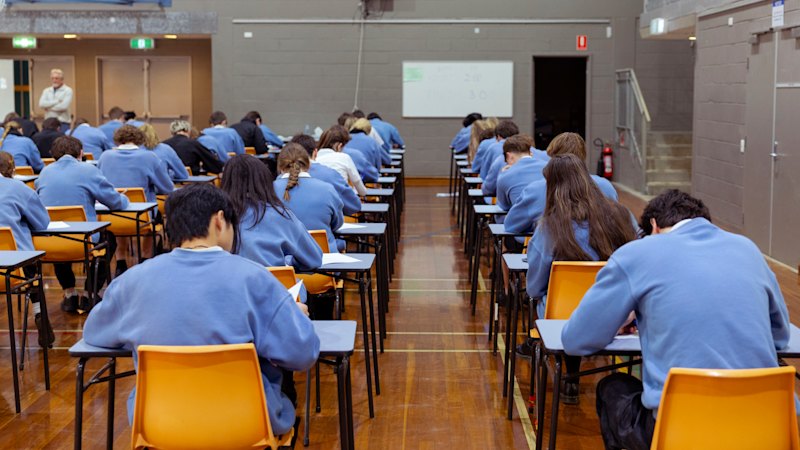
National exams for years 6, 10, and 12 proposed in major Australian schools shake-up

Read the original at The Sydney Morning Herald ↗
Cite

Kowal, E. (2026, October 27). National exams for years 6, 10, and 12 proposed in major Australian schools shake-up. The Sydney Morning Herald. https://www.smh.com.au/education/national-exams-for-years-6-10-and-12-proposed-in-major-australian-schools-shake-up-20261027-p618x8.html?ref=rss&utm_medium=rss&utm_source=rss_feed

Dated from the outlet's own feed. Check the original for its byline.

The Sydney Morning Herald · collected 2026-10-27 · by Emily Kowal

Quick Summary

A new report by the Page Research Centre proposes national exams for Australian students in years 6, 10, and 12 to address inconsistencies in school assessment systems across states. The report highlights issues like "grade-creep" and misuse of AI in assessments, suggesting that a feasibility study be conducted for developing these exams. Opposition figures support the idea, questioning the reliability of current ATAR scores due to varying state regulations on formal exams.
Written locally by qwen2.5:14b on 2026-10-27, using this article's own text rather than the other coverage of the same event (that is the story summary below).

AI analysis runs on qwen2.5:14b, locally

Story summary

The Nationals-backed think tank, the Page Research Centre, has proposed a radical overhaul of Australia's education system by introducing national exams for students in years 6, 10, and 12. The report argues that inconsistent state assessments and "grade-creep" are harming the integrity of the school system. It recommends that the government commission a feasibility study to develop three new national exams to measure student progress from kindergarten to year 12. Each exam period would include an English test, with additional subjects in years 6 and 10. The federal opposition has signaled its support for considering these proposed changes, which aim to establish consistent standards for student assessments across the nation.

Written for “Australian Schools Shake-Up” on 2026-10-28, grounded in this article and the 0 other(s) covering the same event.
Why this leaning score
The model judged this article politically coded and scored it +0.35, but all 3 of its quote(s) are attributed speech - words the article quotes from someone, not the article's own narration, so the score is not published.
Written under an earlier scoring contract, which gave a paragraph rather than checkable quotes. Re-analysing this article replaces it.
Leaning score withheld for article 109224: attributed speech only · logged 2026-10-27

Story

📰 Australian Schools Shake-Up
Education · 1 article(s) covering the same event.

Compared with similar articles

This article reads unscored and hedges 0% of its claims. Each row says how that neighbour differs.
The Sydney Morning Herald
⚖️ leaning not scored 🔴 6% hedged 2 of 35 📰 publisher trust 61
“The articles describe different policy changes in education: one about restructuring schools in Melbourne's west, and the other about proposing national exams for years 6, 10, and 12 across Australia.”
How this article was measured signals, leaning charts, publisher record, byline, topics and claims

Signals How these are calculated →

Claims extracted
20
sentences that state something as happening or true
Uncertain
0%
0 of 20 hedged ("reportedly", "may", "according to")
Leaning
withheld
no quote in the article backed the model's score
Publisher signals
61/100
The Sydney Morning Herald's corrections and hedging, across everything collected from it. Not a measure of accuracy.
Outlets on this story
1
Education
Same framing elsewhere
1
articles that frame the event the way this one does
Analyzed 2026-10-27 · how these are computed

How this is being covered How these are calculated →

Article leaning vs. publisher reliability
Source leaning vs. consistency

Publisher

The Sydney Morning Herald · 5220 article(s) · 12 correction(s) detected
Running correction rate · 12 correction(s)

Who wrote this

Emily Kowal
12 article(s) here · 1 carrying a prediction
🔮 Australian students would face national exams in years 6, 10 and 12 under a radical policy overhaul to fix the nation’s “inconsistent” school assessment system, which the federal opposition said warrants serious consideration.
🔮 Joining the University of Sydney’s faculty of medicine and health from this month, Ardern will engage with students, researchers and the wider community through guest lectures, masterclasses and mentoring.
🔮 As they stared at the plaster casts of the voids left by victims killed in the 79AD eruption of Mt Vesuvius, they had no idea that, almost a year later, the exhibition would feature in their HSC exam.
🔮 “I don’t think it’s olive oil but it could be.
🔮 Instead, Spiers said students across the state received a “gift” in the form of an easily adaptable question that could be moulded to prepared essays.
🔮 Speaking on the third day of hearings into Redeemer Baptist School and its church, which has been described by former members in the inquiry as a “cult”, former student Emma Hughes said during mandatory school camps, students would have to share cabins with teachers.
🔮 On Tuesday, the biggest exam of a student’s school experience, the HSC, will begin.
🔮 Asked if the Department of Youth and Community Services, now the DCJ, ever notified education authorities of the ban, executive director of child protection Nicholas Backo said the department could not confirm due to the age of the records.
🔮 While her year 12 classmates drive to school, sip Vodka Cruisers and vote, 16-year-old Angelina Sidhu will be watching on.
🔮 A report by the Institute for Strategic Dialogue (ISD) found that while any child using social media could be targeted by 764, offenders preyed particularly on vulnerable users of online gaming communities.
Also by Emily Kowal
Nothing else under this byline is closely related to this article, so these are simply their most recent.
All 12 articles by Emily Kowal →

Topics

Australia Australian NSW Nationals the Page Research Centre

Subjects

Australia GPE · 4× Australian NORP · 3× NSW GPE · 2× Julian Leeser PERSON · 1× Leeser PERSON · 1× Melbourne GPE · 1× Nationals ORG · 1× Perth GPE · 1× the Page Research Centre ORG · 1× the Universities Admissions Centre ORG · 1×

Narrative

Report author, Dr Fiona Mueller, said Australian education policies are disproportionately influenced by unproven, experimental approaches to curriculum, teaching, student assessment and other critical areas. “As many Australians are aware, state and territory education authorities are now racing to introduce what they refer to as ‘evidence-based reforms’ to curriculum and teaching,” she said.
framing: assertive · carried by 1 article(s) · first seen 2026-10-27
🔮 Australian students would face national exams in years 6, 10 and 12 under a radical policy overhaul to fix the nation’s “inconsistent” school assessment system, which the federal opposition said warrants serious consideration.
2026-10-27 · The Sydney Morning Herald
National exams for years 6, 10, and 12 proposed in major Australian schools shake-up · assertive framing

Claims (20 extracted, 0 hedged)

Australian students would face national exams in years 6, 10 and 12 under a radical policy overhaul to fix the nation’s “inconsistent” school assessment system, which the federal opposition said warrants serious consideration. asserted
opposition → face → consideration
A landmark report by The Nationals-backed think tank, the Page Research Centre, warns that the different assessments across states, “grade-creep” and unchecked AI use are harming the integrity of Australia’s school system. asserted
assessments → back → system
The report recommends the government commission a feasibility study into the development of three new national exams to measure student progress from kindergarten to year 12. asserted
government → recommend → year
In each exam period, students would complete an English test. asserted
students → complete → test
The report argued assessment should be considered as crucial to education as curriculum and pedagogy, finding Australia lacks nationally consistent standards governing the design and quality assurance of student tests. asserted
Australia → argue → tests
Under the proposed changes, students would sit a series of examinations in year 6 to measure performance in core areas of the curriculum. asserted
students → propose → curriculum
They would sit another series of exams in year 10 and have the opportunity to opt in to final standardised tests in year 12. asserted
They → sit → year
It found that because each state sets its own rules some students can obtain an ATAR without ever sitting a formal exam, while others are mandated to do so. asserted
others → find → exam
Furthermore, it also found the system’s reliance on take home assessments leaves it highly vulnerable to AI misuse and external tutoring. asserted
reliance → find → misuse
Opposition education spokesman Julian Leeser said now was the time to question existing approaches and demand change. asserted
time → say → change
“ATAR is a national system, but how can we be confident in our school-leavers if an ATAR from Perth doesn’t carry the same weight as an ATAR from Melbourne?” Leeser said. asserted
Leeser → carry → Melbourne
“We need the ability to distinguish between whether a student has completed an assessment task, and whether they have learned from it.” asserted
they → need → it
In NSW, the Universities Admissions Centre says ATARs are comparable across all Australian states and territories. asserted
ATARs → say → states
“An ATAR of 85.00 in NSW or the ACT is equivalent to an ATAR of 85.00 in any other state,” it says. asserted
it → say → state
The report found evidence of “grade creep” in year 12 reports, where an increasing number of students are receiving top marks, contradicting Australia’s stagnant or declining performance in independent standardised tests like NAPLAN and PISA. asserted
number → find → NAPLAN
The report has called for an independent review into Australia’s current assessment system which will evaluate the quality of the Australian Tertiary Admission Rank (ATAR), and calls for a national framework to guide school-leavers. asserted
which → call → leavers
Report author, Dr Fiona Mueller, said Australian education policies are disproportionately influenced by unproven, experimental approaches to curriculum, teaching, student assessment and other critical areas. “As many Australians are aware, state and territory education authorities are now racing to introduce what they refer to as ‘evidence-based reforms’ to curriculum and teaching,” she said. asserted
she → say → curriculum
“However, we need to pay equally close attention to the third key element of schooling – student assessment. asserted
we → need → schooling
“The world’s highest performing education systems are unequivocal about the importance of formal examinations for measuring student achievement across the curriculum in valid and reliable ways. asserted
systems → perform → ways
The OECD calls these ‘trusted signals of achievement’. asserted
OECD → call → achievement

💬Give feedback
🕘History 🎫Support