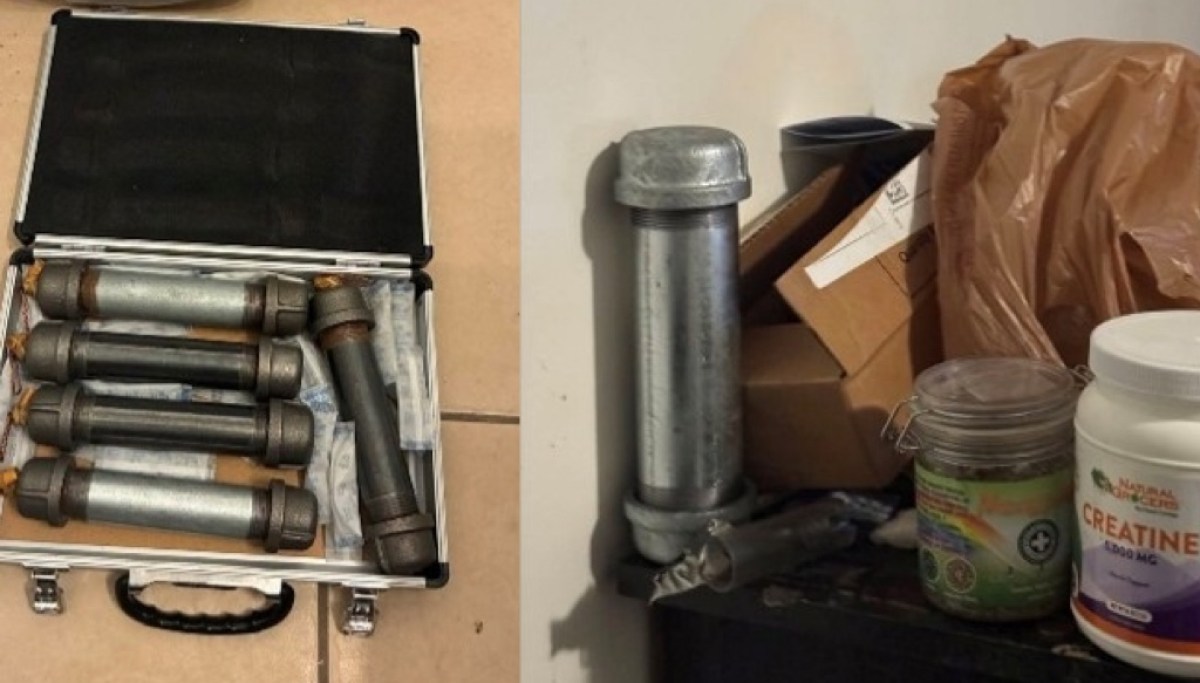
After the Government filed a Criminal Complaint against Holmes on March 13, 2026 , a grand jury returned an Indictment charging Holmes with violating 18 U.S.C. § 875(c) on April 7, 2026.
asserted
jury → file → April
The Indictment alleges that Holmes operated the X account "@MapleStCapital" that displayed an American flag emoji with the statement "END The Fed."
asserted
that → allege → Fed
The Indictment alleges that Holmes posted on that account several statements against the Jewish community and Israel, including: "The jew will be destroyed and discarded," "From the river to the sea every Jew will die," "You inbred people will all die," and "Die Jew."
asserted
people → allege → sea
On or about March 3, the State of Israel posted a video [on the account "@Israel"] that showed a billboard with the face of Ali Khamenei along with the statement: "The world is a better place without Khamenei."
asserted
world → post → Khamenei
In that post, the State of Israel wrote: "It's a first step towards a better world."
asserted
It → write → world
Holmes responded to this post from the State of Israel with the following message: "I'm going to shoot up a synagogue."
asserted
I → respond → synagogue
It is that statement that the Government alleges violated 18 U.S.C. § 875(c)….
asserted
Government → allege → §
The Indictment alleges that:
TIMOTHY HOLMES, defendant herein, knowingly transmitted in interstate commerce a communication containing a threat to injure the person of another, namely, a post on X in which he wrote, in response to a post from "@Israel", "I'm going to shoot up a synagogue", and defendant transmitted the communication for the purpose of making a threat, knowing that the communication would be viewed as a threat, and recklessly disregarding a substantial risk that others would regard the communication as a threat….
Holmes asserts that his statement "I'm going to shoot up a synagogue" is not a true threat because it lacks sufficient specificity.
asserted
it → allege → specificity
Holmes maintains that his post was but a "generalized, albeit offensive, statement directed at an institution or building" that fails to rise to the level of a true threat because "[i]t does not identify a particular individual or group of individuals" and it also does not "specify a location, a time, or any target beyond the generic category of 'a synagogue.
asserted
it → maintain → synagogue
'"
This position is not "an argument about the validity of the indictment in light of the First Amendment, but is instead a dispute over the meaning and inferences that can be drawn from the facts."
asserted
that → draw → facts
This Court has rejected these types of arguments for over a decade because these issues are improper to decide on a motion to dismiss.
asserted
issues → reject → motion
Because Holmes' arguments go to the substantive merits of the Government's case—and not to whether the Indictment is sufficient—the Court rejects them.
asserted
Court → go → them
Holmes' contention that his post is protected political hyperbole fails for the same reasons.
asserted
hyperbole → protect → reasons
Invoking Watts v. United States (1969), Holmes claims that his posts "were responsive to foreign policy events and government statements."
uncertain
posts → invoke → events
The Court understands Holmes' position to be that the First Amendment protects his post as political speech, and thus the Court must dismiss the Indictment because the post does not violate 18 U.S.C. § 875(c).
asserted
post → understand → §
For starters, this position, like many others Holmes raises, tangles and conflates multiple procedural and substantive issues into one incomprehensible ball.
asserted
Holmes → raise → ball
To the extent Holmes' position is that, as facially alleged, the Indictment, even if accepted as true, cannot, as a matter of law, satisfy § 875(c), this argument fails.
asserted
argument → allege → §
The Court cannot accept such a premise.
asserted
Court → accept → premise
This is not a scenario where the Court could comfortably accept the Government's allegations as true and find that it failed to satisfy Rule 7(c)(1).
uncertain
it → accept → Rule
Holmes is not alleged to have posted some mundane political position such as "Taxes are too high!"
asserted
Taxes → allege → position
Nor did he post an offensive, but generally understandably non-threatening statement such as, "Slow drivers should go to hell!"
asserted
drivers → post → hell
He posted: "I'm going to shoot up a synagogue" in response to a post from the State of Israel after posting statements such as: "Die Jew," "You inbred people will all die," "The jew will be destroyed and discarded," and "From the river to the sea every Jew will die."
asserted
Jew → post → sea
Holmes is free to explain to a jury that his post was mere political commentary; but at this stage of the proceedings, the Court finds that the Government has sufficiently alleged that this statement is a "serious expression[ ] conveying that a speaker means to commit an act of unlawful violence."
asserted
speaker → explain → violence
Holmes changes direction by raising three arguments that challenge the Government's position from a statutory standpoint.
asserted
that → change → standpoint
He first claims that the Indictment must fail because his post "I'm going to shoot up a synagogue" does not satisfy 18 U.S.C. § 875(c) because it "refers to a building or institution, not to 'the person of another,'" "does not identify any individual or individuals," and "does not threaten bodily harm to any specific person."
uncertain
it → claim → person
In substance, these arguments challenge whether Holmes' statement is a true threat and are again rejected for the reasons above.
asserted
statement → challenge → reasons
Holmes' next position—that the Government failed to allege sufficient mens rea—is duplicative and rejected for the reasons above….
asserted
Government → fail → reasons
In his fourth and final argument, Holmes presents two constitutional challenges.
asserted
Holmes → present → challenges
Holmes begins by claiming that the Government's prosecution of him is an impermissible content-based restriction on political speech.
asserted
prosecution → begin → speech
The exact direction of Holmes' argument is ill-defined, but the general thrust is that the Government violated 34 U.S.C. § 30506 and the Constitution.
asserted
Government → define → §
To be sure § 30506(4) states that "[n]othing in this division shall be construed to allow prosecution based solely upon an individual's expression of racial, religious, political, or other beliefs[.]"
asserted
n]othing → state → beliefs
This language, however, must be read with its purpose: to establish interpretive safeguards for the Matthew Shepard and James Byrd, Jr. Hate Crimes Prevention Act and its amendments.
asserted
language → read → Act
Holmes offers no authority that the Government's prosecution of someone under 18 U.S.C. § 875(c) for threatening to shoot up a synagogue runs afoul of 18 U.S.C. § 249 or 34 U.S.C. § 30506.
asserted
prosecution → offer → §
Indeed, § 30506 expressly confines its applicability to "this division" of the code which referred to Division E of the National Defense Authorization Act for Fiscal Year 2010, which is where the Matthew Shepard and James Byrd Jr. Hate Crimes Prevention Act of 2009, 18 U.S.C. § 249, was enacted.
asserted
Act → confine → 2009
Simply put, 18 U.S.C. § 875(c) is not part of the equation.
asserted
§ → put → equation
At any rate, the face of the Indictment lends no support for Holmes' position: the Government charged Holmes under § 875(c) for making a threat in interstate commerce; no reasonable inference can be drawn that the Indictment seeks to suppress political speech.
asserted
Indictment → lend → speech
Holmes is again free to present his legal theories to the jury, including his position that posts concerning killing jews is protected political speech.
asserted
posts → present → speech
Holmes' final argument is that the Indictment violates the Due Process Clause because "[a]pplying § 875(c) to prosecute the posting of publicly available information and ambiguous statements about travel—where the defendant's actual conduct was entirely lawful and disclosed to law enforcement—creates intolerable ambiguity."
asserted
conduct → violate → ambiguity
This position fundamentally misunderstands the Indictment and again disregards what the grand jury has charged Holmes with.
asserted
jury → misunderstand → Holmes
Holmes is not charged with violating § 875(c) for posting things about travel or going to Florida.
asserted
Holmes → charge → Florida
…and 4 more, not listed.
 The Aporia