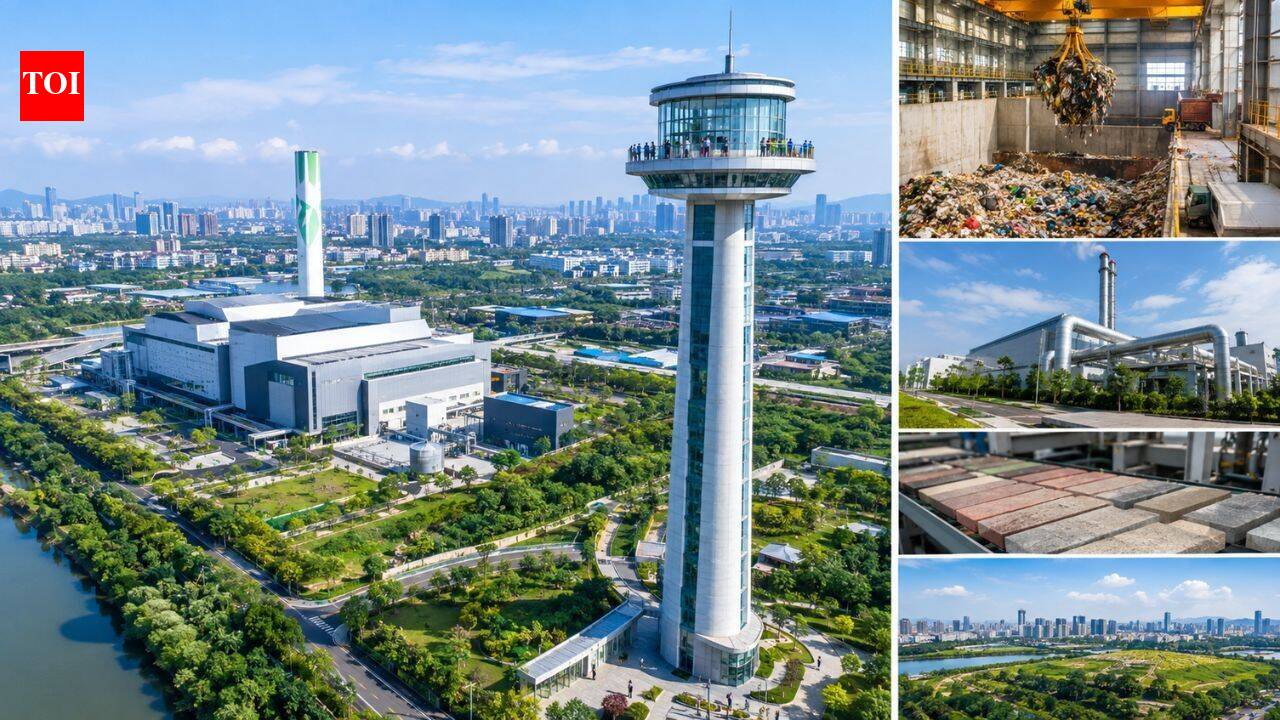
China has converted a chimney at the Fushan Circular Economy Industrial Park in Guangzhou into a 120-metre tower, which serves as a tourist attraction while also processing 8,000 tonnes of household waste daily. The facility is part of China's broader shift from landfill-based waste management to energy and material recovery through incineration. This change reflects an effort to address the increasing volume of urban waste in major cities like Beijing, Shanghai, Guangzhou, and Shenzhen, each generating over 20,000 tonnes daily.
Written by the local model on 2026-09-16,
using this article's own text rather than the other coverage of the
same event (that is the story summary below).
China has turned a huge part of a waste treatment facility in Guangzhou into a public attraction.
asserted
China → turn → attraction
A former chimney at the Fushan Circular Economy Industrial Park has been transformed into a 120-metre-high tower, allowing visitors to look across the site from above.
asserted
visitors → transform → site
The facility processes thousands of tonnes of household waste every day and has become a popular tourist attraction.
asserted
facility → process → waste
This development shows how waste treatment is shifting in China, with rubbish increasingly being processed for energy and material recovery instead of simply being buried.
asserted
rubbish → show → recovery
The 120-metre tower overlooking an 8,000-tonne waste plant
The tower stands at the Fushan Circular Economy Industrial Park in Guangzhou, Guangdong Province.
asserted
tower → overlook → Guangzhou
The State Council Information Office reports that the former chimney was converted into a 120-metre-high tower.
asserted
chimney → report → tower
Xinhua reported that the facility has been developed with a garden-like setting.
asserted
facility → report → setting
Visitors can climb the tower, enjoy coffee and take in a panoramic view of the site.
asserted
Visitors → climb → site
The location has also become part of a national 3A-level tourist attraction.
asserted
location → become → attraction
The setting gives an unique public face to an operation that normally remains out of sight.
asserted
that → give → sight
Beneath the tower, the facility deals with 8,000 tonnes of household waste every day, making it one of the large-scale waste treatment sites serving the city.
asserted
it → deal → city
China is moving towards a different way of treating waste
The Guangzhou facility forms part of a wider change in China's approach to household rubbish.
asserted
facility → move → rubbish
Xinhua reported that the country has been moving away from relying on landfill and towards methods that can recover energy and useful materials from waste.
asserted
that → report → waste
The scale of urban rubbish has made that change increasingly important.
asserted
change → make → rubbish
Beijing, Shanghai, Guangzhou and Shenzhen each generate more than 20,000 tonnes of household waste a day, according to Xinhua.
uncertain
Beijing → generate → Xinhua
In earlier years, large quantities of rubbish accumulated in landfills around some cities.
asserted
quantities → accumulate → cities
The shift means waste is increasingly treated as a material that can still provide value after it has been discarded.
asserted
it → mean → value
Incineration has become a major part of that system, with modern plants using the heat produced during burning to generate electricity and, in some cases, supply heat or steam to industry.
asserted
plants → become → industry
What happens when household waste is incinerated
asserted
waste → happen → ?
According to Xinhua, most of China's household waste is now incinerated instead of simply buried.
uncertain
most → accord → waste
Modern facilities can use the heat generated during the process to produce electricity, while some also supply heat to nearby industrial users.
asserted
some → use → users
Foshan, also in Guangdong, provides one example.
asserted
Foshan → provide → example
Its eco-industrial park processes 4,500 tonnes of household waste each day.
asserted
park → process → waste
The high-temperature steam produced during treatment is supplied through pipelines to nearby factories, where it replaces fossil fuels.
asserted
it → produce → fuels
The process is also designed to control harmful emissions.
asserted
process → design → emissions
Xinhua reports that modern incinerators operate their furnaces at temperatures above 850 degrees Celsius, allowing dioxins to be broken down.
asserted
dioxins → report → degrees
Activated carbon, bag filters and other systems are then used to deal with substances remaining in the flue gas.
asserted
carbon → use → gas
Shanghai's Laogang Waste Disposal Base provides another example.
asserted
Base → provide → example
Xinhua says much of its operation, including unloading, fermentation, incineration and emissions monitoring, is automated.
asserted
much → say → unloading
Its flue-gas pollutants are described as being near zero, with the facility performing beyond Chinese national and European Union standards.
asserted
facility → describe → standards
Turning waste ash into useful material
Waste treatment
asserted
Turning → turn → treatment
The material left behind can also be processed and reused.
asserted
material → leave → ?
Xinhua reports that bottom ash accounts for about 20% of the waste and contains materials such as iron, copper, aluminium and small quantities of gold and silver.
asserted
ash → report → gold
At the Fushan Circular Economy Industrial Park, ash produced in 2025 was processed into material for environmentally friendly bricks used in roads and buildings.
asserted
ash → produce → roads
The quantity processed was about 600,000 tonnes.
asserted
quantity → process → ?
The figures also show how quickly incineration has expanded in China.
asserted
incineration → show → China
Official data cited by Xinhua states that incineration accounted for 78.1 per cent of China's urban household waste treatment capacity by November 2025.
asserted
incineration → cite → November
What happened to China’s old waste mountains
The move towards modern treatment can also be seen in what is happening to former landfill sites.
asserted
what → happen → sites
Xinhua reports that more than 80% of Chinese cities had completed the remediation of ageing waste mountains by 2025.
asserted
% → report → 2025
Shenzhen provides a notable example.
asserted
Shenzhen → provide → example
…and 9 more, not listed.
 The Aporia