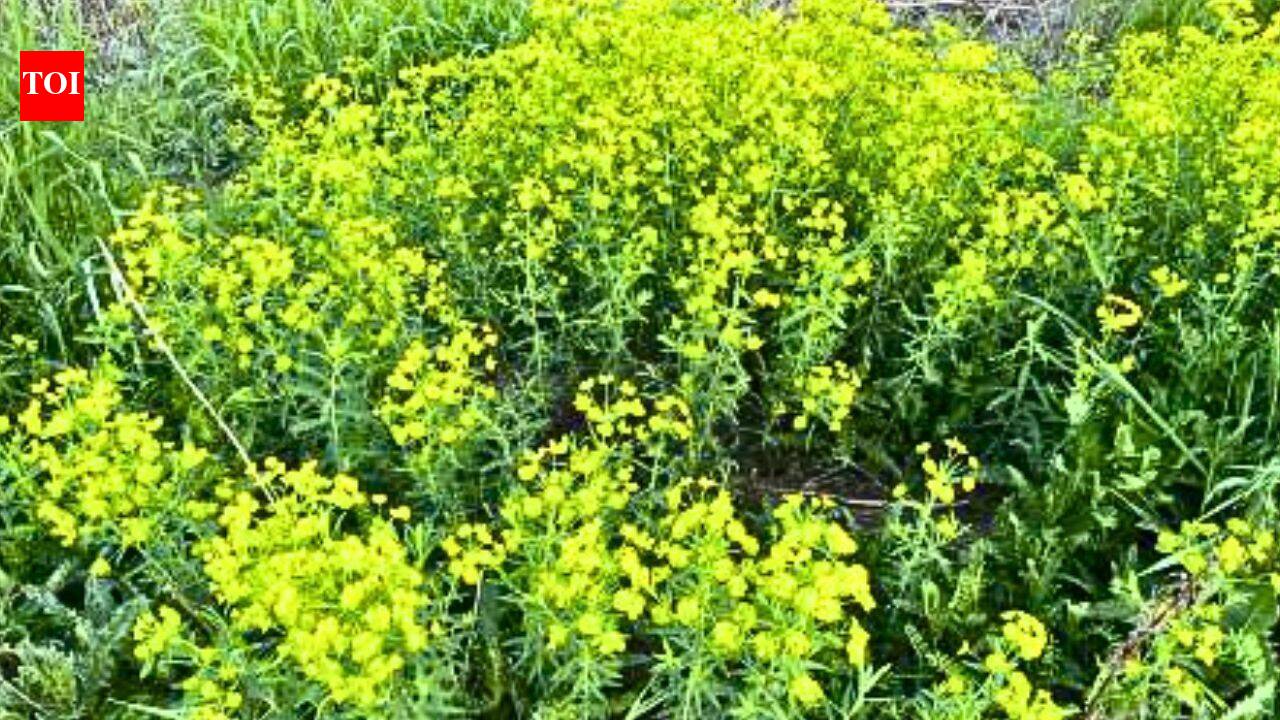
Leafy spurge may have arrived in North America through a Massachusetts ballast dump in 1827

Read the original at Times of India ↗
Cite

TOI World Desk. (2026, October 26). Leafy spurge may have arrived in North America through a Massachusetts ballast dump in 1827. Times of India. https://timesofindia.indiatimes.com/world/rest-of-world/leafy-spurge-may-have-arrived-in-north-america-through-a-massachusetts-ballast-dump-in-1827-contaminated-crop-seeds-later-helped-the-invasive-plant-spread-across-the-us-and-canada/articleshow/135203429.cms

Dated from the outlet's own feed. Check the original for its byline.

Times of India · collected 2026-10-26 · by TOI World Desk

Quick Summary

Leafy spurge (Euphorbia esula), a Eurasian plant, was first recorded in North America in Newbury, Massachusetts, in 1827, likely introduced through contaminated ballast material. The plant spread across the northern United States and southern Canada by the early 1900s, with multiple introductions identified including seeds from spelt brought by Russian immigrants and contaminated crop seeds. Its invasive nature is due to its ability to reproduce via both seeds and roots in diverse habitats.
Written locally by qwen2.5:14b on 2026-10-26, using this article's own text rather than the other coverage of the same event (that is the story summary below).

AI analysis runs on qwen2.5:14b, locally

Story summary

As of recent reports, leafy spurge (Euphorbia esula), a plant native to Eurasia, may have arrived in North America through a ballast dump in Massachusetts in 1827, according to the United States Department of Agriculture (USDA). The first documented collection of this invasive species was made that year in Newbury, Massachusetts. Although it likely originated from a single introduction via ballast, multiple introductions are also possible, with contaminated crop seeds aiding its spread across new areas.

By the early 1900s, leafy spurge had become widespread across the northern United States and southern Canada, particularly in states such as Oregon, Idaho, Montana, Wyoming, Colorado, North Dakota, South Dakota, Nebraska, Minnesota, and Wisconsin. Its extensive root system and ability to reproduce from both seeds and roots have made it an invasive plant that persists and spreads in various habitats over time, impacting local ecosystems.

Written for “Leafy Spurge Origin Story” on 2026-10-26, grounded in this article and the 0 other(s) covering the same event.
Why this leaning score
This article does not take a side on a contested political question, so it has no leaning score. That is an answer rather than a gap: a match report or a rescue can be warmly or critically written without being left or right, and scoring it anyway is how approval of a subject gets recorded as a political position.
No political leaning scored for article 107051 · logged 2026-10-26

Story

📰 Leafy Spurge Origin Story
Environment · 1 article(s) covering the same event.

Compared with similar articles

Nothing to compare against. No article is close enough to this one for the pipeline to have linked or judged the pair.
How this article was measured signals, leaning charts, publisher record, byline, topics and claims

Signals How these are calculated →

Claims extracted
33
sentences that state something as happening or true
Uncertain
9%
3 of 33 hedged ("reportedly", "may", "according to")
Leaning
not political
takes no side on a contested political question
Publisher signals
59/100
Times of India's corrections and hedging, across everything collected from it. Not a measure of accuracy.
Outlets on this story
1
Environment
Same framing elsewhere
1
articles that frame the event the way this one does
Analyzed 2026-10-26 · how these are computed

How this is being covered How these are calculated →

Article leaning vs. publisher reliability
Source leaning vs. consistency

Publisher

Times of India · 3364 article(s) · 2 correction(s) detected
Running correction rate · 2 correction(s)

Who wrote this

TOI World Desk
1188 article(s) here · 1 carrying a prediction
🔮 He also explained why their decision to include him had meant so much to him, adding: “They could have just ignored me, but the fact they saw I was on my own and took me in was just amazing.”
🔮 According to a May report by the Dublin Inquirer, she applied for additional time approximately two months before her Irish Residence Permit expired.
🔮 According to the United States Department of Agriculture (USDA), several introductions may have occurred, while contaminated crop seeds helped the plant establish in new areas.
🔮 Elon Musk has announced plans to give every child in America a share of SpaceX in 2027, a proposal that could involve tens of millions of recipients and billions of dollars in stock.
🔮 The funding has supported child psychology and protection services, including work in the country's Verapaz region, home to Indigenous Mayan communities.
🔮 According to the orchestra and Ensemble Arts’ official announcement on October 22, 2026, the commitment will support international tours, cultural exchanges and new music.
🔮 A 5,610-acre stretch of a multigenerational Florida ranch will remain protected from future development after state officials approved a $12.9 million conservation easement.
🔮 As a result, the earlier judgment in the bank's favour could not stand.
🔮 A Kentucky appeals court has stopped a lower court from investigating the mental capacity of Tamara Williams, a widow who rejected her late husband's will to claim a larger share of his estate.
🔮 By handing over these rights permanently, Harrison ensured that money earned from sales, radio broadcasts and public performances of the songs would support charity rather than provide personal income.
Wire or desk byline, not an individual reporter.
Also by TOI World Desk
Nothing else under this byline is closely related to this article, so these are simply their most recent.
All 1188 articles by TOI World Desk →

Topics

Canada Massachusetts USDA United States the Forest Service

Subjects

United States GPE · 4× Canada GPE · 3× the Forest Service ORG · 3× Idaho GPE · 2× Massachusetts GPE · 2× Ontario GPE · 2× Oregon GPE · 2× USDA ORG · 2× Department of Agriculture ORG · 1× the United States ORG · 1×

Narrative

The Forest Service identifies Oregon, Idaho, Montana, Wyoming, Colorado, North Dakota, South Dakota, Nebraska, Minnesota, and Wisconsin among the states where leafy spurge is most widespread and invasive.
framing: assertive · carried by 1 article(s) · first seen 2026-10-26
🔮 According to the United States Department of Agriculture (USDA), several introductions may have occurred, while contaminated crop seeds helped the plant establish in new areas.

Claims (33 extracted, 3 hedged)

A plant native to Eurasia was recorded in North America in 1827, likely introduced through a ballast dump in Massachusetts. asserted
plant → record → Massachusetts
Known as leafy spurge (Euphorbia esula), the species later spread across the northern United States and southern Canada. asserted
species → know → States
According to the United States Department of Agriculture (USDA), several introductions may have occurred, while contaminated crop seeds helped the plant establish in new areas. uncertain
plant → accord → areas
Its extensive root system and ability to reproduce from both seeds and roots help it persist and spread in a range of habitats over time. asserted
it → reproduce → time
How leafy spurge first arrived in North America asserted
spurge → arrive → America
The first US collection of leafy spurge was made in 1827 in Newbury, Massachusetts. asserted
collection → make → Newbury
The plant was thought to have originated from a ballast dump, although the review says there were likely multiple introductions into North America. asserted
review → think → America
A review cited by the Forest Service suggests at least four possible early introductions. uncertain
review → cite → introductions
The first Canadian collection was recorded in 1899 in Huron County, Ontario. asserted
collection → record → County
The species was brought by Russian immigrants in contaminated spelt from Germany. asserted
species → bring → Germany
Early spread was also linked to the planting and cultivation of contaminated smooth brome and cereal seed originating both inside and outside North America. asserted
spread → link → America
These records point to several possible routes by which the plant became established across the continent over time. asserted
plant → point → time
Leafy spurge became widespread across North America by the early 1900s By the early 1900s, leafy spurge was widespread in the northern United States and southern Canada. asserted
spurge → become → States
It had been recorded in Ontario by 1889 and Iowa by 1899. asserted
It → record → 1899
Around 1900, it was described as naturalised in parts of the northeastern United States, while reports also placed it in Oregon and Washington. asserted
reports → describe → Oregon
It was recorded in Idaho in the early 1900s. asserted
It → record → 1900s
The Forest Service identifies Oregon, Idaho, Montana, Wyoming, Colorado, North Dakota, South Dakota, Nebraska, Minnesota, and Wisconsin among the states where leafy spurge is most widespread and invasive. asserted
spurge → identify → states
In western Canada, it occurs as far north as Yukon. asserted
it → occur → Yukon
How did leafy spurge spread through roots and seeds Leafy spurge is an erect perennial plant that usually grows between 20 and 90 centimetres tall. asserted
that → spread → roots
Its narrow leaves grow along the stems, while leaves near the flower clusters are heart-shaped. asserted
leaves → grow → clusters
When the stems are damaged, they release a milky fluid. asserted
they → damage → fluid
The plant produces small seed capsules that split explosively when mature, ejecting seeds. asserted
that → produce → seeds
It also regenerates from its root crown, root buds, and root fragments. asserted
It → regenerate → crown
Its persistent root system can be deep and extensive, allowing shoots to emerge even after above-ground growth has been damaged. asserted
growth → allow → ground
The species grows in roadsides, old fields, pastures, meadows, areas beside rivers, and open woodlands. asserted
species → grow → rivers
It can establish in disturbed sites and persist in many habitats. asserted
It → establish → habitats
How did leafy spurge affect native plants and grazing animals asserted
spurge → affect → plants
The Forest Service describes leafy spurge as a highly invasive plant that can establish in stable, undisturbed native plant communities. asserted
that → describe → communities
Its rapid vegetative spread and dense stands can replace native or rare plants. asserted
spread → replace → plants
Thick layers of plant litter may prevent light-demanding species from establishing, while other research discussed in the review suggests that the plant may also affect neighbouring vegetation through chemicals and changes to soil conditions. uncertain
plant → prevent → conditions
Leafy spurge is avoided by cattle and horses when other forage is available, and its milky sap can cause severe diarrhoea in both animals. asserted
sap → avoid → animals
Control is difficult because roots can survive after above-ground growth is removed. asserted
growth → survive → ground
Sheep, goats and introduced insects, including flea beetles, have been used to reduce its abundance. asserted
Sheep → introduce → abundance

💬Give feedback
🕘History 🎫Support