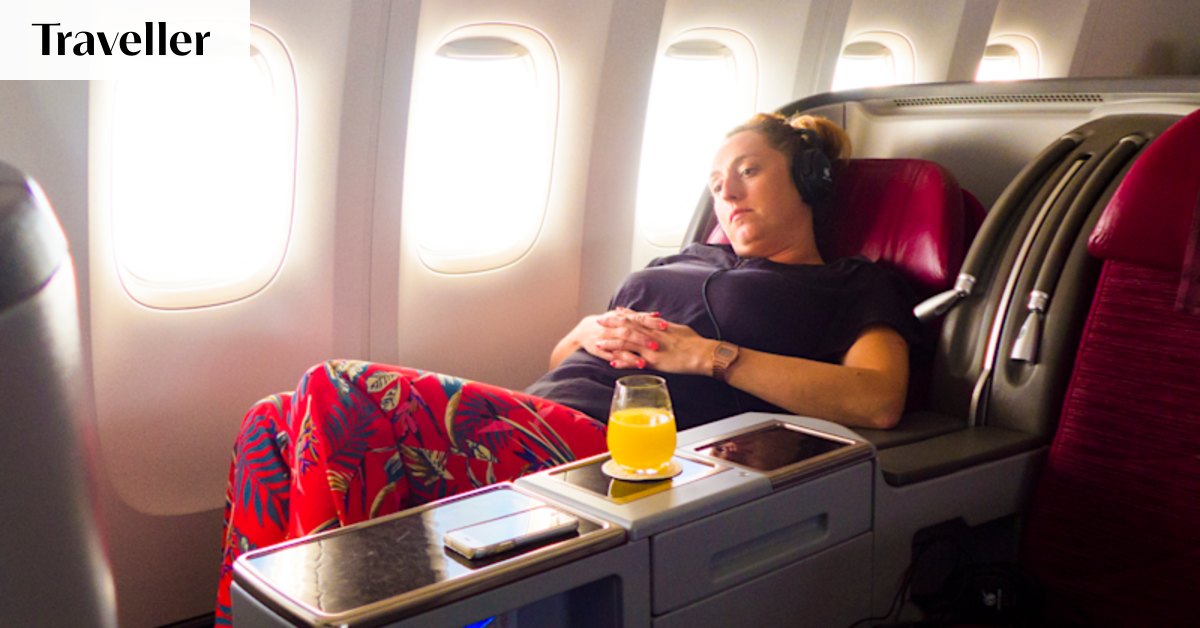
Is it time to rename business class?
asserted
it → rename → class
If you use that section of the plane, or keep a beady eye on who turns left as you head right, you might have noticed that the user of the privileged cabin is changing.
uncertain
user → use → cabin
Sure, there are a few men and women in suits, refusing drinks while they sleep to prepare for a meeting or crack on with emails and spreadsheets.
asserted
they → be → emails
But they are very likely to be joined today by holidaymakers in comfy garments, families with kids and 20-somethings wielding cutting-edge tech.
asserted
they → join → tech
At the end of last year, The Business Travel Magazine reported that Qantas regional general manager for the UK, Europe and Africa, Darsh Chapman, claimed that on flights from London, around 70 per cent of customers in business cabins were leisure travellers.
asserted
cent → report → cabins
It’s a huge turnaround, as businesspeople once occupied as much as 90 per cent of the spacious seats.
asserted
businesspeople → ’ → seats
Wong Hong, director general of the 18-member Association of Asia Pacific Airlines, says that the suits are losing that edge to leisure travellers who can buy their way out of economy class – though not into first class, when it is still offered.
asserted
it → say → class
The notion of a business “class” of passenger belongs to the era of lava lamps and disco.
asserted
notion → belong → lamps
During the pioneering decades of aviation, only the wealthy could afford to fly.
uncertain
wealthy → afford → aviation
Then, during the ’70s, airlines realised that full-fare economy passengers wanted a quieter space and perks.
asserted
passengers → realise → space
Japan Airlines, KLM, Pan Am and British Airways were among the major firms that sectioned off parts of the main cabin and offered special full-fare upgrades.
asserted
that → section → upgrades
Qantas is usually credited with coining and launching a dedicated “business class” cabin in 1979, charging fares around 15 per cent higher than economy for a separate cabin and upgraded ground services.
asserted
Qantas → credit → cabin
But changes from both the supply and demand sides have altered the clientele.
asserted
changes → alter → clientele
Many companies are reluctant to spend heavily on business class flights amid challenging economic conditions.
asserted
companies → spend → conditions
Tickets in the posh seats cost considerably more than the 15 per cent alluded to above; on transatlantic flights, the cost is more like double that of an economy-class seat.
asserted
cost → cost → seat
Given that corporate meetings can take place on any number of digital platforms, there is also less need to send mid-level executives half-way round the world for what might be a single day’s work.
uncertain
what → give → world
Non-business passengers are making use of a medley of means to access more comfortable seats, especially on medium-to long-haul flights.
asserted
passengers → make → flights
These include redeeming miles, price tracking, tapping loyalty schemes and bank cards, promotional windows, mixed-cabin itineraries with attractive deals and even seat auctions.
asserted
These → include → deals
The burgeoning luxury and cruise-travel markets draw customers with deep pockets; if you’re spending $20,000 on an Antarctic cruise, you’re probably not going to fly from Europe or North America to Ushuaia in southern Argentina in a cramped economy seat.
asserted
you → burgeon → seat
There’s also a new trend of business class passengers taking along a companion.
asserted
passengers → ’ → companion
According to a study last year by travel management company Perk, 73 per cent of executives bring family, friends or pets on work trips, with a perhaps surprising 7 per cent taking a pet along for the ride.
uncertain
cent → accord → ride
No wonder that the flatbeds are increasingly taken up by retirees, younger passengers, parents flying with children and wised-up holidaymakers – not to mention the hordes of influencers who seem to have won over many of the major airlines and national tourist boards.
asserted
who → take → airlines
It’s often said that the work-life balance has tipped the way of non-stop work, with a smartphone functioning as a 24-hour pager.
asserted
smartphone → say → pager
Perhaps what we are seeing is a merging on board.
asserted
seeing → see → board
How do you know if the guy in the shorts is on a business trip or not?
asserted
guy → know → trip
Is a passenger using TikTok to share photographs of her meal and seat linen actually working, or wasting everyone’s time?
asserted
using → use → time
The downside of the democratisation is obvious: noisier co-passengers, lights on, drinks being served all night, children crying.
asserted
children → on → democratisation
Business-doing passengers complain that the new market segment pushes in at the boarding queue and that 21st-century children who need constant attention can be troublesome.
asserted
who → do → attention
And as the passenger manifest becomes less exclusive, there’s evidence that business class itself is being downgraded, too.
asserted
class → become → ?
Food is engineered to cut costs rather than delight the diner.
asserted
Food → engineer → diner
Regular travellers sometimes observe that Asian carriers are more “traditional” – i.e. deferent – but, generally speaking, business class is being downgraded and the difference between travel classes is being eroded.
asserted
difference → observe → classes
So, is it time to do away with business class altogether – leaving a harder-to-cross chasm between (premium) economy and the lofty delights of first class?
asserted
it → do → class
For all the changes, it’s unlikely the business class section is due for mothballing just yet.
asserted
section → ’ → mothballing
The International Air Transport Association reports that premium traffic accounts for about a fifth of passenger revenue while representing only around 7 per cent of passenger miles.
asserted
traffic → report → miles
Airlines are not all agreed on how to develop the smarter seats.
asserted
Airlines → agree → seats
British Airways is aiming at offering the world’s largest business class cabin on its 12 refurbished A380s – with business class occupying the entire upper deck.
asserted
class → aim → deck
Other airlines are leaning into the latest tech, including entertainment synced to passengers’ carry-on gizmos.
asserted
airlines → lean → gizmos
Qatar Airways, credited with raising the bar for business booths a decade ago, is still considered a leader when it comes to ergonomics and digital security.
asserted
it → credit → ergonomics
Of course, “business class” has already been rebranded many times.
asserted
class → rebrande → ?
It has been called club, executive, upper, signature and lots of forgettable names incorporating airlines’ or their loyalty schemes’ names, or both schemes’ names.
asserted
It → call → names
…and 1 more, not listed.
 The Aporia