A new study suggests that the Arctic was already moving towards another glaciation nearly 2,000 years ago, before rising greenhouse gas emissions reversed the trend.
uncertain
emissions → suggest → trend
Researchers found that the Barnes Ice Cap in Canada's Arctic began expanding again around that time, reaching its greatest extent in this advance around 1960.
asserted
Cap → find → 1960
It has since retreated, reversing centuries of ice growth.
asserted
It → retreat → growth
Published in
Science on 22 October, the study, titled
Late Holocene reexpansion of the Laurentide Ice Sheet, examines the last surviving remnant of the Laurentide Ice Sheet, which once covered much of Canada and parts of the northern United States.
asserted
which → publish → States
The researchers argue that human-caused
global warming overwhelmed the natural cooling influence of changes in Earth's orbit, halting the ice cap's expansion.
asserted
warming → argue → expansion
The findings offer physical evidence of a renewed glacial advance in the Arctic.
asserted
findings → offer → Arctic
How the Arctic ice cap began growing again
The Barnes Ice Cap, located on Baffin Island in Nunavut, Canada, covers an area roughly the size of Delaware.
asserted
Cap → begin → Delaware
It is the last remnant of the Laurentide Ice Sheet, which reached across much of North America during the last glacial period.
asserted
which → reach → period
According to the study's reconstruction, the ice cap reached its minimum interglacial dimensions around 3,600 years ago.
uncertain
cap → accord → dimensions
It began expanding again approximately 2,000 years ago, as cooler summers allowed more snow and ice to survive the melting season.
asserted
snow → begin → season
The advance continued for centuries, reaching its greatest extent around 1960.
asserted
advance → continue → 1960
The trend then reversed.
asserted
trend → reverse → ?
Since the 1980s, the ice cap's margins have retreated by an average of about four metres a year, according to reporting on the study.
uncertain
margins → retreat → study
The researchers attribute this reversal to rising greenhouse gas emissions, which have warmed Arctic summers and caused the ice cap to lose more ice than it gains.
asserted
it → attribute → ice
The authors interpret the renewed expansion as the beginning of the next glaciation, interrupted before a much larger continental ice sheet could develop.
uncertain
sheet → interpret → glaciation
What drives an ice age?
asserted
What → drive → age
Study finds global warning reversed the ice age.
asserted
warning → find → age
The climate of the Earth naturally oscillates between colder glacial periods and warmer interglacial periods.
asserted
climate → oscillate → periods
We are now in the Holocene , a relatively warm period that began about 11,700 years ago , after the last glacial period .
asserted
that → begin → period
These long-term changes are driven by variations in Earth's orbit and orientation, known as Milankovitch cycles.
asserted
changes → drive → cycles
They alter how sunlight is distributed across the planet, including how much summer sunlight reaches high northern latitudes.
asserted
sunlight → alter → latitudes
Cooler summers allow more snow to survive from one year to the next.
asserted
snow → allow → next
Over long periods, this snow can accumulate into ice.
asserted
snow → accumulate → ice
As ice spreads, it reflects more sunlight back into space, encouraging further cooling and potentially allowing ice sheets to grow.
asserted
sheets → spread → cooling
The researchers argue that these natural conditions were favouring renewed ice growth while human-produced greenhouse gases increasingly warmed the atmosphere.
asserted
gases → argue → atmosphere
By the 1960s, they say, the warming influence had become strong enough to reverse the advance.
asserted
influence → say → advance
How researchers reconstructed the ice cap's history
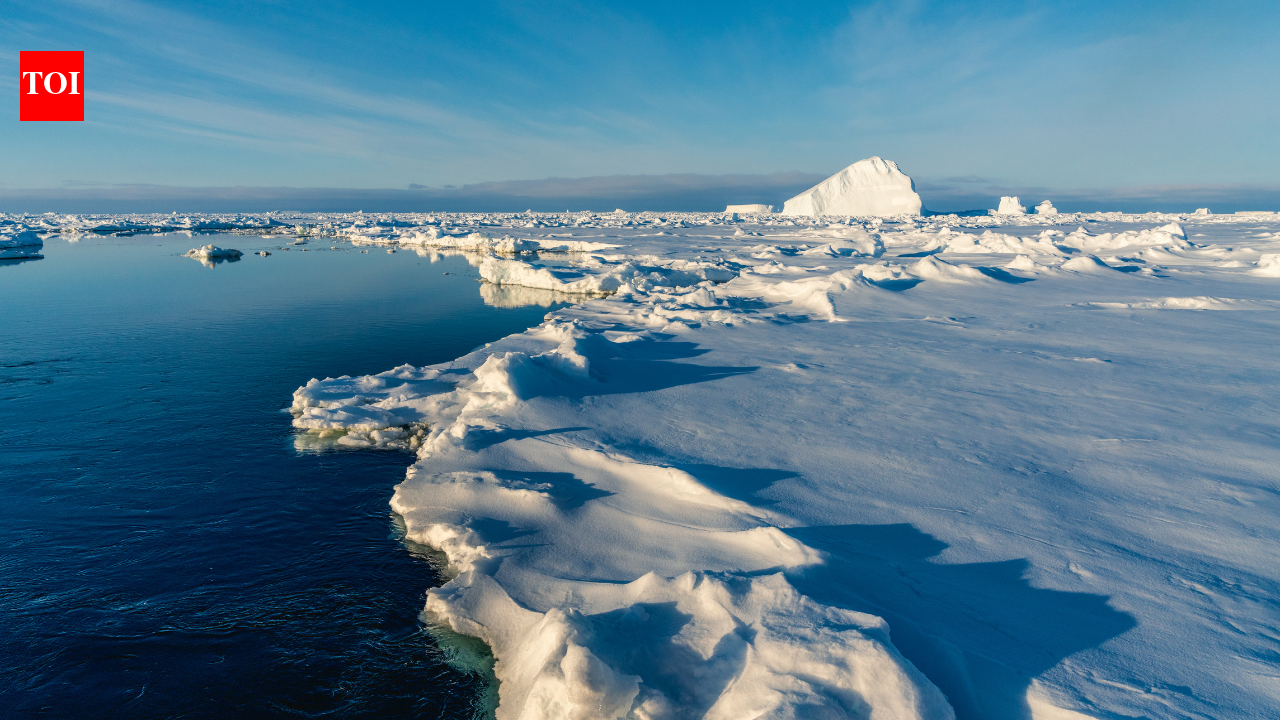
Melting ice caps in the Arctic region.
The evidence comes partly from plants preserved beneath the advancing ice.
asserted
evidence → reconstruct → ice
Because the Barnes Ice Cap is frozen to its bedrock, rather than sliding over it like many glaciers, it can preserve vegetation that once grew on the exposed ground.
asserted
that → freeze → ground
As the ice advances, it covers and kills mosses and other plants.
asserted
it → advance → mosses
When the ice later retreats, these remains become exposed again.
asserted
remains → retreat → ?
Researchers can use radiocarbon dating to estimate when the plants died, providing what scientists call a “kill date” for the advancing ice.
asserted
scientists → use → ice
By comparing dates from different locations, the team reconstructed the sequence of the ice cap's expansion.
asserted
team → compare → expansion
The researchers also used beryllium-10 exposure dating, which measures how long rocks have been exposed to cosmic radiation, to help establish when the landscape was last uncovered by ice.
asserted
landscape → use → ice
Historical aerial photographs and mapped ice margins provided additional evidence of the ice cap's more recent retreat.
asserted
photographs → map → retreat
Taken together, these records indicate that the ice cap had already begun to expand again well before the modern reversal.
asserted
cap → take → reversal
The timing of that reversal is attributed by the researchers to anthropogenic warming, but they say more research is required to understand the precise mechanisms behind glacial inception.
asserted
research → attribute → inception
What does this mean for the next ice age?
What does this mean for the future of our planet?
asserted
this → mean → planet
The findings revisit a debate from the early 1970s, when scientists discussed the possibility of an approaching glaciation.
asserted
scientists → revisit → glaciation
A meeting at Brown University reportedly prompted a warning letter to US President Richard Nixon.
uncertain
meeting → prompt → Nixon
Later media coverage of the discussion, alongside a period of cooler weather, was frequently cited by climate-change skeptics as evidence against global warming.
asserted
coverage → cite → warming
…and 11 more, not listed.
 The Aporia