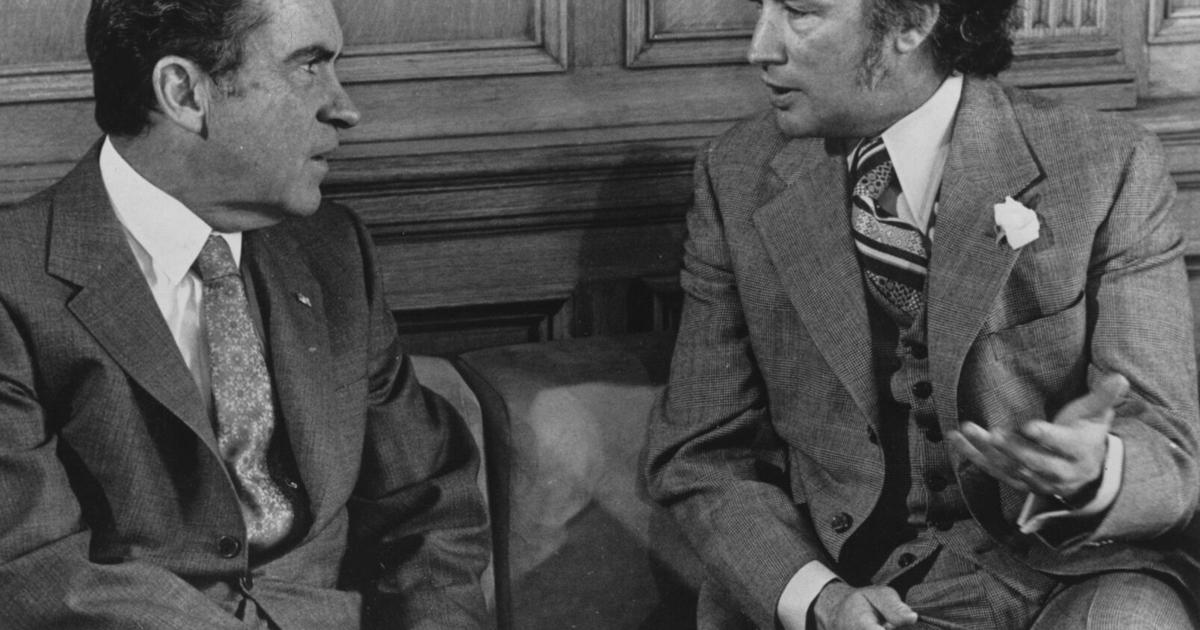
It wasn’t the threat of annexation that sparked Canada’s first pivot away from the United States and toward Europe.
asserted
that → spark → Europe
“It is time for us to recognize that we have very separate identities, that we have significant differences and that nobody’s interests are furthered when these realities are obscured.”
asserted
realities → recognize → differences
These were the words of then-U.S. president Richard Nixon, delivered to Canadian lawmakers in the House of Commons on April 14, 1972.
asserted
These → deliver → April
America’s retreat on the world stage had been dubbed the “Nixon Doctrine.”
asserted
retreat → dub → stage
But it was preceded by the “Nixon shock” — a global 10 per cent surcharge on U.S.-bound goods that was calculated to balance trade deficits.
asserted
that → precede → deficits
It was more than half a century ago, but there are many modern echoes in the twists and turns of this earlier attempt at securing the Canadian economy.
asserted
It → be → economy
In addition to the tariffs on Canadian goods, there was a hard-driving U.S. treasury secretary who was determined to end the special treatment for Ontario’s automobile industry.
asserted
who → be → industry
The Howard Lutnick of that time was John Connally, a former Texas governor who had been shot in 1963 while riding in the same limousine as John F. Kennedy, who was killed by an assassin’s bullet.
asserted
who → shoot → bullet
As Prime Minister Mark Carney welcomes European Commission President Ursula von der Leyen to Montreal this coming week for the Canada-EU summit, there are expectations of concrete measures to flesh out the offer of “associate” EU membership for Canada, or at least an alliance that deepens and enhances transatlantic ties.
asserted
that → welcome → ties
But it won’t be the first time the Old World has shimmered like an oasis for a Canadian prime minister seeking alternatives to the United States.
asserted
World → shimmer → States
In the fall of 1972, Pierre Trudeau’s Liberal government published an article examining what to do about the troubled Canada-U.S. relationship.
asserted
government → publish → relationship
It was entitled, “Options for the Future.”
asserted
It → entitle → Future
“The emphasis of the third option is on Canada — on decisions that have to be taken in this country by Canadians — rather than matters to be negotiated with the United States,” said Mitchell Sharp, Trudeau’s external affairs minister.
asserted
Sharp → have → States
“It means ensuring our continued freedom to develop in our own way through a judicious use of Canadian sovereignty.”
asserted
It → mean → sovereignty
It’s a copy-and-paste version of the preamble to Carney’s every public utterance and press release — that, in a rapidly changing world, “Canada is focused on what we can control.”
asserted
we → ’ → what
The modern-day mantra in Ottawa is building up the economy at home and broadening partnerships abroad with the goal of doubling exports to non-U.S. countries by 2030.
asserted
mantra → build → 2030
In the 1970s, large swaths of the Canadian economy, from mining to automobiles to manufacturing, were owned and operated by American investors and multinational corporations.
asserted
swaths → own → investors
Unemployment was high and, in branch-plant Canada, there were fears the economic uncertainty south of the border could drive joblessness higher still.
uncertain
uncertainty → be → joblessness
The Trudeau government responded with a heavy dose of economic nationalism.
asserted
government → respond → nationalism
It created the Foreign Investment Review Agency to examine investments and acquisitions for their potential negative impacts on the Canadian economy and employment.
asserted
It → create → economy
Provincial governments took control of the potash mines in Saskatchewan and partially nationalized asbestos mines in Quebec.
asserted
governments → take → Quebec
Ottawa cancelled tax credits for companies advertising in American-owned Reader’s Digest and Time magazine, with Trudeau’s secretary of state for culture, J. Hugh Faulkner, proclaiming, “We have to create our own identity …
asserted
We → cancel → identity
The alternative is to be simply overrun by the American arts and cultures.”
asserted
alternative → overrun → arts
Boost to NATO commitment
The Trudeau government stepped back onto the world stage by increasing defence spending after a years-long budget freeze.
asserted
government → step → freeze
Under pressure from allies, it also boosted Canada’s NATO troop contributions.
asserted
it → boost → contributions
And it launched overseas trade missions and support programs for Canadian exporters looking to promote and sell their products and services abroad.
asserted
it → launch → products
Trudeau’s ultimate gambit was the signing of an agreement, widely known as the “contractual link,” meant to bind Canada a little closer to the nine-country European Economic Community, a rapidly growing precursor to what is now the 27-member European Union.
asserted
what → know → Community
“We do not know — indeed Europe does not know — how far or how fast its experiment in integration will take it,” Trudeau said in 1975 during a visit to London.
asserted
Trudeau → know → London
But he said the deal would allow Canada and Europe to “consult and confer” going forward.
asserted
Canada → say → ?
The eventual treaty, signed in July 1976, pledged in vague terms to offer favourable treatment in international trade and close co-operation on commercial and economic matters.
asserted
treaty → sign → matters
Canadians were bullish on the possibilities, but not everyone was convinced.
asserted
everyone → convince → possibilities
A New York Times article cited an unnamed official with the Canadian Manufacturers’ Association who called the deal “a bland bucket of fog.”
asserted
who → cite → fog
It did, however, flash on the Central Intelligence Agency’s radar.
asserted
It → flash → radar
A May 1975 report assessed the impending deal as “more political than economic” and, for Trudeau, “a major public demonstration” of his government’s Third Option policy in action.
uncertain
report → assess → action
Another CIA report after the Canada-Europe agreement was signed predicted it was “likely to have little economic effect on Canada” because the new partners were at cross purposes.
asserted
partners → sign → purposes
Ottawa wanted to export finished goods to Europe, but the Europeans were shopping for Canadian raw materials like energy and minerals.
asserted
Europeans → want → energy
The skeptical American spies were proven right.
asserted
spies → prove → ?
In a 1989 journal article that examined whether Canada’s Third Option pivot away from the U.S. had been “a complete failure,” the academics Gordon Mace and Gérard Hervouet determined that exports to America had remained “well over 65 per cent” since the 1970s while the proportion of exports to other parts of the world had varied only slightly.
asserted
proportion → examine → world
The problem had not been with Ottawa’s efforts to diversify, but rather with the private sector’s follow-through.
asserted
problem → diversify → through
”(Canadian business) did not feel, at that time, that there were enough incentives to balance the costs of expanding economic relations outside the North American markets,” Mace and Hervouet concluded.
asserted
Mace → feel → markets
…and 16 more, not listed.
 The Aporia