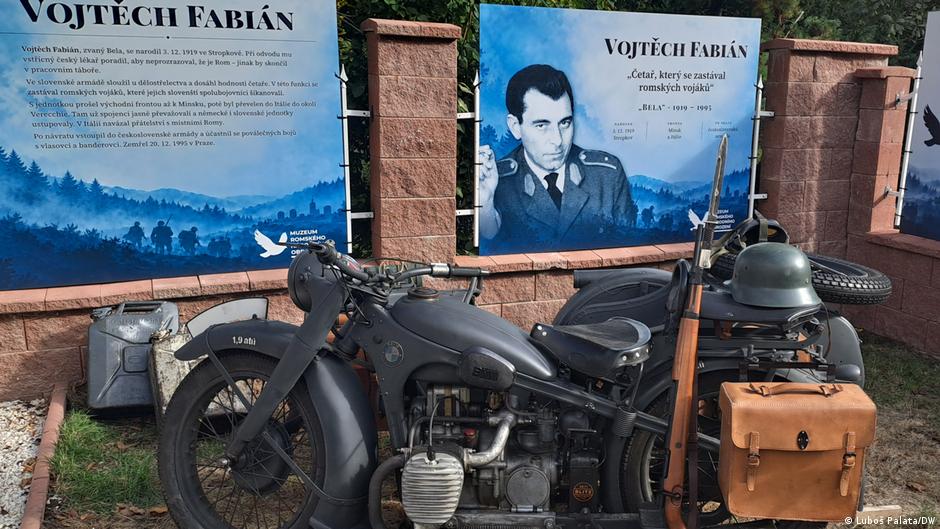
For more than half a million Roma in Czechia and Slovakia, October 15, 2026, marks an important milestone.
asserted
October → mark → milestone
That day, an exhibition on a largely forgotten chapter of Czech history opened at the Museum of the Romani National Revival in Prague.
asserted
exhibition → forget → Prague
The exhibit explores the role of Czech and Slovak Romani resistance fighters during the Nazi German occupation and the dismantling of Czechoslovakia from 1938 to 1945.
asserted
exhibit → explore → 1945
Until now, Czech and Slovak Roma appeared in the history of World War II almost exclusively as victims of the Holocaust against Roma and Sinti.
asserted
Roma → appear → Roma
In the so-called Protectorate of Bohemia and Moravia, Nazi Germany murdered approximately 90% of the Czech Roma during World War II.
asserted
Germany → call → II
However, what is less well known is that a large number of Czech and Slovak Roma fought against the German occupiers as partisans in resistance groups and as soldiers in the Czechoslovak Underground Army, or Defense of the Nation, ON.
asserted
number → know → Nation
Roma have heroes, too
asserted
Roma → have → heroes
The exhibition at the Museum of the Roma National Movement therefore marks a turning point in how the Roma are viewed during World War II.
asserted
Roma → mark → II
At least that is the hope of museum director Emil Scuka, a lawyer, former prosecutor and one of the best-known Czech Roma activists.
asserted
that → know → activists
"We were not only victims; we were also heroes," Scuka said in his speech to several hundred attendees at the exhibition opening, most of whom were Roma from Czechia and Slovakia.
asserted
most → say → Czechia
"Many people, not even among the Roma themselves, are aware that we Roma fought against Nazism," he noted.
asserted
he → fight → Nazism
In his view, "organizing and opening the exhibition was something my generation owed to these Roma heroes and today we are repaying that debt.
asserted
we → organize → debt
Scuka called on those present: "Bring your children and grandchildren here so they can see for themselves and realize that the Roma have heroes too!"
He also pointed out that this topic had been completely marginalized in Czech and Slovak historical writing for decades and that the Roma had therefore decided on their own to document the fates of their war heroes.
asserted
Roma → call → heroes
The exhibition presents the detailed life stories of 100 of the most significant Roma partisans and Roma soldiers from the Czech underground army and resistance groups who fought against the Nazis.
asserted
who → present → Nazis
"We found over 1,400 Romani fighters in the archives.
asserted
We → find → archives
From among them, we selected the 100 most interesting stories for this exhibition," said exhibition curator Radoslav Scuka at the opening.
asserted
Scuka → select → opening
Groundbreaking research on Roma resistance fighters
Among these figures is Anton Facuna, a sergeant in the American intelligence agency Office of Strategic Services (OSS), who was flown to Slovakia in October 1944 on a secret mission.
asserted
who → fly → mission
Another is Josef Serinek, known by the nickname "Black Partisan from Vysocina," who managed to escape from the Nazi concentration camp for Roma in Lety and subsequently founded and commanded the large Capajev-Cerny partisan unit in the Bohemian-Moravian Highlands.
asserted
who → know → Highlands
In 2022, Czech President Milos Zeman posthumously awarded him the Medal for Heroism.
asserted
Zeman → award → Heroism
Toward the end of his life, Serinek shared his memories with historian Jan Tesar, who later wrote the three-volume book "Ceska cikanska rapsodie", which translates to Czech Gypsy Rhapsody.
asserted
which → share → Rhapsody
Except for Tesar's book, the history of Roma resistance against Nazism has not been researched by Czech and Slovak historians to this day.
asserted
history → research → day
"I am not aware of any scholarly historical work that deals with Roma resistance against Nazism," Prokop Tomek, a historian at the Military History Institute in Prague, told DW.
asserted
Tomek → deal → DW
"The number of 1,400 Roma who took part in the fight against Nazism as members of the resistance or in the foreign army does not strike me as an exaggeration and corresponds to the proportion of the Roma population in Czechoslovakia," Tomek said, adding that the "exhibition on the Roma resistance against Nazism during the war is undoubtedly groundbreaking.
asserted
exhibition → take → war
To this day, many Roma in Czechia and Slovakia do not publicly acknowledge their ethnic identity.
asserted
Roma → acknowledge → identity
This is partly due to experiences with the Holocaust during the Nazi era that have been passed down through generations.
asserted
that → pass → generations
Czech historians and politicians continue to debate the extent to which the Czech authorities of the Protectorate were complicit in the extermination of the Czech Roma.
asserted
authorities → continue → Roma
However, one thing is certain: the police registration of all Roma, which had been enshrined in law in Czechoslovakia since 1927, facilitated the extermination of the Roma by the German Nazis.
asserted
which → enshrine → Nazis
According to estimates by the Czech government, approximately 250,000 Roma live in the country today.
uncertain
Roma → accord → country
In the 2021 census, however, only 21,000 people identified as Roma.
asserted
people → identify → Roma
Of all ethnic groups in Czechia, which has a population of 10 million, the Roma are among the three largest ethnic minorities in terms of numbers.
asserted
Roma → have → numbers
However, they are the most socially disadvantaged, have very little political representation, and are therefore scarcely present in Czech politics.
asserted
they → have → politics
This article was originally written in German.
asserted
article → write → German
 The Aporia