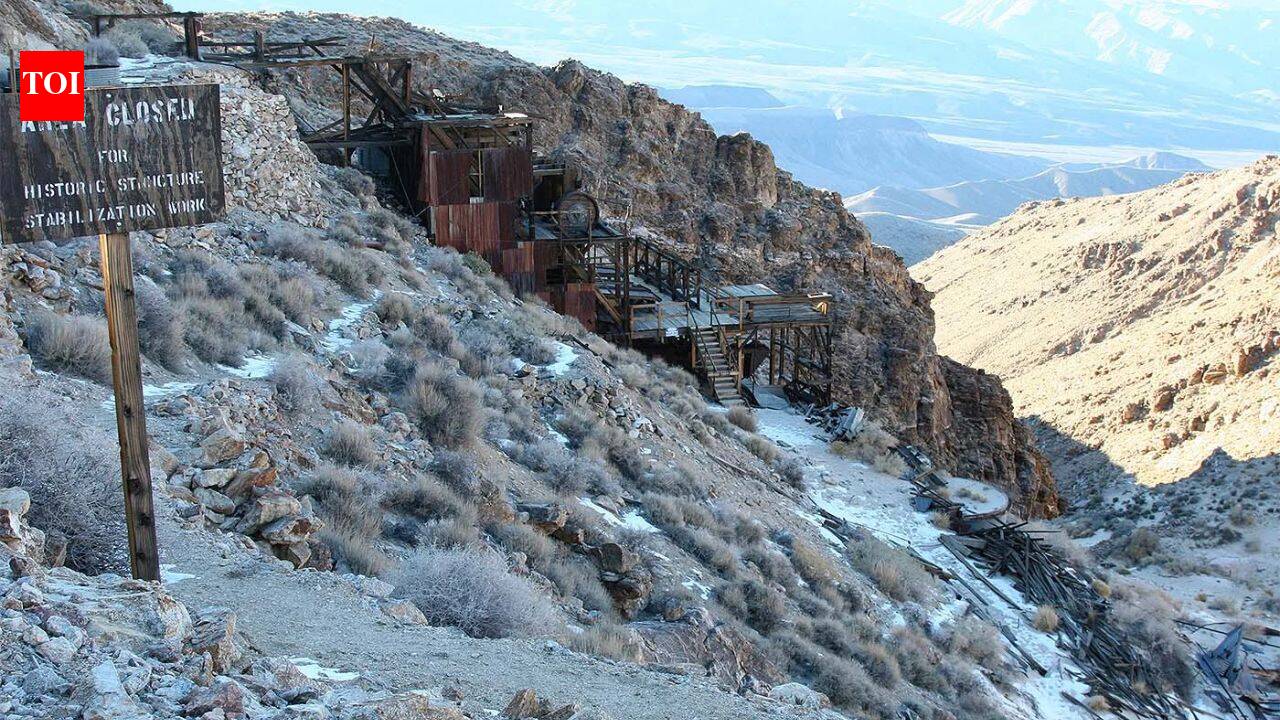
A gold discovery in 1906 transformed a remote part of California's Death Valley region into a busy mining settlement.
asserted
discovery → transform → settlement
Skidoo attracted hundreds of people hoping to make their fortunes, eventually growing to a population of around 700.
asserted
Skidoo → attract → 700
The town became one of the area's most important gold-mining centres, producing approximately $1.5 million in revenue during its main period of activity.
asserted
town → become → activity
However, the settlement's success depended on difficult mining conditions and the ability to transport water across the desert.
asserted
success → depend → desert
As mining activity declined, residents gradually left, turning Skidoo into a ghost town.
asserted
residents → decline → town
Skidoo attracted 700 people after the 1906 gold discovery
According to the US National Park Service, two prospectors discovered gold in the area in 1906.
uncertain
prospectors → attract → 1906
Their find attracted interest in a region where mining offered the possibility of substantial financial rewards, despite the challenges of working in a remote desert environment.
asserted
mining → attract → environment
Skidoo developed in the Panamint Mountains within what is now Death Valley National Park.
asserted
what → develop → Mountains
Its growth formed part of a wider period of renewed interest in gold and silver mining across the Death Valley region during the early 20th century.
asserted
growth → form → century
The settlement reached a population of approximately 700, with people arriving to work in the mines and support the growing community.
asserted
people → reach → community
Western Mining History also reports that Skidoo had a newspaper, a bank, a school and telephone service at its height in 1907.
asserted
Skidoo → report → 1907
These facilities reflected how quickly a remote mining camp developed into a functioning town.
asserted
camp → reflect → town
Extracting the metal required infrastructure, workers and a reliable supply of water, all of which had to be established in a challenging landscape.
asserted
all → extract → landscape
A long pipeline helped the mining operation grow
One of Skidoo's biggest challenges was obtaining enough water to process the gold-bearing rock.
asserted
One → help → rock
The town's location in an arid region made a dependable supply essential to its mining activities.
asserted
supply → make → activities
The National Park Service states that a 23-mile metal pipeline was constructed to carry water to the mill and the town.
asserted
pipeline → state → mill
The system connected the mining operation with a distant water source, allowing the processing facility to operate in an otherwise dry environment.
asserted
facility → connect → environment
Western Mining History describes the pipeline as an important undertaking associated with mine owner Bob Montgomery.
asserted
History → describe → Montgomery
Water was carried from Birch Spring, high on the western side of Telescope Peak, to the mill.
asserted
Water → carry → mill
The pipeline provided water to prospectors exploring isolated parts of the desert.
asserted
pipeline → provide → desert
Building such a system required considerable investment and planning.
asserted
Building → build → investment
Without a steady water supply, the operation would have struggled to process ore on a large scale.
asserted
operation → struggle → scale
The pipeline therefore became a crucial part of Skidoo's development, supporting both gold extraction and activity in the surrounding area.
asserted
pipeline → become → area
The mill opened in 1907, according to the National Park Service.
uncertain
mill → open → Service
Its purpose was to extract gold from the ore brought from the mines.
asserted
purpose → extract → mines
The construction of the facility marked an important step in turning the original discovery into a more organised mining enterprise.
asserted
construction → mark → enterprise
How much gold revenue did Skidoo produce
Skidoo became one of California's notable gold-mining settlements during its relatively short period of prosperity.
asserted
Skidoo → produce → prosperity
The NPS estimates that the operation generated about $1.5 million in revenue during its main mining years.
asserted
operation → estimate → years
The figure illustrates the scale of the operation, although it represents historical revenue rather than the town's value in modern money.
asserted
it → illustrate → money
It also shows that Skidoo's success rested on more than a single discovery, with numerous mining claims contributing to the area's output.
uncertain
claims → show → output
Production continued as miners worked to extract gold from the surrounding deposits.
asserted
miners → continue → deposits
In September 1908, the Los Angeles Herald reported that gold bricks worth $10,000 from the Skidoo mines had arrived in nearby Rhyolite before being sent to the mint.
asserted
bricks → report → mint
The shipment represented 15 days of production and was considered typical of the preceding 3 months.
asserted
shipment → represent → months
The ore was also increasing in both quantity and quality at the time.
asserted
ore → increase → time
However, the revenue figures alone do not capture the practical difficulties of operating in the desert.
asserted
figures → capture → desert
Skidoo's prosperity faded after 1917
The mining boom eventually lost momentum.
asserted
boom → fade → momentum
According to the NPS, Skidoo was the Death Valley region's largest mining operation from 1907 to 1917, but most residents moved away after 1917.
uncertain
residents → accord → 1917
The decline reflected the uncertain nature of mining settlements, whose fortunes depended heavily on the continued viability of local mineral deposits.
asserted
fortunes → reflect → deposits
Once the main period of activity ended, the town could no longer sustain the population and services that had developed around the mines.
uncertain
that → end → mines
Mining did not stop completely when residents began leaving.
asserted
residents → stop → ?
…and 10 more, not listed.
 The Aporia