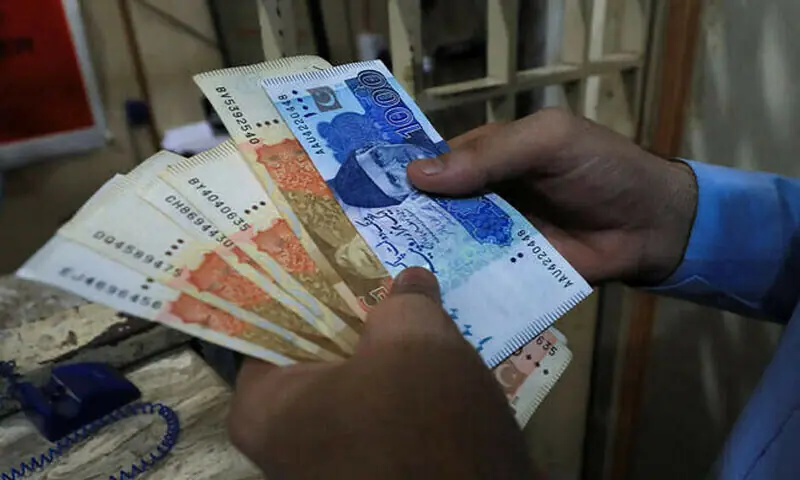
Pakistan’s trade deficit with Gulf partner countries narrowed 26.35 per cent to $2.85bn in the first quarter of 2026-27 against $3.87bn a year earlier, largely due to lower imports and moderately higher exports.
asserted
deficit → narrow → imports
These two countries accounted for $947.923 million of the gross decline in import payments, partly offset by the substantial increase in imports from Oman.
asserted
countries → account → Oman
On the export side, the UAE accounted for approximately 66.21pc of Pakistan’s total exports to the seven countries in 1QFY27, followed by Saudi Arabia at 19.45pc.
asserted
UAE → account → 19.45pc
The remaining five countries collectively accounted for just 14.34pc, according to data compiled by the State Bank of Pakistan.
uncertain
countries → remain → Pakistan
The Middle East conflict has disrupted Pakistan’s trade since March.
asserted
conflict → disrupt → March
Exports to most Gulf states are shrinking, while imports from them are surging—worsening Pakistan’s external vulnerability and dependence on Gulf energy and raw materials.
asserted
imports → shrink → energy
Lower imports, higher exports cut gap by 26pc to $2.85bn in July-September
September emerged as the sixth month after the March contraction, suggesting Pakistan’s import flows are highly sensitive to geopolitical developments, particularly in energy corridors.
asserted
flows → emerge → corridors
Pakistan remained heavily reliant on energy imports, particularly from the UAE and Saudi Arabia, which accounted for 90pc combined.
asserted
which → remain → 90pc
Other countries, including Qatar, Kuwait, Oman, Jordan and Bahrain, remain secondary contributors despite their export capacity.
asserted
countries → include → capacity
Pakistan’s exports to the Middle East rose 10.96pc to $864.878m in 1QFY27, up from $779.425m in the same period last year.
asserted
exports → rise → period
In FY26, exports to the region fell by over 2pc to $3.093bn from $3.152bn the previous year.
asserted
exports → fall → 3.152bn
In contrast, imports from the region fell 20.02pc to $3.717bn in 1QFY27, down from $4.648bn a year earlier.
asserted
imports → fall → 4.648bn
In FY26, imports posted negative growth of 4pc to $16.413bn from $17.097bn a year earlier.
asserted
imports → post → 17.097bn
Country-wide data showed exports to Saudi Arabia grew by 4.92pc in 1QFY27 from a year ago.
asserted
exports → show → 1QFY27
Imports, however, dipped by 18.52pc from Saudi Arabia, showing a clear dip in Pakistan’s imports of Saudi goods, especially oil.
asserted
Imports → dip → goods
A positive trend was observed in export proceeds to the UAE, which increased by 16.35pc in 3MFY27, with notable gains in Abu Dhabi, Ajman, and Fujairah.
asserted
which → observe → Dhabi
Imports from the UAE fell by 6.15pc, mainly due to lower petroleum and commodity inflows.
asserted
Imports → fall → inflows
Exports to Qatar fell by nearly 22.79pc, while imports dipped by 72.51pc in 1QFY27 year on year.
asserted
imports → fall → year
The import decline reflects a major reversal in energy-related purchases from the region.
asserted
decline → reflect → region
Exports to Kuwait dipped 2.24pc, but imports plunged 97.46pc in 1QFY27.
asserted
imports → dip → 1QFY27
This indicates Pakistan’s reliance on Kuwaiti imports, especially petroleum, compared to a year ago.
asserted
This → indicate → imports
Exports to Bahrain contracted 23.07pc, while imports also dipped 17.31pc in 1QFY27.
asserted
imports → contract → 1QFY27
Exports to Jordan rose by 4.70pc, while imports declined 29.27pc.
asserted
imports → rise → 4.70pc
Pakistan’s exports to Oman rose 10.73pc while imports surged 97.40pc during July-September.
asserted
imports → rise → July
 The Aporia