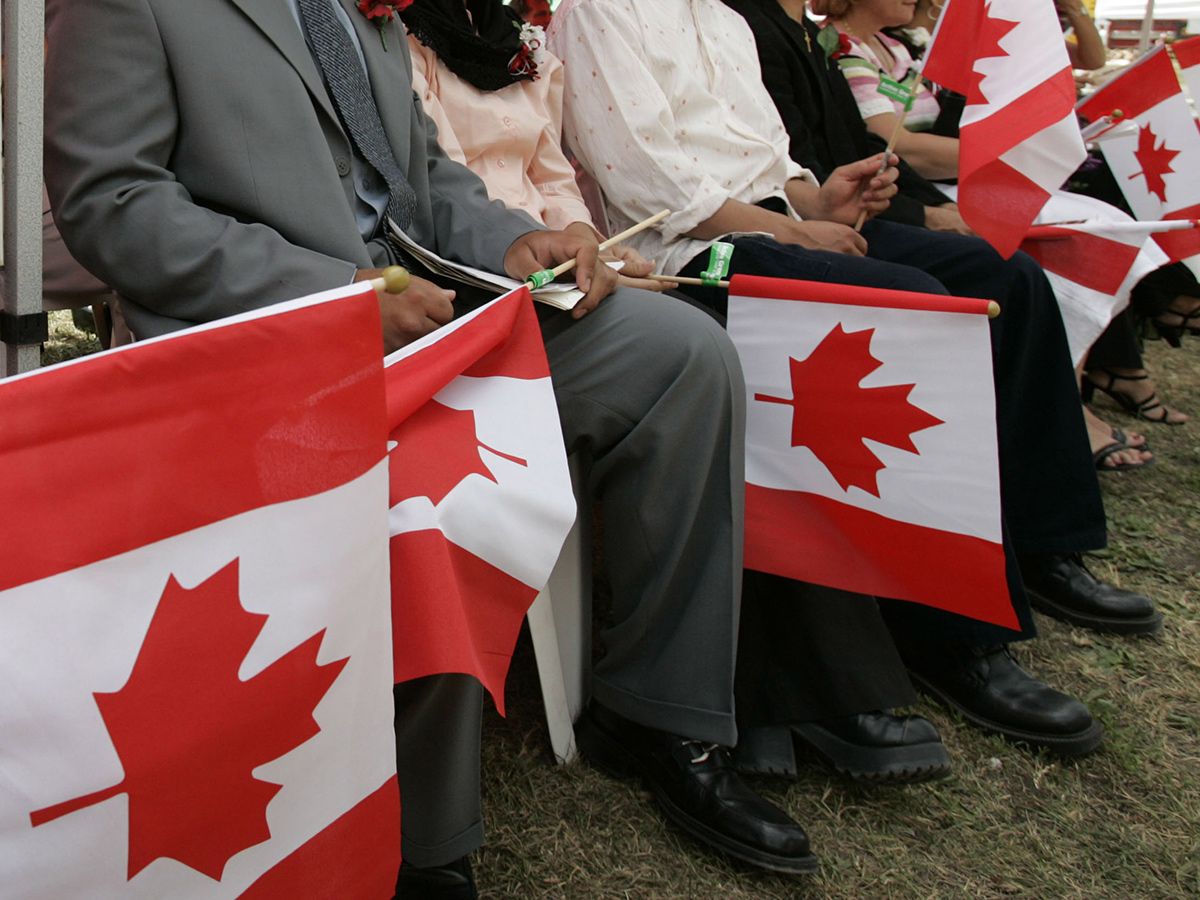
Canada’s anti-immigrant sentiment softening, according to new poll

Read the original at National Post ↗
Cite

Lambie, C. (2026, October 24). Canada’s anti-immigrant sentiment softening, according to new poll. National Post. https://nationalpost.com/news/canada/canadas-anti-immigrant-sentiment-softening-according-to-new-poll

Dated from the outlet's own feed. Check the original for its byline.

National Post · collected 2026-10-24 · by Chris Lambie

Quick Summary

A recent poll by EKOS for the Association for Canadian Studies indicates shifting attitudes towards immigration in Canada, with 45% of respondents believing there are too many immigrants, down from previous years. Canadians in Atlantic provinces and on the Prairies are most likely to think there are too many immigrants, while British Columbians and Quebecers are least concerned about it. The poll also shows a rise in those who believe Canada doesn’t have enough immigrants, up 10 percentage points since March 2025.
Written locally by qwen2.5:14b on 2026-10-24, using this article's own text rather than the other coverage of the same event (that is the story summary below).

AI analysis runs on qwen2.5:14b, locally

Story summary

A recent EKOS poll conducted for the Association for Canadian Studies shows that 45% of Canadians believe there are too many immigrants in the country, a decrease from previous years. The survey indicates regional variation: respondents in Manitoba and Saskatchewan (52%) were most likely to think Canada has an excess of immigrants, followed by Atlantic Canada (50%), Alberta, and Ontario (46%). In contrast, residents of British Columbia (39%) and Quebec (40%) were least concerned about having too many immigrants. The poll reflects a softening in anti-immigrant sentiment compared to the past three years, with Mark Carney’s Liberal government set to announce immigration levels for the next three years before presenting a budget on November 5, 2026.

Written for “Canada Immigrant Sentiment Softening” on 2026-10-24, grounded in this article and the 0 other(s) covering the same event.
Why this leaning score
The article's own words the score was based on. Each is quoted verbatim and was checked against the article text before being stored, so you can find it in the original.
Reading Leans left (beta estimate) Confidence high
Leaning: leans left for article 103912 (high confidence, 1 verified quote) · logged 2026-10-24

Story

📰 Canada Immigrant Sentiment Softening
Politics · 1 article(s) covering the same event.

Compared with similar articles

This article reads leans left and hedges 16% of its claims. Each row says how that neighbour differs.
The Globe and Mail
⚖️ Leans right further right than this 🔴 3% hedged 1 of 30 📰 publisher trust 53
“The articles discuss different aspects of public opinion on immigration in Canada, with Article A focusing specifically on Alberta's referendum results and Article B presenting a national poll across all provinces.”
How this article was measured signals, leaning charts, publisher record, byline, topics and claims

Signals How these are calculated →

Claims extracted
32
sentences that state something as happening or true
Uncertain
16%
5 of 32 hedged ("reportedly", "may", "according to")
Leaning
Leans left
of the writing, not the subject · beta estimate
Publisher signals
60/100
National Post's corrections and hedging, across everything collected from it. Not a measure of accuracy.
Outlets on this story
1
Politics
Same framing elsewhere
1
articles that frame the event the way this one does
Analyzed 2026-10-24 · how these are computed

How this is being covered How these are calculated →

Article leaning vs. publisher reliability
Source leaning vs. consistency

Publisher

National Post · 1110 article(s) · 2 correction(s) detected
Running correction rate · 2 correction(s)

Who wrote this

Chris Lambie
15 article(s) here · 0 carrying a prediction
🔮 Royal Caribbean’s Oasis of the Seas left Cape Liberty, N.J., on Sunday, diverting course from its original itinerary of Florida, then the Bahamas, to sail instead for Halifax, where passengers will spend 24 hours of their seven-day cruise.
🔮 Police wouldn’t say Wednesday whether the kidnappers were successful in getting cryptocurrency from their victim, who suffered minor injuries.
🔮 “Premier Tim Houston shared his well-wishes for Gus when it was announced that he would be undergoing surgery,” Houston’s press secretary, Catherine Klimek, said Tuesday in an email.
🔮 The party won 59 of the National Assembly’s 127 seats and will need support from some members of the three opposition parties to reach 64 votes and get legislation passed.
🔮 An administrative review is a formal process used to assess matters that may affect a member’s continued service while providing procedural fairness.
🔮 But the unique circumstances of this offence and this offender satisfy the court that a discharge would not be contrary to the public interest,” Provincial Court Judge Lloyd Strickland wrote in a recent decision.
🔮 “At the hearing, she described herself as someone who could not read or write.”
🔮 Murray testified that her “messages with the breeder show the parties always intended that she would own Walter,” said the decision.
🔮 “Mr. Singh, a permanent resident of Canada, asks the court to impose a sentence that would preserve his right to appeal a deportation order arising from his convictions,” Justice Joe Patrick Paul Fiorucci said in his Sept. 15 decision.
🔮 The Crown argued that “while Mr. Baig’s mental faculties may have been impacted by cannabis, his acts were still volitional,” said the decision.
Also by Chris Lambie
Nothing else under this byline is closely related to this article, so these are simply their most recent.
All 15 articles by Chris Lambie →

Topics

British Columbians Canada Canadians Manitoba Quebecers

Subjects

Canada GPE · 7× Canadians NORP · 5× British Columbians NORP · 4× Quebec GPE · 4× Manitoba GPE · 3× Quebecers NORP · 3× Saskatchewan GPE · 3× Alberta GPE · 2× B.C. GPE · 2× Ontario GPE · 2×

Narrative

“But clearly relative to the previous three years, we are seeing some change in feeling around that and some loosening of concern on the part of Canadians.” Manitoba and Saskatchewan respondents were most likely to say Canada has too many immigrants (52 per cent), followed by Atlantic Canada (50 per cent), then Alberta and Ontario (both at 46 per cent). British Columbians were least likely to say Canada has too many immigrants (39 per cent), followed closely by Quebecers (40 per cent). The poll comes ahead of Mark Carney’s Liberal government announcing immigration levels for the next three years in the coming weeks before presenting a budget on Nov. 5.
framing: assertive · carried by 1 article(s) · first seen 2026-10-24
2026-10-24 · National Post
Canada’s anti-immigrant sentiment softening, according to new poll · assertive framing

Claims (32 extracted, 5 hedged)

Canadians in the Atlantic region and on the Prairies are most likely to think there are too many immigrants coming to this country while British Columbians and Quebecers are least likely to see it that way, according to a new poll. uncertain
Columbians → think → poll
When you look at all 10 provinces, 45 per cent of Canadians polled said we have too many immigrants, 31 per cent indicated we have about the right number, and 13 per cent said we don’t have enough, according to the poll conducted earlier this month by EKOS for the Association for Canadian Studies. uncertain
we → look → Studies
“We’re still seeing the large plurality of Canadians saying there are too many immigrants,” said Jack Jedwab, the association’s president. asserted
Jedwab → see → Canadians
“But clearly relative to the previous three years, we are seeing some change in feeling around that and some loosening of concern on the part of Canadians.” Manitoba and Saskatchewan respondents were most likely to say Canada has too many immigrants (52 per cent), followed by Atlantic Canada (50 per cent), then Alberta and Ontario (both at 46 per cent). British Columbians were least likely to say Canada has too many immigrants (39 per cent), followed closely by Quebecers (40 per cent). The poll comes ahead of Mark Carney’s Liberal government announcing immigration levels for the next three years in the coming weeks before presenting a budget on Nov. 5. asserted
government → see → Nov.
British Columbians topped the list of those who said Canada has about the right number of immigrants (34 per cent), followed by Alberta and Quebec (both at 32 per cent). asserted
Canada → top → cent
Those polled in Manitoba and Saskatchewan were least likely to say Canada has the right number of immigrants (26 per cent). asserted
Canada → poll → immigrants
British Columbians were also the most likely to say Canada doesn’t have enough immigrants (18 per cent), followed by Quebec (16 per cent), Atlantic Canada (13 per cent), and Ontario (12 per cent). asserted
Canada → say → Quebec
Immigration concerns have declined across the board, but they’re still high in Atlantic Canada and lowest in B.C. and Quebec, according to the poll. uncertain
they → decline → poll
Quebecers were most likely to strongly agree with the need for a common set of values (42 per cent strongly agreed with that, and another 42 per cent somewhat agree). asserted
cent → agree → that
Only 31 per cent of respondents in Manitoba and Saskatchewan strongly agreed with the need for a common set of values, while 42 per cent somewhat agreed. asserted
cent → agree → values
But a near equal share believes cohesion requires people accepting others with different values, according to the poll. uncertain
people → believe → poll
In all 10 provinces, 40 per cent of respondents strongly agreed with that statement, while another 39 per cent somewhat agreed. asserted
cent → agree → statement
Those who indicated Canada has too many immigrants was down 13 percentage points from a separate Leger poll conducted in March 2025. asserted
Canada → indicate → March
Those who say we don’t have enough was up 10 percentage points over that same period. asserted
we → say → period
In Atlantic Canada, the number of respondents indicating there are too many immigrants has dropped eight percentage points since March 2025, from 58 per cent to 50 per cent. asserted
number → indicate → cent
In B.C., that number dropped 17 percentage points from 56 per cent in March 2025 to 39 per cent. asserted
number → drop → cent
In Quebec it tumbled 18 percentage points to 40 per cent. asserted
it → tumble → cent
For all 10 provinces, immigration concerns have fallen 13 percentage points from March 2025 until this month, from 58 per cent to 45 per cent. asserted
concerns → fall → cent
The new poll indicates a majority of Canadians believe that a cohesive society requires a common set of values. asserted
society → indicate → values
For all 10 provinces, 39 per cent of those polled strongly agreed with that sentiment, while 44 per cent somewhat agreed with it. asserted
cent → poll → it
Among those who feel Canada has too many immigrants, 89 per cent say social cohesion requires shared common values. asserted
cohesion → feel → values
Sixty-four per cent of them say it requires accepting different values. asserted
it → say → values
“The people who believe that we need shared common values for cohesion are far more inclined to say there are too many immigrants,” Jedwab said. asserted
Jedwab → believe → cohesion
“On the other hand, those saying we need to accept different values are far more inclined to say that we’ve got about the right number or, in fact, not enough. asserted
we → say → enough
We're still seeing the large plurality of Canadians saying there are too many immigrants Among those who say Canada has too many immigrants, 51 per cent indicated they’re very attached to Canada. asserted
they → see → Canada
“These people are saying, ‘I don’t feel as good about Canada because there are too many immigrants,'” Jedwab said. asserted
Jedwab → say → Canada
That attachment jumps to 70 per cent for the folks who think we have the right number of newcomers. asserted
we → jump → newcomers
Immigrants are less likely than non-immigrants to feel that there are too many immigrants, according to the poll. uncertain
Immigrants → feel → poll
Among those born here, 47 per cent said we have too many immigrants, 31 per cent indicated the number’s about right, and 12 per cent indicated there’s not enough. asserted
cent → bear → immigrants
For those born outside Canada, 35 per cent said we have too many immigrants, 29 per cent said the number’s about right and 20 per cent said there’s not enough. asserted
cent → bear → immigrants
“Some of the softening we’re seeing in attitudes towards immigration seem to be coming from that immigrant cohort whose anxiety I think is also diminishing,” Jedwab said. asserted
Jedwab → see → anxiety
The survey of 1,222 Canadian adults was conducted online Oct. 9-15 using EKOS’ Probit research panel. asserted
survey → conduct → panel

💬Give feedback
🕘History 🎫Support