Nobody knows what the latest government money committed to car-making is actually for.
asserted
money → know → making
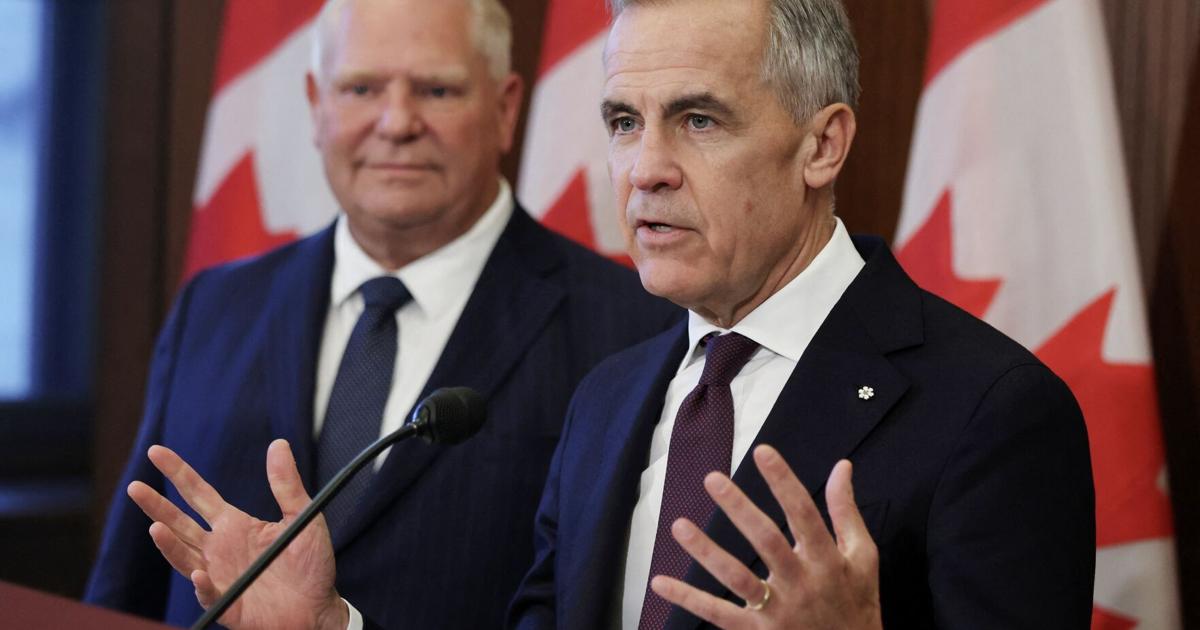
The $2.5-billion jointly announced by the federal and Ontario governments this week, for “large-scale automotive capital projects,” was of course welcomed by representatives of a domestic industry battered by Donald Trump’s tariffs.
asserted
billion → announce → tariffs
But it’s not something they were specifically pushing for — most of them only found out the night before that the announcement was coming — and details were scant.
asserted
details → ’ → them
Nor has there been much indication of global automakers imminently considering major new investments in vehicle assembly here, amid the ongoing uncertainty about access to the U.S. market.
asserted
automakers → consider → market
Adding to the mystery is that the new money is being presented as largely going toward making electric vehicles here, which has recently been less a domestic manufacturing focus of both the industry and the governments than it was a couple of years ago.
asserted
it → add → years
In fact, buried in the same announcement was a backtracking on Ottawa’s plans to toughen Canada’s rules on regulating vehicle emissions, which could further weaken the domestic EV market for the next few years.
uncertain
which → bury → years
How does this fit with previous auto spending?
asserted
this → fit → spending
And it wasn’t made clear how the new money — part of a broader announcement of support for industries like steel suffering from the trade war — fits with or complements $3-billion in tariff relief that Ottawa committed to the auto sector earlier this year, much of which has seemingly not yet been spent.
asserted
much → make → which
None of that means the money is unneeded or will be misspent.
asserted
money → mean → that
It’s conceivable the governments are quietly in talks with a company — one of the five already assembling vehicles in Ontario or a newcomer — and that this is a precursor to a surprise announcement of new manufacturing capacity.
asserted
this → ’ → capacity
Even if not, better to err on the side of overcommitting to helping Ontario’s industrial belt survive the Trump era.
asserted
belt → err → era
Canada needs a real auto strategy
But this week’s confusion was the latest indication that we’re overdue for a coherent plan that tells us what sort of post-Trump future our leaders envision for Canadian automaking, how different it could look from the industry as we know it, and how all these scattershot policies are supposed to achieve it.
uncertain
policies → need → it
As of now, all we really have to go on is a mostly reactive and generally underwhelming strategy that Ottawa released last winter.
asserted
Ottawa → have → that
Aside from tariff relief funding, it mostly involved a scrapping of Justin Trudeau’s EV sales mandate (replaced by the emissions rules that Carney is now also weakening), a return of EV purchase incentives, and a slightly ambiguous promise to more pointedly wield our own tariff policies to protect domestic manufacturing.
asserted
Carney → involve → manufacturing
Left unanswered were big, directional questions which underlie policy choices, and which have only grown more pressing since
asserted
which → leave → choices
Many of them stem from how we intend to make up for the ever-shrinking presence of the traditional North American automakers (General Motors, Ford and Stellantis).
asserted
we → stem → automakers
The Big Three once accounted for the bulk of Canadian vehicle assembly, but now only contribute about a third of it, and are liable to recede further because of both fealty to the U.S. and struggles navigating the global transition to EVs.
asserted
Three → account → EVs
That leads to the contentious matter of how enthusiastic we are to try to replace some of that footprint with Chinese EV manufacturing — something that wasn’t clarified by the government’s flustered response to the prospect of China’s Leapmotor moving into Stellantis’s Brampton plant.
asserted
Leapmotor → lead → plant
And if not them, do Ottawa and Queen’s Park believe there’s a serious chance in the next few years of attracting automakers from South Korea or Europe that don’t currently have Canadian car-assembly presences?
asserted
that → believe → presences
Could more Canadian-made cars be made for the domestic market?
uncertain
cars → make → market
Then there’s the question of whether more Canadian-made vehicles, most of which have long been sold in the U.S., could be made for the domestic market instead.
uncertain
most → ’ → market
That could involve working largely with Toyota and Honda, which have a closer correlation between Canadian manufacturing and sales than the U.S.-based companies to begin with, but again we haven’t heard much about how policies could help with that.
uncertain
policies → involve → that
Nor do we know if part of the strategy could involve trying to ship some Canadian-made cars across the Atlantic as part of our closer economic ties with Europe.
uncertain
part → know → Europe
We also don’t know the government position on some car-making facilities being converted to producing military vehicles as part of the defence-industrial push — another possibility that’s emerged for the Brampton plant, and received strong auto-industry and union pushback.
asserted
that → know → pushback
And it’s really hard to understand where Ottawa stands on how aggressively Canada should try to join nearly everyone overseas in ditching gas-powered vehicles for electric ones, rather than avoiding winding up on an island with the U.S. in resisting that shift.
asserted
Canada → ’ → shift
All this is easier said than done, particularly when the ground beneath us is so unstable.
asserted
ground → say → us
With the day-to-day volatility Trump has inflicted upon the industry, it’s understandable that governments seem to be making up policies on the fly.
asserted
governments → inflict → fly
But as with other industries for which the visions have recently been more forward-looking — energy, resources, defence — we need to have some idea what it is we’re trying to build into the 2030s and beyond.
And all the more so, if we’re going to keep newly pledging billions of dollars toward that future.
asserted
we → need → future
 The Aporia