In 1941, with the world at war, U.S. President Franklin Roosevelt and British Prime Minister Winston Churchill met in Newfoundland to set down principles for an international order.
asserted
Roosevelt → meet → order
The Atlantic Charter affirmed peoples’ right to choose their own governments, enjoy free trade and live without fear and want.
asserted
Charter → affirm → fear
It helped shape the institutions established after the war.
asserted
It → shape → war
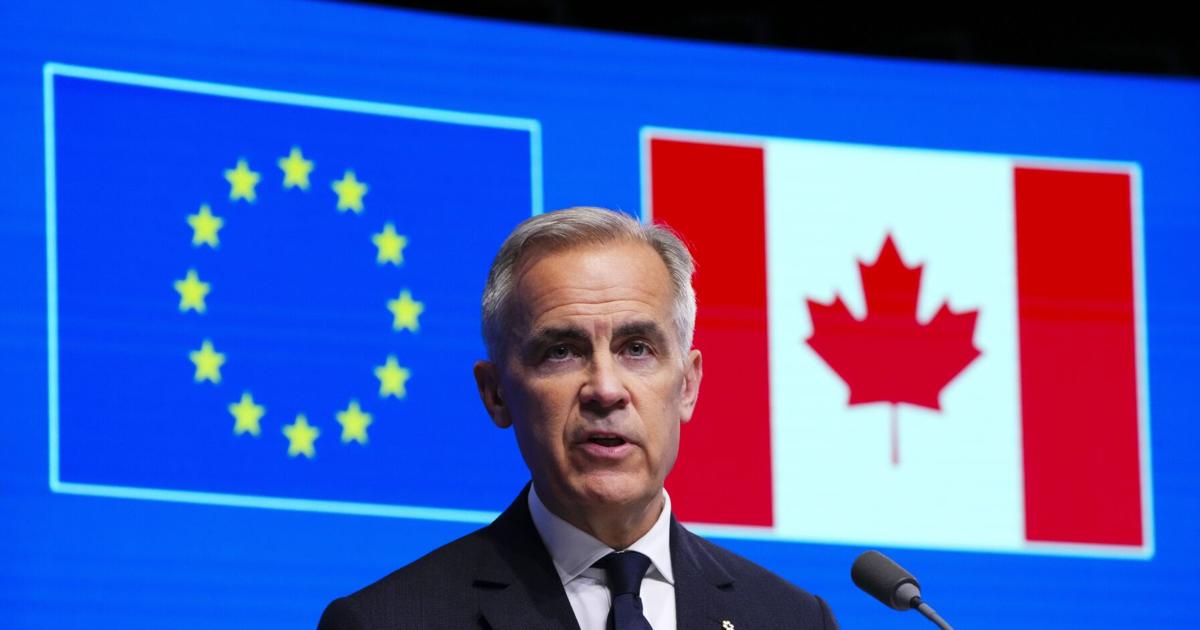
Eighty-five years later, a group of Canadian foreign-policy experts is urging Canada and the European Union to outline a new Middle Power Charter at next week’s Canada–EU Summit in Montreal.
asserted
group → urge → Montreal
The charter would unite these democracies, determined to defend their independence, tackle problems none of them can solve alone, and co-operate on the technologies essential to national security, economic prosperity and self-governance.
asserted
none → unite → security
That’s a good start.
asserted
That → ’ → ?
But this new world order coincides with a new technology order, altered by artificial intelligence.
asserted
order → coincide → intelligence
It requires middle powers to develop a new model of technological sovereignty, where each nation cultivates critical digital capabilities for self-sufficiency and co-operates closely with trusted partners.
asserted
nation → require → partners
Done right, international co-operation can strengthen national sovereignty.
asserted
operation → do → sovereignty
Who controls Canada’s AI future?
asserted
Who → control → future
Canadian hospitals, businesses and governments are adopting AI systems, supplied mostly by American companies.
asserted
hospitals → adopt → companies
Citizens are beginning to use personal AI agents such as Meta’s MUSE.
asserted
Citizens → begin → MUSE
As intelligent agents take over tasks and manage an organization’s processes, these AI systems will accrue enormous economic value.
asserted
systems → take → value
Who owns their knowledge?
asserted
Who → own → knowledge
Who controls access?
asserted
Who → control → access
Who sets those terms?
asserted
Who → set → terms
Much hand-wringing has focused on the AI “kill switch.”
asserted
wringing → focus → switch
True, an American AI company, perhaps under U.S. government pressure, could suspend service to a Canadian institution during a cross-border dispute.
uncertain
company → suspend → dispute
Further, as AI displaces knowledge work and jobs, Canadian companies would increasingly pay licence fees to providers rather than wages to employees.
asserted
companies → displace → employees
A data centre located in Canada is not necessarily the answer.
asserted
centre → locate → Canada
If AI software, operating decision rights, or legal authority remain abroad, a foreign government or corporation might extract exorbitant rent or shut off a critical service.
uncertain
government → remain → service
Canada cannot build everything for itself.
asserted
Canada → build → itself
But we need enough computing power, secure storage, reliable AI models, skilled people and domestic control to keep key services running.
asserted
we → need → services
Sensitive public information must remain subject to Canadian law.
asserted
information → remain → law
In a crisis, our hospitals, financial system, government and critical infrastructure must be able to operate on Canadian-controlled systems.
asserted
hospitals → operate → systems
Building an AI alliance for middle powers
Co-operation among middle powers could solve this problem.
uncertain
Co → build → problem
Canada, Europe, Japan, South Korea, Australia and others have talent, capital, energy resources, advanced industries and large markets.
asserted
Canada → have → talent
Acting together, they could accomplish what none could afford independently.
uncertain
none → act → what
In an AI Alliance for Middle Powers, each country would build and maintain its own digital foundation.
asserted
country → build → foundation
On top of that, members would share AI know-how, large-scale computing facilities, research, networks and services under common technical rules, standards and licences.
asserted
members → share → rules
A business could move its applications from one trusted provider to another without reworking everything.
uncertain
business → move → everything
Governments could collaborate on advanced AI models and keep sensitive data and key operations at home.
uncertain
Governments → collaborate → home
If an ally changed course or the alliance fell apart, then Canada could still function.
uncertain
Canada → change → course
We can have the best of both: national self-sufficiency where essential, international co-operation where beneficial.
asserted
We → have → both
Co-operation should increase each country’s sovereignty, not diminish it.
asserted
operation → increase → it
The partners could also help their AI companies grow.
uncertain
companies → help → ?
Canada has Cohere; France has Mistral.
asserted
France → have → Mistral
Universities, entrepreneurs and public laboratories across these countries have much to contribute.
asserted
Universities → have → much
Joint access to computing power, investment and government purchasing could give promising companies a fighting chance against industry giants elsewhere.
uncertain
access → compute → giants
We need competition, not government monopoly.
asserted
We → need → competition
…and 19 more, not listed.
 The Aporia