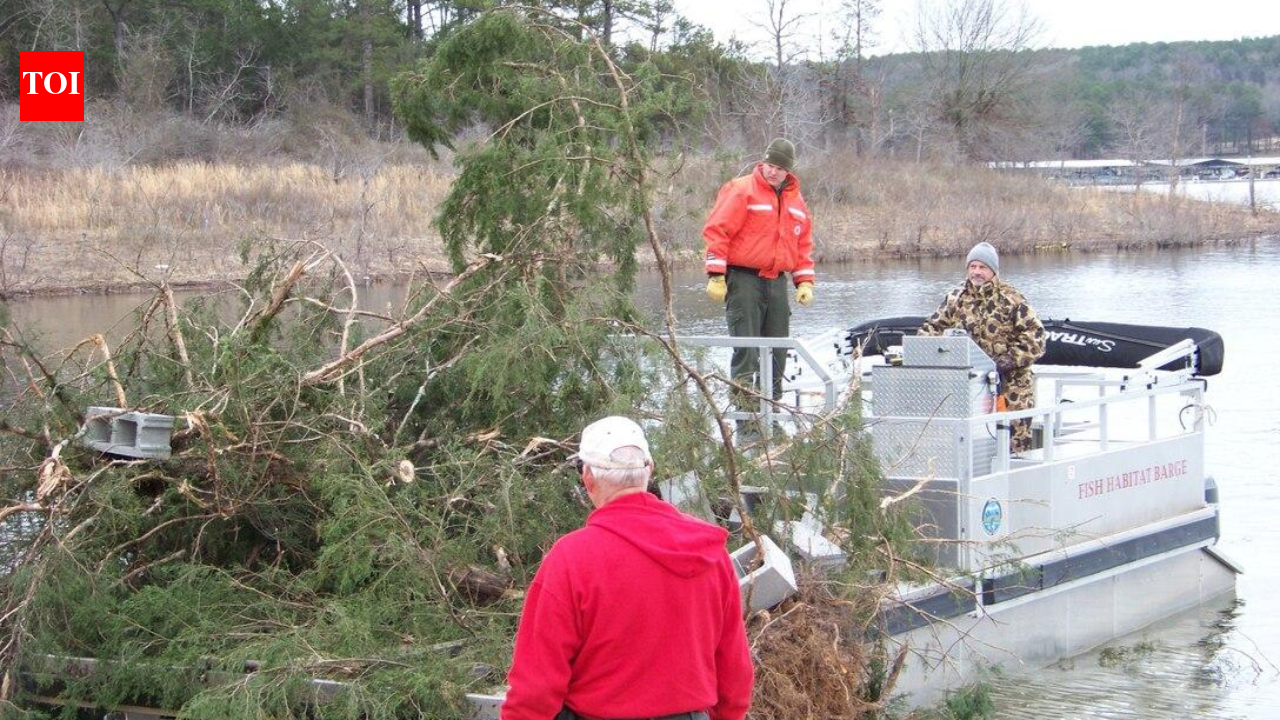
Instead of building concrete reefs, conservation workers in Nebraska have turned trees cleared from overgrown lake banks into underwater fish habitats, placing around 150 trees at 16 locations across two lakes.
asserted
workers → build → lakes
The project, completed in September 2026, aims to give smaller fish places to hide from predators while improving fishing access along the shore.
asserted
project → complete → shore
According to the Nebraska Game and Parks Commission, the trees were transported and submerged using a new Aquatic Habitat Barge at Bridgeport State Recreation Area.
uncertain
trees → accord → Area
The project used approximately 60 cedar and Russian olive trees at five locations in the recreation area's southeast lake and another 90 trees at 11 locations in the middle lake.
asserted
project → use → lake
The trees were removed from crowded shoreline areas, allowing crews to address two problems at once: overgrown banks that restricted access for anglers and a shortage of underwater woody habitat for fish.
asserted
that → remove → fish
The commission announced the work on October 22, explaining that the brush piles would provide shelter for smaller fish and help support the aquatic food web.
asserted
piles → announce → web
The project is part of Nebraska's wider effort to improve lake habitats and make fishing more productive.
asserted
fishing → improve → habitats
How trees become underwater fish shelters
Trees that might otherwise be removed as shoreline vegetation can serve another purpose once submerged.
uncertain
that → become → purpose
Their branches and trunks create a network of spaces where small fish can hide, making it harder for larger predatory fish to reach them.
asserted
fish → create → them
The underwater structures also provide surfaces where algae and other organisms can grow.
asserted
algae → provide → surfaces
These can attract plankton and small aquatic creatures, which in turn become food for fish.
asserted
which → attract → fish
The resulting chain of interactions helps support a wider aquatic food web.
asserted
chain → result → web
The Nebraska Game and Parks Commission said the brush piles are intended to benefit fish populations and anglers by improving habitat conditions.
asserted
piles → say → conditions
However, the announcement does not provide post-project monitoring data demonstrating a measured increase in fish numbers at the two lakes.
asserted
announcement → provide → lakes
The trees are not simply dumped into the water at random.
asserted
trees → dump → water
Crews transport and position them at selected underwater locations, while the commission makes approximate placement information available through its lake habitat and structure maps.
asserted
information → transport → maps
These help anglers identify underwater features that may attract fish.
uncertain
that → help → fish
The project also illustrates how vegetation removed for one practical reason can be reused to address a different environmental need.
asserted
vegetation → illustrate → need
Clearing crowded banks improves fishing access
The work has a benefit beyond the underwater ecosystem.
asserted
work → clear → ecosystem
The cedar and Russian olive trees were cut from overgrown shoreline areas, opening up sections of the banks for anglers.
asserted
trees → cut → anglers
Shoreline vegetation can restrict access to the water, particularly at locations where trees and branches have grown densely.
asserted
trees → restrict → locations
Removing selected trees can make it easier for people to reach the water's edge while allowing some of the same material to be reused as fish habitat.
asserted
some → remove → habitat
Bridgeport State Recreation Area, located in western Nebraska, covers approximately 326 acres, including 78 acres of water spread across five sandpit lakes.
asserted
Area → locate → lakes
The area offers fishing, boating, camping, swimming and other outdoor activities, according to the state agency.
uncertain
area → offer → agency
Its waters support several fish species, including largemouth bass, walleye, bluegill, yellow perch and channel catfish.
asserted
waters → support → bass
Rainbow trout are also stocked in some of the area's lakes.
asserted
trout → stock → lakes
Improving underwater habitat can help fisheries managers maintain suitable conditions for fish while making recreational waters more useful to visitors.
asserted
waters → improve → visitors
Part of a wider habitat restoration effort
Nebraska has been using a range of approaches to improve aquatic habitats, including submerged trees, artificial fish attractors and rock structures.
asserted
Nebraska → use → trees
The Nebraska Game and Parks Commission's Aquatic Habitat Program was established in 1997.
asserted
Program → establish → 1997
According to the agency, it has generated more than $90 million for improvements to 137 water bodies across the state.
uncertain
it → accord → state
The programme supports projects intended to improve aquatic conditions, fisheries and recreational access.
asserted
programme → support → conditions
A 2026 overview published by Nebraskaland Magazine, the commission's outdoor publication, describes other efforts involving woody habitat.
asserted
overview → publish → habitat
At 11 lakes along Interstate 80, invasive eastern red cedar and Russian olive trees were removed to improve shoreline access, with some of the cut trees placed in the lakes to create fish habitat.
asserted
some → remove → habitat
The state has also used rock shoals at other reservoirs.
asserted
state → use → reservoirs
In partnership with the US Bureau of Reclamation, 42 shoals were built at Medicine Creek Reservoir in 2025, following the construction of 43 at Swanson Reservoir in 2023.
asserted
shoals → build → 2023
These structures provide underwater habitat in areas that otherwise offer relatively few features for fish.
asserted
that → provide → fish
The different projects show that habitat restoration does not depend on a single design.
asserted
restoration → show → design
Depending on the water body and its needs, managers can use woody material, rocks or purpose-built structures to increase habitat diversity.
asserted
managers → depend → diversity
The Bridgeport project specifically uses trees rather than newly constructed rock structures.
asserted
project → use → structures
However, the commission has not described it as a formal replacement for concrete reefs, and the wider state programme continues to use other habitat-building methods where appropriate.
asserted
programme → describe → methods
…and 8 more, not listed.
 The Aporia