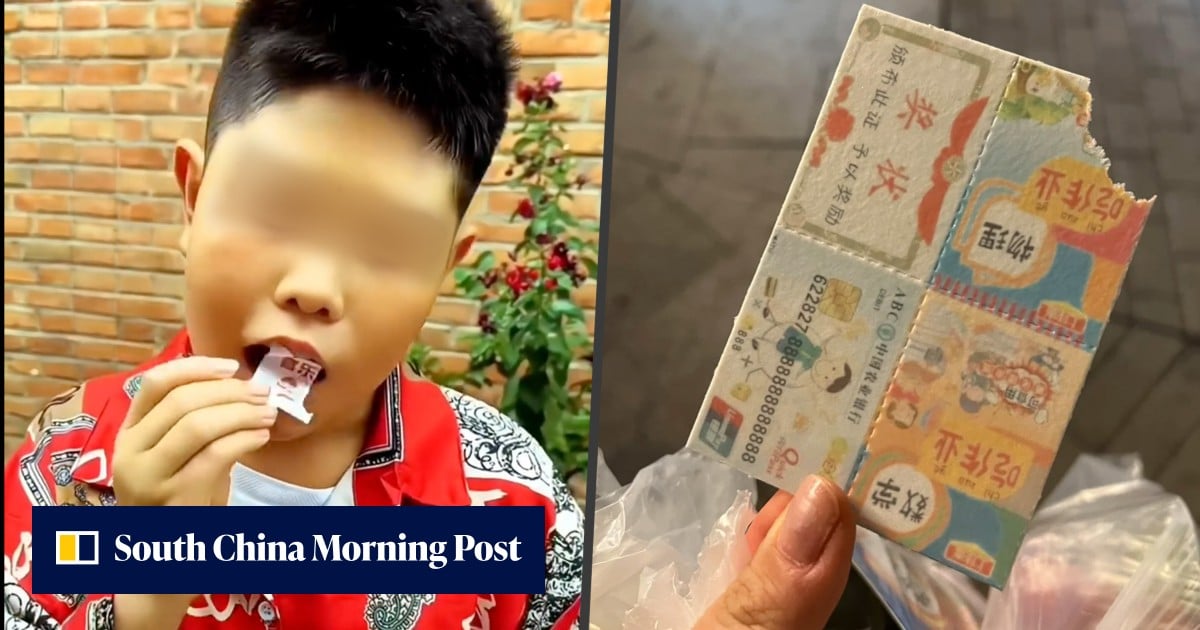
Photo via South China Morning Post

Chinese students ‘eating homework’ to relieve exam stress draws amused public reactions

Read the original at South China Morning Post ↗
Cite

Lu, F. (2026, September 15). Chinese students ‘eating homework’ to relieve exam stress draws amused public reactions. South China Morning Post. https://www.scmp.com/news/people-culture/trending-china/article/3367520/chinese-students-eating-homework-relieve-exam-stress-draws-amused-public-reactions?utm_source=rss_feed

Dated when The Aporia collected the article, usually within hours of publication. Check the original for its exact date and byline.

South China Morning Post · collected 2026-09-15 · by Fran Lu

Quick Summary

Chinese children are using a trend called "eating homework" to relieve exam stress by consuming rice paper snacks shaped like textbooks and workbooks. These edible study materials, available for as little as 0.50 yuan ($0.075) each on e-commerce platforms, have become popular among primary and secondary school students, drawing amused reactions from the public while also raising concerns about food safety.
Written by AI on 2026-09-15, from this article's own text only (the story summary below draws on all the coverage).

AI analysis

Story summary

In China, primary and secondary school students have started consuming a snack called "homework" to relieve exam stress. These snacks, made from rice paper, resemble miniature versions of textbooks and workbooks but are entirely edible. The trend has gained viral popularity on e-commerce platforms, with each snack costing less than 0.50 yuan (7.5 US cents). While the practice offers a playful way for students to cope with heavy academic pressure, it also raises concerns about food safety.

Written for “Chinese Students Eating Homework” on 2026-11-01, grounded in this article and the 0 other(s) covering the same event.

Story

📰 Chinese Students Eating Homework
Education · 1 article(s) covering the same event.

Compared with similar articles

Nothing to compare against. No article is close enough to this one for the pipeline to have linked or judged the pair.
How this article was measured signals, leaning charts, publisher record, byline, topics and claims

Signals How these are calculated →

Claims extracted
3
sentences that state something as happening or true
Uncertain
0%
0 of 3 hedged ("reportedly", "may", "according to")
Leaning
not political
takes no side on a contested political question
Publisher signals
64/100
South China Morning Post's corrections and hedging, across everything collected from it. Not a measure of accuracy.
Outlets on this story
1
Education
Same framing elsewhere
1
articles that frame the event the way this one does
Analyzed 2026-09-15 · how these are computed

How this is being covered How these are calculated →

Article leaning vs. publisher reliability
Source leaning vs. consistency

Publisher

South China Morning Post · 3502 article(s) · 6 correction(s) detected
Running correction rate · 6 correction(s)

Who wrote this

Fran Lu
24 article(s) here · 0 carrying a prediction
🔮 Chinese fugitive poses as dead twin brother for 2 decades exposed by sibling’s ex-lover At his arrest, Chen was leading an ordinary life under a false name, confident his ruse would keep him hidden A Chinese fugitive who posed as his deceased twin brother for 19 years was recently arrested after his late brother’s ex-girlfriend identified him. In 2002, a robbery took place in Yuhuan, in eastern China’s Zhejiang province.
🔮 Online community in China is heart-wrenched over a driver’s goodwill in pulling a rope across a road as a warning sign, which ultimately took the life of a passer-by.
🔮 The video interview’s rapid success placed the 29-year-old woman in the spotlight, but she later expressed her willingness to “quit the Internet anytime” in an interview with the Chinese media outlet New Weekly if “my fame begins to consume my time.”
Also by Fran Lu
Nothing else under this byline is closely related to this article, so these are simply their most recent.
All 24 articles by Fran Lu →

Topics

China Chinese

Subjects

China GPE · 2× Chinese NORP · 2×

Narrative

Chinese students ‘eating homework’ to relieve exam stress draws amused public reactions For some children, consuming the very assignments that weigh them down offers a playful way to ease crushing academic pressure Children in China are embracing the trend of consuming “homework” made from rice paper as a way to alleviate their heavy study burdens, raising concerns regarding food safety. Recently, a snack called “homework” has gained viral popularity among primary and secondary school students.
framing: assertive · carried by 1 article(s) · first seen 2026-09-15
2026-09-15 · South China Morning Post
Chinese students ‘eating homework’ to relieve exam stress draws amused public reactions · assertive framing

Claims (3 extracted, 0 hedged)

Chinese students ‘eating homework’ to relieve exam stress draws amused public reactions For some children, consuming the very assignments that weigh them down offers a playful way to ease crushing academic pressure Children in China are embracing the trend of consuming “homework” made from rice paper as a way to alleviate their heavy study burdens, raising concerns regarding food safety. Recently, a snack called “homework” has gained viral popularity among primary and secondary school students. asserted
snack → eat → students
These snacks resemble miniature versions of Chinese textbooks and workbooks, but they are marketed as entirely edible. asserted
they → resemble → textbooks
On China’s e-commerce platforms, these edible workbooks are priced at less than 0.50 yuan (7.5 US cents) each. asserted
workbooks → price → yuan
💬Give feedback
🕘History 🎫Support