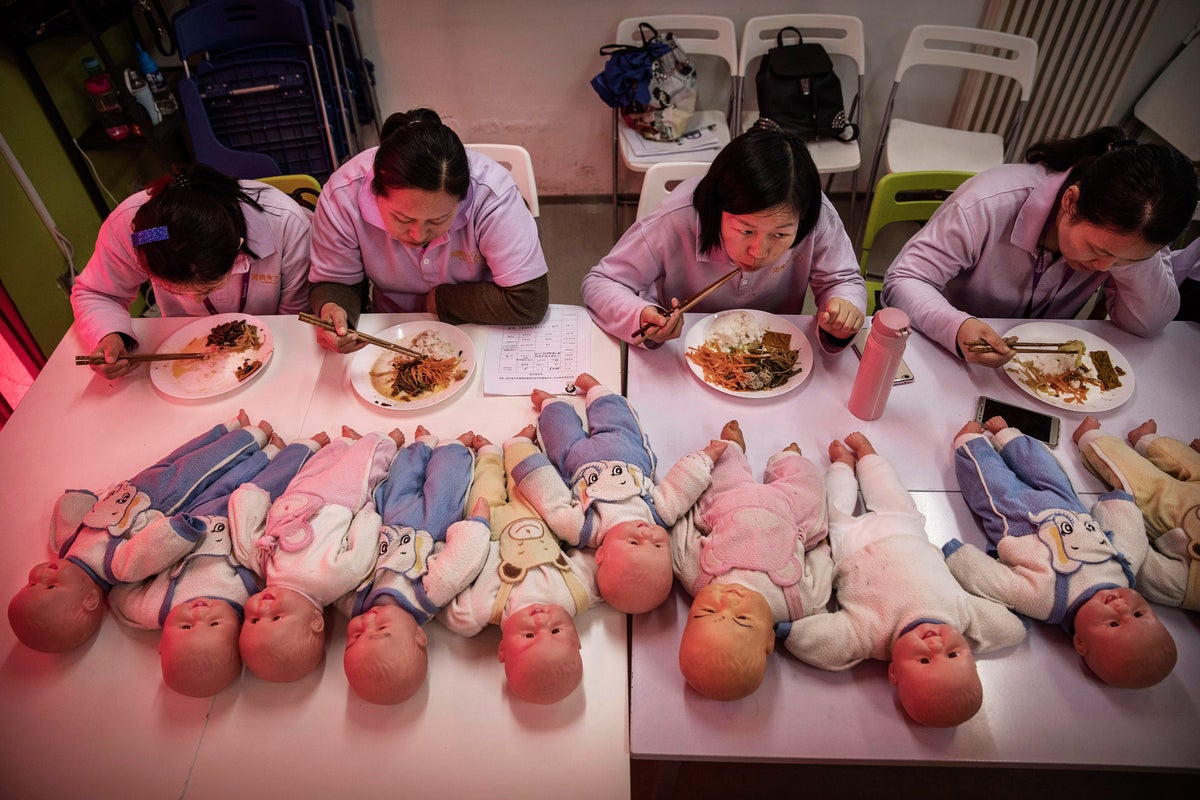
China aims to build ‘fertility-friendly society’ as birth rate plummets for fourth year

Read the original at The Independent ↗
Cite

Zhang, Y., & Chen, X. (2026, October 23). China aims to build ‘fertility-friendly society’ as birth rate plummets for fourth year. The Independent. https://www.independent.co.uk/asia/china/china-one-child-policy-birth-rates-population-b3072359.html

Dated from the outlet's own feed. Check the original for its byline.

The Independent · collected 2026-10-23 · by Yukun Zhang, Xiuhao Chen

Quick Summary

China’s State Council has pledged to create a “fertility-friendly society” amid concerns over declining birth rates, which fell for the fourth consecutive year in 2025. The council also noted a 7.5% decrease in marriage registrations in the first half of 2026 compared to the same period in 2025. At a meeting on October 23, policymakers vowed to support families through tax incentives and improvements in social security and housing to encourage childbearing and alleviate concerns about an ageing population’s impact on the economy and social insurance systems.
Written locally by qwen2.5:14b on 2026-10-23, using this article's own text rather than the other coverage of the same event (that is the story summary below).

AI analysis runs on qwen2.5:14b, locally

Story summary

China’s State Council pledged to build a “fertility-friendly society” with policies supporting marriage, childbirth, and childrearing at a meeting on October 23, 2026. The country’s birth rate fell for the fourth consecutive year in 2025 to a record low, raising fears about strain on its social insurance system due to fewer babies being born each year. Additionally, marriage registrations dropped by 7.5% in the first half of 2026 compared to the same period last year. To address these issues, the council called for optimizing tax, social security, and housing policies to encourage families to have children, echoing efforts to reform a decades-long household registration system so that migrant workers can access urban public services like enrolling their children in city schools.

Written for “China's Fertility Policy Update” on 2026-10-23, grounded in this article and the 0 other(s) covering the same event.
Why this leaning score
This article does not take a side on a contested political question, so it has no leaning score. That is an answer rather than a gap: a match report or a rescue can be warmly or critically written without being left or right, and scoring it anyway is how approval of a subject gets recorded as a political position.
No political leaning scored for article 102254 · logged 2026-10-23

Story

📰 China's Fertility Policy Update
Politics · 1 article(s) covering the same event.

Compared with similar articles

Nothing to compare against. No article is close enough to this one for the pipeline to have linked or judged the pair.
How this article was measured signals, leaning charts, publisher record, byline, topics and claims

Signals How these are calculated →

Claims extracted
13
sentences that state something as happening or true
Uncertain
38%
5 of 13 hedged ("reportedly", "may", "according to")
Leaning
not political
takes no side on a contested political question
Publisher signals
59/100
The Independent's corrections and hedging, across everything collected from it. Not a measure of accuracy.
Outlets on this story
1
Politics
Same framing elsewhere
1
articles that frame the event the way this one does
Analyzed 2026-10-23 · how these are computed

How this is being covered How these are calculated →

Article leaning vs. publisher reliability
Source leaning vs. consistency

Publisher

The Independent · 2944 article(s) · 6 correction(s) detected
Running correction rate · 6 correction(s)

Who wrote this

Yukun Zhang
1 article(s) here · 1 carrying a prediction
🔮 Amid a backdrop of plummeting birth rates and marriage registrations, there are fears the world’s second-most populous nation will see huge strain placed on its social insurance system with fewer babies being born each year.
The only article under this byline in the corpus.
Xiuhao Chen
1 article(s) here · 1 carrying a prediction
🔮 Amid a backdrop of plummeting birth rates and marriage registrations, there are fears the world’s second-most populous nation will see huge strain placed on its social insurance system with fewer babies being born each year.
The only article under this byline in the corpus.

Topics

China Independent State Council The State Council's

Subjects

China GPE · 5× State Council ORG · 2× Deng Xiaoping PERSON · 1× Independent NORP · 1× The State Council's ORG · 1×

Narrative

The cabinet meeting also called for making basic public services more equal, echoing the government's moves to reform a decades-long household registration system so that workers who migrated from rural farms to cities can access more urban public services, including enrolling their children in public schools in the city.
framing: mixed · carried by 1 article(s) · first seen 2026-10-23
🔮 Amid a backdrop of plummeting birth rates and marriage registrations, there are fears the world’s second-most populous nation will see huge strain placed on its social insurance system with fewer babies being born each year.

Claims (13 extracted, 5 hedged)

China should build a “fertility-friendly society” with policies supporting marriage, childbirth and childrearing, the country’s State Council has pledged. asserted
Council → build → marriage
Amid a backdrop of plummeting birth rates and marriage registrations, there are fears the world’s second-most populous nation will see huge strain placed on its social insurance system with fewer babies being born each year. asserted
babies → plummet → system
At a State Council meeting today (October 23), policymakers vowed to offer more support to families to stabilise the birth rate, which in 2025 fell for the fourth consecutive year to a record low. asserted
which → vow → low
The number of marriage registrations also dropped by about 7.5% in the first half of 2026 compared with the same period last year, according to official data. uncertain
number → drop → data
The government should focus on optimising tax, social security and housing to encourage couples to have families, the council body said, according to a readout aired by state television. uncertain
body → focus → television
The State Council's pledges are a sign that policymakers are concerned about the strain a shrinking and ageing population could put on the country's social insurance system and overall economic growth, which has been weighed down by weak domestic consumer demand. uncertain
which → shrink → demand
"Population is the foundational condition for economic and social development," officials said in the meeting, calling for efforts so that "high-quality population development" could better support "high-quality economic and social development." Authorities have in recent years stepped up fiscal support for boosting births, including rolling out a nationwide childcare subsidy programme and waiving or cutting pre-school tuition fees. They have also vowed to foster "positive attitudes towards marriage and childbearing". uncertain
They → say → marriage
The cabinet meeting also called for making basic public services more equal, echoing the government's moves to reform a decades-long household registration system so that workers who migrated from rural farms to cities can access more urban public services, including enrolling their children in public schools in the city. asserted
who → call → city
For decades, China’s strict one-child policy attempted to curb extreme population growth by limiting families to just one baby. asserted
policy → attempt → baby
It was brought in by Deng Xiaoping in 1980 after China’s population exploded from 540 million in 1949 to around 969 million. asserted
population → bring → million
The policy was credited for being a key factor in China’s economic boom in the last 20th century, but was often cruelly enforced, with punishments for violators scoping from hefty fines to forcible abortions and brutal sterilisation of mothers. asserted
policy → credit → mothers
It also skewed towards more boys being born than girls, with widespread sex-selective abortions and female infanticide both in rural areas and in China’s cities. asserted
It → skew → cities
While the one-child policy officially ended in January 2016 in favour of a two-child cap - which was lifted to three children in May 2021 - in 2025, just 7.92 million babies were born, a 17% decrease from the previous year. uncertain
babies → end → decrease

💬Give feedback
🕘History 🎫Support