That is 0 articles you have read today.
The Aporia is free and carries no advertising, so readers are the only
thing paying for it. If you are getting this much out of it, a small
donation is what keeps it independent.
Daily limit reached
You have read 0 articles today.
That is more than the 15 a day The Aporia gives away,
and well past what it can carry on nothing. Your allowance resets at
midnight.
There is no advertising here and nothing about you is sold, so readers
are the only thing paying for it. If the site is worth this much of
your day, it is worth a few dollars.
Everything else stays open: the
maps, the
directory and
search do
not count against this, and neither does re-opening something you have
already read today.
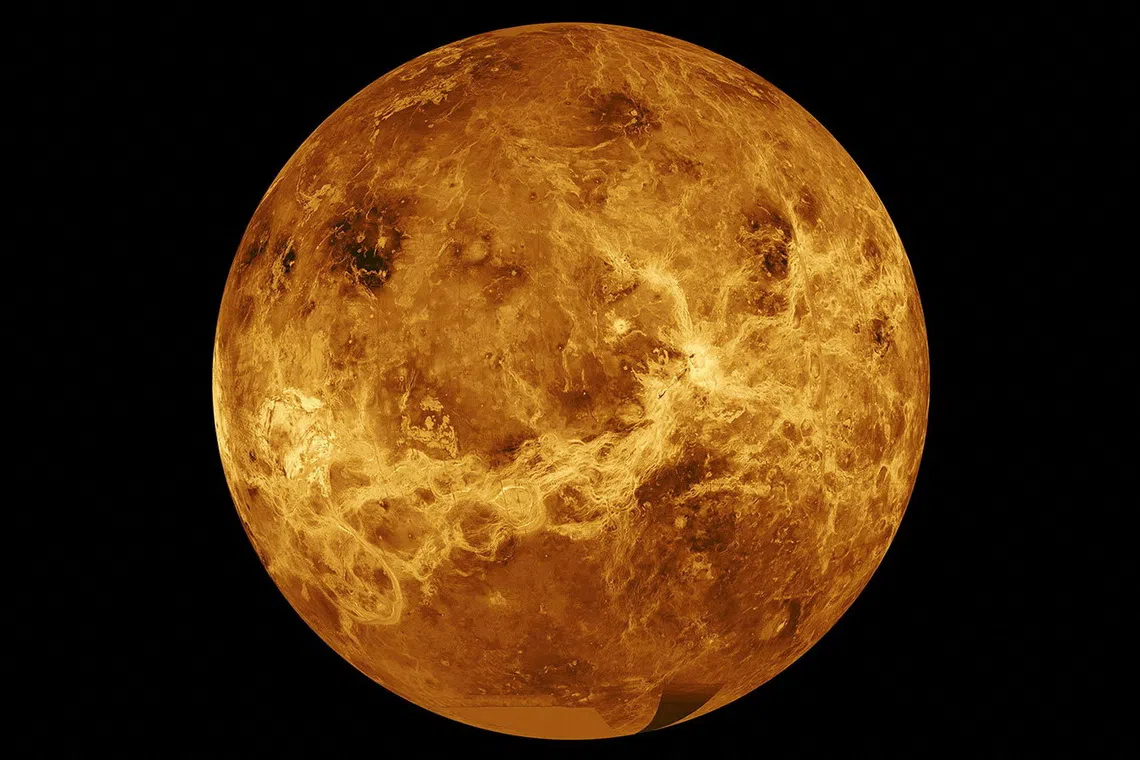
A study published on September 14 by astrophysicists at the University of California, Riverside, suggests that Venus may have once had a moon that eventually crashed into the planet due to its extremely slow rotation speed. Stephen Kane, the lead author, argues this theory based on computer models showing hypothetical moons spiraling inward and colliding with Venus within about a billion years after the planet's formation. This contrasts with previous theories proposing either the absence of lunar formation or destruction by an impact event.
Written by the local model on 2026-09-15,
using this article's own text rather than the other coverage of the
same event (that is the story summary below).
Story summary
A new astrophysics study published on September 14 suggests that Venus, often called Earth's twin due to its similar size, mass, and structure, might have once had a moon but lost it through celestial "cannibalism." Scientists at the University of California, Riverside propose that Venus’s extremely slow rotation speed would have caused any moon orbiting it to spiral inward over time, eventually colliding with the planet. According to astrophysicist Stephen Krane, lead author of the study in The Astrophysical Journal, computer models based on planetary physics indicate all hypothetical moons around Venus meet this fate sooner or later. This theory challenges previous explanations for why Venus lacks a moon and provides new insights into the dynamics of planetary bodies in our solar system.
Written for “Venus Moon Mystery” on 2026-09-17,
grounded in this article and the 0 other(s) covering the same event.
Why this leaning score
This article does not take a side on a contested political
question, so it has no leaning score. That is an
answer rather than a gap: a match report or a rescue can be warmly
or critically written without being left or right, and scoring it
anyway is how approval of a subject gets recorded as a political
position.
No political leaning scored for article 10149 · logged 2026-09-15
Astrophysics study suggests Venus may have swallowed its moon
AI generated
uncertain
Venus → suggest → moon
A California-based astrophysicist presented a new theory on Sept 14 to explain why Venus, the planet most like Earth in size, mass and structure, lacks its own moon.
asserted
Venus → base → moon
The extremely slow speed at which Venus rotates on its axis would have doomed any natural satellite that may once have orbited that planet to gradually spiral closer to its parent and ultimately be consumed in a cataclysmic smash-up.
uncertain
that → rotate → up
So goes the theory offered by scientists at the University of California, Riverside, and published on Sept 14 in The Astrophysical Journal, marking a departure from past explanations for why Venus, the second planet from the sun, is without a lunar companion.
“If it had a moon, and it likely did at some point, it could not have kept it,” astrophysicist Stephen Krane, lead author of the study, told Reuters.
uncertain
Krane → go → Reuters
“That moon would have crashed down on the planet in a relatively short time scale.
asserted
moon → crash → scale
Krane said data from computer models based on planetary physics and simulating the gravitational mechanics of hypothetical Venusian moons of various sizes showed them all meeting the same fate – sooner or later collapsing into their mother planet.
asserted
them → say → planet
Such a presumed moon-gobbling event likely occurred within the first billion years in the history of Venus, which like the rest of the solar system dates back about 4.5 billion years, Krane said.
asserted
Krane → presume → system
Scientists previously theorised that Venus, known as Earth’s “twin”, either never acquired its own moon to begin with, or possibly had a moon that was obliterated in the massive impact from another celestial object.
uncertain
that → theorise → object
Earth spins more swiftly than Venus
asserted
Earth → spin → Venus
The UC Riverside study, focusing on Earth-moon dynamics, found that planetary rotational speed was the key factor.
asserted
speed → focus → dynamics
In contrast to Venus, which takes 243 Earth days to complete a single rotation – slightly longer than its orbit around the sun – Earth spins on its axis every 24 hours, more than two hundred times more rapidly than Venus, Krane said.
asserted
Krane → take → Venus
The transfer of energy from Earth’s faster rotation is gradually pushing our moon farther away, causing it to recede from Earth at the rate of 4cm a year – precisely measured by mirrors left on the lunar surface in 1969 by Apollo 11‘s astronauts.
asserted
it → push → astronauts
Venus, the third brightest object in the night sky after the sun and moon, looms large as point of study for scientists seeking to learn more about Earth’s history, and its future.
asserted
Venus → loom → history
Similar in its rocky structure but slightly smaller than Earth, Venus is enveloped in a thick, toxic atmosphere that has created a runaway greenhouse effect, scorching its surface at temperatures as high as 471 deg C, hot enough to melt lead.
asserted
that → envelop → lead
While there is no proof a Venusian moon ever existed, it is unlikely that Venus, in its infancy, somehow avoided the kind of world-shattering collision with another proto-planet that is widely believed to have formed Earth’s moon, according to Krane.
uncertain
that → be → Krane
The dawn of the inner solar system was crowded with large rocky objects hurtling through space and smashing into one another, with Venus probably taking more celestial hits than Earth because Venus was closer to the sun.
asserted
Venus → crowd → sun
Scientists hope to unlock more secrets of Venus with two forthcoming NASA missions set for launch in the late 2020s or early 2030 dubbed DAVINCI+ and VERITAS to study the planet’s atmosphere and geologic features.
asserted
Scientists → hope → atmosphere
 The Aporia