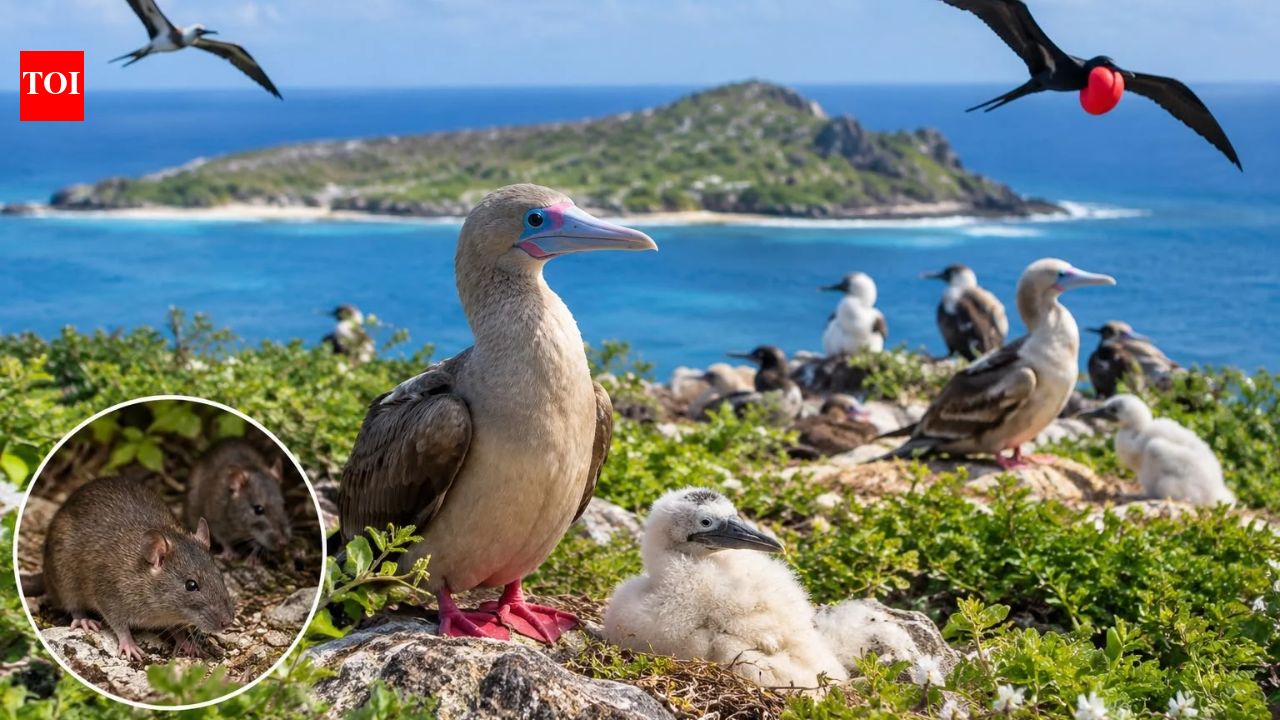
A Pacific island has recorded a significant recovery in several seabird populations following the removal of invasive rats in 2005.
asserted
island → record → 2005
A
study published in Conservation Biology examined how seven seabird species responded after rodents were eradicated from Surprise Island in New Caledonia.
asserted
rodents → publish → Caledonia
According to the researchers, three species experienced substantial population increases, with their breeding populations eventually reaching between two and ten times their earlier levels.
uncertain
populations → accord → levels
The findings also revealed that recovery did not happen immediately for every species.
asserted
recovery → reveal → species
While some seabirds increased within a few years, others showed improvements only after longer periods of monitoring, highlighting the importance of sustained conservation efforts.
asserted
others → increase → efforts
Why invasive rats threatened seabirds
Surprise Island is a small, uninhabited island in the Pacific, covering approximately 24 hectares.
asserted
Island → threaten → hectares
Before the eradication programme, it was home to invasive black rats and house mice, which posed a threat to nesting seabirds.
asserted
which → pose → seabirds
Rodents can prey on eggs and chicks, reducing the number of young birds that survive to adulthood.
asserted
that → prey → adulthood
On islands where seabirds nest on the ground or in accessible locations, these introduced predators can have particularly damaging effects.
asserted
predators → nest → effects
Native birds may have evolved without such predators and may lack effective defences against them.
uncertain
birds → evolve → them
In 2005, conservationists eliminated the invasive rodents from Surprise Island.
asserted
conservationists → eliminate → Island
The eradication was confirmed as successful in 2006.
asserted
eradication → confirm → 2006
Researchers subsequently examined whether removing the predators helped seabird populations recover and whether the benefits differed between species.
asserted
benefits → examine → species
Scientists tracked seven seabird species
asserted
Scientists → track → species
The research team monitored seven seabird species, including red-footed boobies, brown boobies, masked boobies, noddies and frigatebirds.
asserted
team → monitor → boobies
Their analysis combined surveys conducted before and after the eradication with observations collected over subsequent years.
asserted
analysis → combine → years
Annual surveys between 2002 and 2009 provided information about breeding populations before and shortly after the rodents were removed.
asserted
rodents → provide → populations
Researchers also used earlier observations from 1995 and 1996 and later surveys conducted between 2017 and 2021.
asserted
Researchers → use → 2017
Rather than simply counting birds flying over the island, the team recorded active nests containing adults, eggs or chicks to estimate the number of breeding pairs.
asserted
team → count → pairs
This approach helped them assess whether the seabirds were establishing and maintaining breeding populations.
asserted
seabirds → help → populations
Some responded relatively quickly, while others took considerably longer to show clear signs of recovery.
asserted
others → respond → recovery
Noddies and frigatebirds increased after eradication
Noddies and frigatebirds were among the species that showed relatively early improvements after the invasive rodents disappeared.
asserted
rodents → increase → improvements
Their breeding populations increased within four years of eradication, suggesting that the island had become a more favourable place for nesting.
asserted
island → increase → nesting
Researchers estimated that the island supported around 400 breeding pairs in 1995.
asserted
island → estimate → 1995
By 2021, the estimated number had reached 5,346 pairs, representing approximately a tenfold increase.
asserted
number → estimate → increase
Frigatebirds also experienced substantial growth.
asserted
Frigatebirds → experience → growth
Researchers recorded 1,586 breeding pairs in October 2017, compared with 398 pairs estimated in December 1996.
asserted
Researchers → record → December
The researchers suggested that birds arriving from nearby islands may have contributed to these increases.
uncertain
birds → suggest → increases
With invasive rodents no longer threatening their eggs and chicks, Surprise Island could provide safer nesting opportunities for seabirds looking to establish new breeding sites.
uncertain
Island → threaten → sites
Red-footed boobies showed delayed recovery
asserted
boobies → show → recovery
Red-footed boobies responded differently.
asserted
boobies → respond → ?
During the first four years after eradication, researchers did not observe a clear increase in their breeding population.
asserted
researchers → observe → population
This showed why short-term surveys alone may not provide a complete picture of the effects of conservation work.
uncertain
surveys → show → work
Later observations revealed stronger growth.
asserted
observations → reveal → growth
The estimated number of breeding pairs reached 4,698 in 2017 and 5,548 in 2019, before declining to 3,256 in 2021.
asserted
number → estimate → 2021
Before the rodents were removed, the estimated population had never exceeded 2,883 pairs.
asserted
population → remove → pairs
The delayed increase may be linked to the birds’ breeding biology.
uncertain
increase → delay → biology
Long-lived seabirds often take several years to mature, so improvements in breeding success may take time to translate into a larger adult population.
uncertain
improvements → take → population
However, not every species showed a clear long-term increase.
asserted
species → show → increase
Brown and masked boobies did not experience the same measurable recovery, indicating that removing invasive predators does not guarantee identical results for all seabirds.
asserted
removing → experience → seabirds
…and 6 more, not listed.
 The Aporia