Photo via Al Jazeera

Syria fuel price hikes test public patience with economic recovery

Read the original at Al Jazeera ↗
Cite

Salhani, J. (2026, September 14). Syria fuel price hikes test public patience with economic recovery. Al Jazeera. https://www.aljazeera.com/features/2026/9/14/syria-fuel-price-hikes-test-public-patience-with-economic-recovery?traffic_source=rss

Dated when The Aporia collected the article, usually within hours of publication. Check the original for its exact date and byline.

Al Jazeera · collected 2026-09-14 · by Justin Salhani

Quick Summary

Protests have erupted across Syrian cities as residents respond to government-imposed fuel price hikes, with diesel prices increasing by 40%, petrol by at least 25%, and cooking gas by nine percent. These protests follow months of mounting public discontent over rising energy costs and broader economic hardships since the regime change in December 2024. The Syrian government defends the measures as temporary, attributing them to global supply issues stemming from conflicts involving Iran and Yemen, while also facing parliamentary pressure to address the crisis.
Written by AI on 2026-09-14, from this article's own text only (the story summary below draws on all the coverage).
See how they differ ↓

AI analysis

Story summary

On September 14, Syria experienced widespread protests triggered by significant fuel price hikes announced by the government on Saturday night. Diesel prices increased by 40% to 175 Syrian pounds ($1.32) per liter, while other fuels saw rises ranging from 25% to 28%. The hikes added pressure to an already struggling economy where 90% of Syrians live below the poverty line, exacerbated by years of civil war and international sanctions. Protesters in cities like Damascus, Aleppo, and Idlib blocked key roads and oil tanker routes, demanding lower fuel prices and calling for the dismissal of energy officials. The Syrian parliament has summoned the Energy Minister to explain the price increases during a hearing scheduled for Thursday, indicating growing political concern over public dissatisfaction.

Written for “Syria Fuel Price Protests” on 2026-11-20, grounded in this article and the 3 other(s) covering the same event.

How they differ

3 outlets covered “Syria Fuel Price Protests”.

What each outlet says

One AI summary per outlet of its latest article on this story, written from that article alone and checked against it. Open the article for the outlet's own words.

Al JazeeraThis outlet14 Sep

Protests have erupted across Syrian cities as residents respond to government-imposed fuel price hikes, with diesel prices increasing by 40%, petrol by at least 25%, and cooking gas by nine percent. These protests follow months of mounting public discontent over rising energy costs and broader economic hardships since the regime change in December 2024. The Syrian government defends the measures as temporary…

Syria fuel price hikes test public patience with economic recovery (this article)2 articles from Al Jazeera on this story
The Straits Times14 Sep

Fuel price hikes in Syria have led to widespread protests across the country, marking the largest demonstrations since President Bashar al-Assad's rule began two years ago. Diesel prices were increased by 40% on Saturday, reaching 175 Syrian pounds ($1.32) per liter, causing citizens to block major roads and demand lower fuel costs despite government claims that price increases are due to global procurement costs…

Syria fuel price hikes trigger widest protests since Assad fall →
Euronews14 Sep

Fuel prices in Syria increased by 25% to 40%, leading to protests in six provinces where demonstrators blocked roads and oil tanker routes on consecutive days. Over 50 members of the People's Assembly signed a request demanding that Energy Minister Mohammed al-Bashir appear before parliament for questioning regarding the price hikes, with the hearing scheduled for Thursday at noon local time. The price increases…

Fuel price protests spread across Syria as parliament summons energy minister →

Where they agree and split

Framing

How the first headlines put it

Stated as fact3
The headlines (3)

Syria fuel price hikes trigger widest protests since Assad fall The Straits Times · stated as fact

Fuel price protests spread across Syria as parliament summons energy minister Euronews · stated as fact

Syria fuel price hikes test public patience with economic recovery Al Jazeera · stated as fact

The full story: what happened, how it changed, and all 4 articles →

Compared with similar articles

This article reads leans left and hedges 5% of its claims. Each row says how that neighbour differs.
Al Jazeera
Leans left Hedges 2 of 50 claims Outlet record 60/100
The Straits Times
Leans left Hedges 1 of 22 claims Outlet record 64/100
NPR
Leans right further right than this Hedges 2 of 24 claims Outlet record 60/100
“The articles discuss different events in distinct locations: Yemen for Houthis' territorial gains and Syria for fuel price protests.”
Euronews
Leans left Hedges 2 of 21 claims Outlet record 60/100
ABC News (US)
Hedges 0 of 1 claims Outlet record 67/100
“The articles describe different events: one covers protests in Syria over fuel price hikes, while the other discusses oil price increases due to attacks on shipping routes.”
Toronto Star
Leans left Hedges 0 of 37 claims Outlet record 64/100
“The articles cover protests related to fuel price hikes, but they describe different locations and timing with ARTICLE A focusing on multiple Syrian cities and towns starting Sunday while ARTICLE B focuses specifically on the Kurdish northeast near Tal Tamr on Wednesday.”

Story

Syria Fuel Price Protests
Politics · 4 article(s) covering the same event. Compare every outlet's account →
How this article was measured signals, leaning charts, publisher record, byline, topics and claims

Signals How these are calculated →

Claims extracted
38
sentences that state something as happening or true
Uncertain
5%
2 of 38 hedged ("reportedly", "may", "according to")
Leaning
Leans left
of the writing, not the subject · beta estimate
Publisher signals
60/100
Al Jazeera's corrections and hedging, across everything collected from it. Not a measure of accuracy.
Outlets on this story
4
Politics
Same framing elsewhere
1
articles that frame the event the way this one does
Analyzed 2026-09-14 · how these are computed

How this is being covered How these are calculated →

Article leaning vs. publisher reliability
Source leaning vs. consistency

Publisher

Al Jazeera · 6131 article(s) · 4 correction(s) detected
Running correction rate · 4 correction(s)

Who wrote this

Justin Salhani
13 article(s) here · 1 carrying a prediction
Iraq’s Prime Minister Ali al-Zaidi is set to visit Lebanon on his latest regional visit aimed at boosting economic cooperation amid the fallout from the US-Israel war on Iran.
Lebanon’s second airport is scheduled to begin operating test flights on Independence Day, November 22, in what experts and analysts say could prove to be a boon to the country after years of war and an economic collapse.
Recommended Stories list of 3 items- list 1 of 3‘Greater Israel’: Christian Zionism’s role in US policy - list 2 of 3US election results could be positive for Lebanon, Hezbollah chief says - list 3 of 3More
“The Syrian role would probably count for more in Riyadh than on Yemen’s front lines because it would show that the new Syria can share a partner’s security burden,” Nanar Hawach, a Syrian analyst, told Al Jazeera, adding that even a training and support role from the Syrian government rather than a direct combat role would satisfy Riyadh. “The reports and the denials can both be partly right since Syrian officers training Yemeni forces inside the kingdom is different from Syrian troops fighting in Yemen.
When a government led by reformists took control in early 2025, there was hope that the situation would improve.
Recommended Stories list of 3 items- list 1 of 3Hezbollah funding plan indicates a new challenge to Lebanon’s government - list 2 of 3Lebanese sceptical Israeli polls will bring change, end occupation of south - list 3 of 3How to stop the US-Israel war on Iran
“If people feel Damascus is more concerned with protecting the relationship with the Jordanians than accountability, some of the anger could turn inward.”
“Along its line in Quneitra and Daraa [areas of southern Syria that Israel has invaded], Israel treats neighbouring communities differently, reviving wartime grievances between Syrians that any future Syria-Israel arrangement would struggle to undo.”
As Israel’s October 27 election nears, so does the possibility that the government that has overseen the invasion and reoccupation of southern Lebanon could be deposed.
Last week, Hezbollah announced it would provide financial support to families in Lebanon who had lost their homes in the latest war with Israel.
Also by Justin Salhani
Nothing else under this byline is closely related to this article, so these are simply their most recent.
All 13 articles by Justin Salhani →

Topics

Houthi Syria Syrian Syrians the Mecca Pact

Subjects

Syria GPE · 9× Syrian NORP · 6× Syrians NORP · 3× Al Jazeera ORG · 2× Bashar al-Assad PERSON · 1× Energy ORG · 1× Houthi NORP · 1× Iran GPE · 1× Mohammed al-Bashir PERSON · 1× Yemen GPE · 1×

Narrative

Still, after a July visit, the International Monetary Fund recommended that the Syrian government collect more revenue and be more selective about what it spends money on “to create the fiscal space needed to create room for development spending and to enhance the social safety net to protect the most vulnerable segments of the population”.
framing: assertive · carried by 1 article(s) · first seen 2026-09-14
Recommended Stories list of 3 items- list 1 of 3Protests break out across Syria over fuel price increases - list 2 of 3Will the Houthi attacks activate the Mecca Pact? - list 3 of 3At least seven killed in fire at prison in northern Syria
2026-09-14 · Al Jazeera
Syria fuel price hikes test public patience with economic recovery · assertive framing

Claims (38 extracted, 2 hedged)

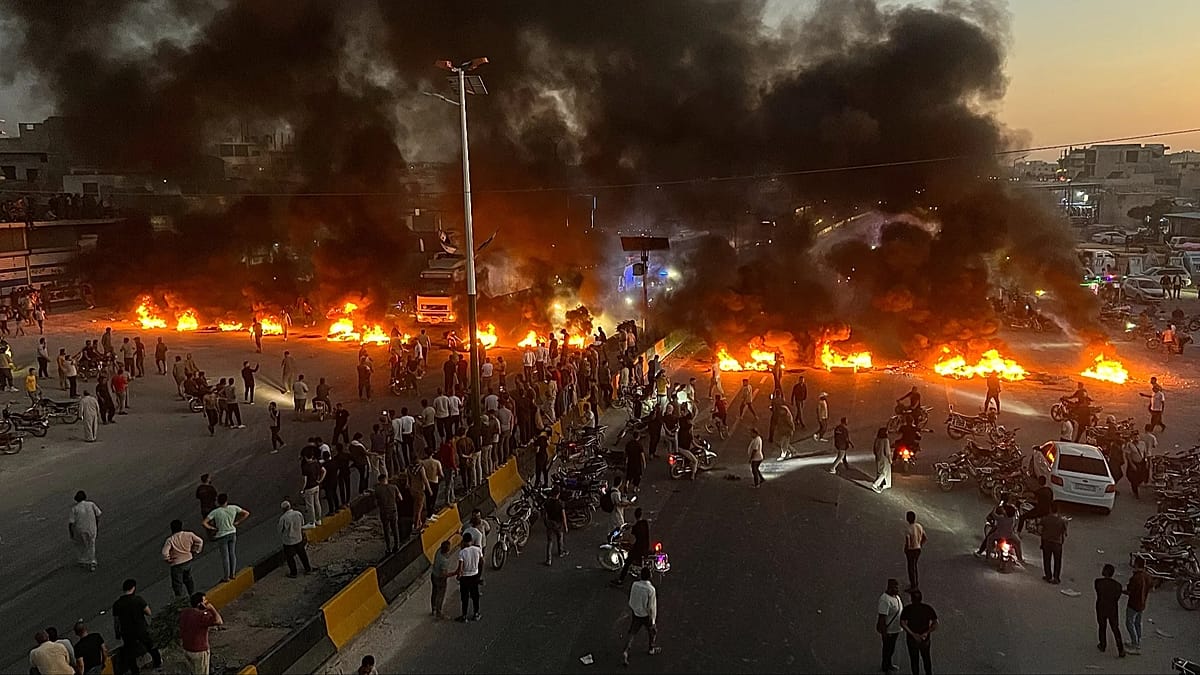
The sight of protesters blocking roads and burning tyres on the streets of several Syrian cities and towns has highlighted popular anger over a government decision to increase fuel prices and a wider cost-of-living crisis. asserted
protesters → block → living
The protests, which erupted on Sunday, come after months of complaints about soaring energy costs and criticisms that the lives of many Syrians have not improved since the fall of former Syrian leader Bashar al-Assad’s regime in December 2024. asserted
lives → erupt → December
Recommended Stories list of 3 items- list 1 of 3Protests break out across Syria over fuel price increases - list 2 of 3Will the Houthi attacks activate the Mecca Pact? - list 3 of 3At least seven killed in fire at prison in northern Syria asserted
seven → break → Syria
The Syrian government has defended its efforts, arguing that it will take time to overcome decades of economic stagnation and international isolation. asserted
it → defend → stagnation
The trigger for Sunday’s protests was a government announcement that diesel prices would rise by 40 percent, petrol by at least 25 percent and cooking gas around nine percent. asserted
prices → rise → percent
The government said the increases were temporary and caused by a spike in refined petroleum products following the US-Israeli war on Iran and renewed hostilities in Yemen. asserted
increases → say → Yemen
However, the Syrian parliament has summoned Energy Minister Mohammed al-Bashir for a hearing on rising fuel costs, a sign that officials were concerned by the public outcry. asserted
officials → summon → outcry
Public anger When anti-regime forces overthrew al-Assad’s government, much of the country erupted in celebration. asserted
much → overthrow → celebration
It came after more than a decade of war and the 50-year rule of the al-Assad family, which had led to international sanctions on the country. asserted
which → come → country
Aside from expectations that freedoms would increase after the fall of the regime, which operated as a police state, many Syrians also hoped the country’s dire economic conditions would improve. asserted
conditions → increase → state
That has been a tough task for the new Syrian government, led by President Ahmed al-Sharaa. asserted
That → lead → Sharaa
Since coming to power 21 months ago, the government has focussed on securing international legitimacy and lifting the complex network of sanctions placed on Syria. asserted
government → come → Syria
In August, Syria was removed from the US state sponsors of terrorism list, building on earlier decisions to lift sanctions by the US, the European Union and other world powers. asserted
Syria → remove → US
This allowed for Syria to be reintegrated into the world economy and receive increased foreign investment. asserted
Syria → allow → investment
There has been optimism in Syria, but while the government insists that the positive impact of the removal of sanctions and other government actions will take time, patience has run out for some. asserted
patience → insist → some
“Fuel itself is not an isolated energy issue right now; it’s related to the cost of living crisis for every household and business in Syria,” Vittorio Maresca di Serracapriola, sanctions lead analyst at Karam Shaar Advisory, told Al Jazeera. asserted
it → relate → Jazeera
“The anger right now reflects a deeper concern that the recovery stemming from the sanctions relief and Syria’s gradual reconnection with the global financial system is not yet translating into affordable [prices].” asserted
recovery → reflect → prices
“The protests show that Syrians increasingly hold their own government responsible for what they pay,” Nanar Hawach, a Syrian political analyst, told Al Jazeera. asserted
Hawach → show → Jazeera
“Sanctions relief weakened the argument that hardship comes from outside and raised expectations at the same time. asserted
hardship → weaken → time
Much of the anger is also coming from areas that backed the change of government, making this the kind of discontent a government can answer only with results.” asserted
government → come → results
Syria’s poverty rate is around 90 percent, according to the UN’s World Food Programme. uncertain
rate → accord → Programme
The rise in fuel costs has a universal impact, affecting the price of transport but also food and other services. asserted
rise → have → transport
“A 40 percent diesel hike is not just inconvenient; it is really a threat to [people’s] economic survival on a daily basis,” Maresca di Serracapriola said. asserted
Serracapriola → say → basis
Syria remains highly dependent on energy imports. asserted
Syria → remain → imports
The country produces around 102,000 barrels of oil per day, compared with domestic needs of around 325,000 barrels per day, al-Bashir said. asserted
Bashir → produce → day
Syria refines some of its crude domestically but its refineries cannot produce enough petroleum products to meet demands, forcing it to import substantial quantities of diesel, petrol and other fuels. asserted
refineries → refine → diesel
The Syrian government said it was working on an overhaul of the Baniyas refinery – the country’s largest – in the hope that it will raise processing capacity at the facility from around 80,000 to 130,000 barrels per day. asserted
it → say → day
Meanwhile, the Ministry of Energy said prices would continue to be reviewed as global market conditions change. asserted
conditions → say → Energy
It also said it would work over the long term to expand refining and storage capacity. asserted
it → say → capacity
Authorities will now look for ways to temper public anger. asserted
Authorities → look → anger
Hawach suggested a “protected diesel price for public transport and farmers”, as well as the government announcing dates for when temporary price increases would end. uncertain
increases → suggest → dates
“[This] would likely cost the treasury less than the concessions it has tended to make after protesters block roads, and would give people a reason to wait rather than take to the streets,” he said. asserted
he → cost → streets
The protests have come about as the Syrian government attempts to rebuild the country after a war that devastated much of the country and killed hundreds of thousands of people. asserted
that → come → people
Sanctions removal has borne some fruit: the World Bank approved around $491m in grants to Syria to support infrastructure and economic development since last year. asserted
Bank → bear → year
Still, after a July visit, the International Monetary Fund recommended that the Syrian government collect more revenue and be more selective about what it spends money on “to create the fiscal space needed to create room for development spending and to enhance the social safety net to protect the most vulnerable segments of the population”. asserted
it → recommend → population
So far, the government has benefited from a degree of patience among Syrians. asserted
government → benefit → Syrians
But despite the progress made over the past year, that patience is beginning to wear thin – particularly among the country’s most vulnerable, who have yet to feel the benefits of economic growth. asserted
who → make → growth
“The question is whether this whole process of recovery will translate into credible relief for households, workers, small businesses and farmers facing the knock-on effects of inflation and higher energy prices,” Maresca di Serracapriola said. asserted
Serracapriola → translate → inflation
Give feedback · no sign-in needed

No sign-in needed for now. Your note is sent without a name, so it cannot be answered.

History Support