Photo via Dawn

Japan to launch historic round-trip mission to Mars moon

Read the original at Dawn ↗
Cite

AFP. (2026, October 18). Japan to launch historic round-trip mission to Mars moon. Dawn. https://www.dawn.com/news/2038006/japan-to-launch-historic-round-trip-mission-to-mars-moon

Dated from the outlet's own feed. Check the original for its byline.

Dawn · collected 2026-10-18 · by AFP

Quick Summary

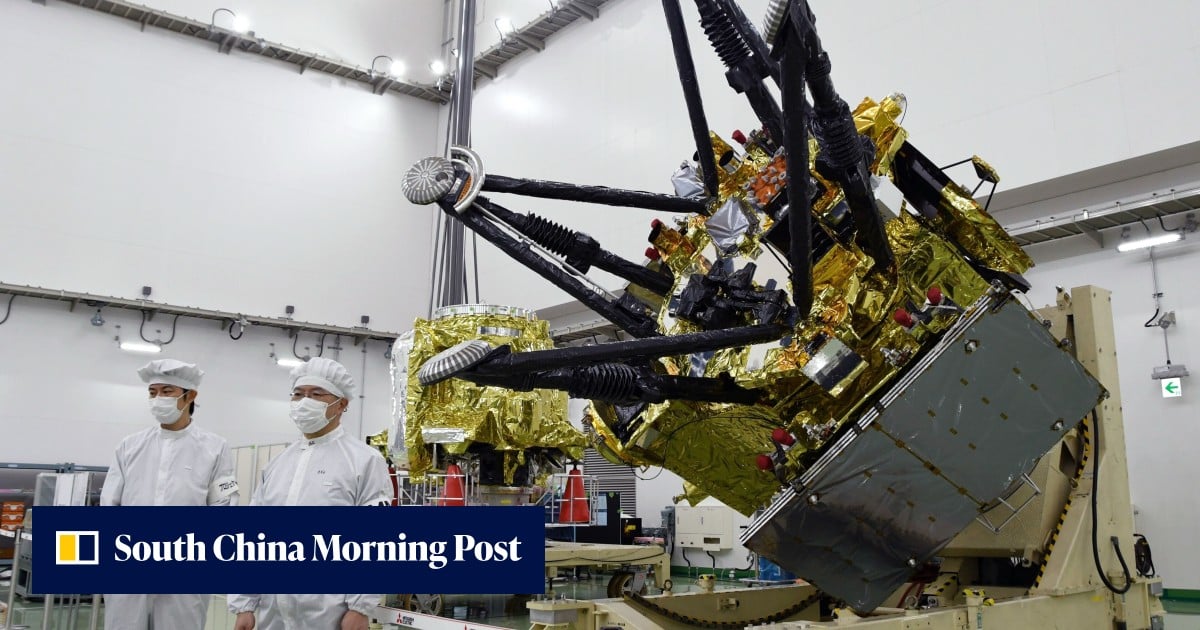
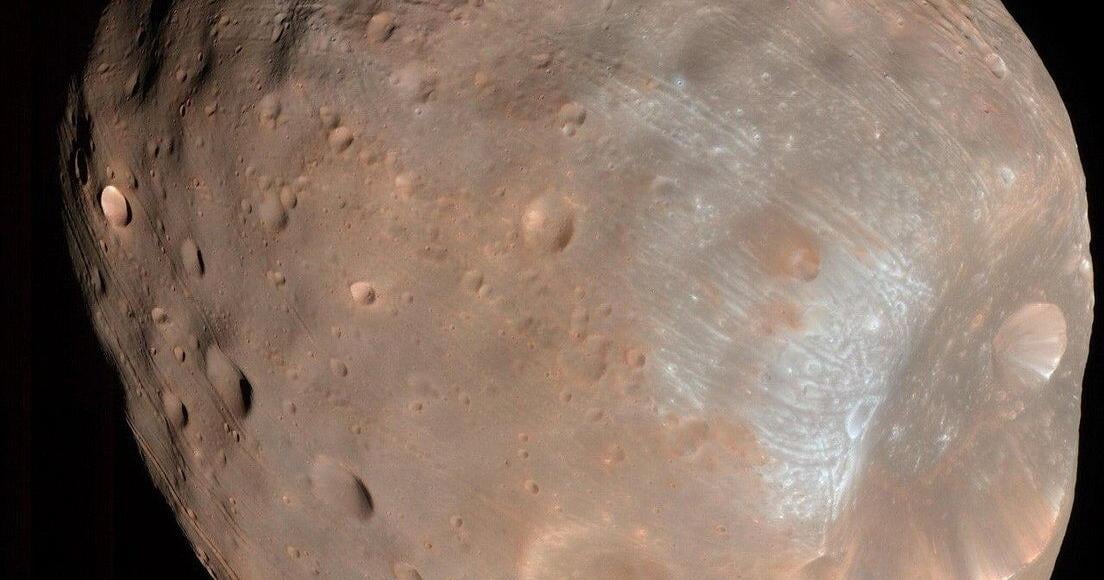
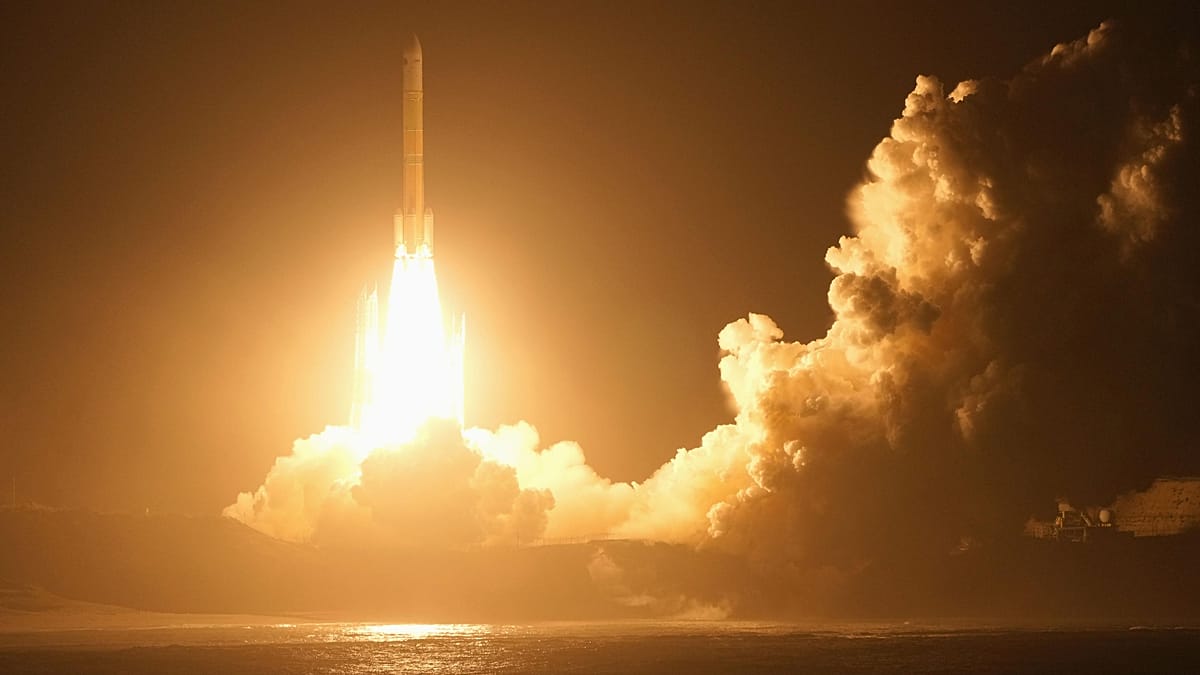
Japanese scientists are launching a mission to Mars's moons Phobos and Deimos using an unmanned probe called Martian Moons eXploration (MMX). Set to launch from Tanegashima Space Centre on Tuesday at 4:41 am local time, the MMX will orbit Phobos for up to three years before landing and collecting at least 10 grams of surface material. The mission aims to determine the origin of Mars's moons and explore their potential as stepping stones for human exploration of Mars.
Written by AI on 2026-10-18, from this article's own text only (the story summary below draws on all the coverage).
See how they differ ↓

AI analysis

Story summary

Japan launched the MMX probe on October 20, 2026, from Tanegashima Island, starting a five-year mission to collect samples from Mars's moon Phobos. The Japan Aerospace Exploration Agency (JAXA) is leading this international effort, which includes contributions from NASA ($122 million), the French Space Agency ($95 million), the German Space Agency ($79 million), and the European Space Agency ($24 million). This mission aims to study Phobos' origins and formation, as well as provide insights into Mars's history. No previous mission has successfully brought samples back from Phobos or its companion Deimos. If successful, samples will return to Earth in 2031.

Written for “Japan Launches Martian Moon Mission” on 2026-11-21, grounded in this article and the 9 other(s) covering the same event.

How they differ

8 outlets covered “Japan Launches Martian Moon Mission”.

What each outlet says

One AI summary per outlet of its latest article on this story, written from that article alone and checked against it. Open the article for the outlet's own words.

DawnThis outlet18 Oct

Japanese scientists are launching a mission to Mars's moons Phobos and Deimos using an unmanned probe called Martian Moons eXploration (MMX). Set to launch from Tanegashima Space Centre on Tuesday at 4:41 am local time, the MMX will orbit Phobos for up to three years before landing and collecting at least 10 grams of surface material. The mission aims to determine the origin of Mars's moons and explore their…

Japan to launch historic round-trip mission to Mars moon (this article)
Toronto Star19 Oct

Japan launched a spacecraft from Tanegashima Island on Tuesday, beginning a five-year mission aimed at exploring Mars' moons Phobos and Deimos. The \$578 million project, led by the Japan Aerospace Exploration Agency and involving five international space agencies, will attempt to land a rover named Idefix and collect samples from Phobos for return to Earth in 2031. This mission is the first of its kind, as no…

Japan launches spacecraft to mysterious moons of Mars in a bold mission to bring home soil samples →2 articles from Toronto Star on this story
New York Post18 Oct

Japan plans to launch a spacecraft on October 18, 2026, aimed at Phobos, one of Mars's moons, for the first mission to collect samples. The five-year endeavor, led by Japan’s Aerospace Exploration Agency (JAXA) with support from NASA and other agencies, seeks to uncover details about Phobos' formation and composition. Scientists hope that studying materials from Phobos, which may contain up to 0.1% Martian material…

Japan to launch first-ever mission to get samples from a Martian moon →
BBC19 Oct

A space mission led by the Japanese Space Agency, called Mars Moons Exploration (MMX), is scheduled to launch on Monday with plans to collect a sample from Phobos, one of Mars' moons, and return it to Earth in 2031 for analysis. The spacecraft will study both Deimos and Phobos during its mission but focus primarily on Phobos, deploying a rover to scout potential landing sites before collecting just 10 grams of moon…

Mission set to blast off for Mars to grab a piece of its moon →
ABC News (AU)19 Oct

Japan has launched a space rocket from Tanegashima Space Centre to study Phobos, one of Mars's moons, for the first time. The five-year mission by the Japan Aerospace Exploration Agency (JAXA) aims to collect at least 10 grams of sand and rock samples from Phobos using a rover equipped with special landing legs to ensure stability on the low-gravity moon. Upon completion of its objectives in 2027, the MMX spacecraft…

Japan launches first mission to collect samples from Martian moon →
Show 1 more outlets
CBC20 Oct

Japan launched a spacecraft from Tanegashima Island on Tuesday as part of an ambitious five-year mission to explore Mars's moon Phobos and return samples to Earth by 2031. The $812 million project, known as MMX for Martian Moons Exploration, aims to land a robotic prospector and the French-German rover Idefix on Phobos, which is about 22 kilometers in diameter. If successful, this would be the first landing and…

Japan launches spacecraft to mysterious moons of Mars →

Where they agree and split

Framing

How the first headlines put it

Stated as fact3
An achievement1
The headlines (4)

Japan to launch spacecraft on a mission to get samples from a Martian moon Toronto Star · stated as fact

Japan readies Martian moon mission to uncover origins of life South China Morning Post · stated as fact

Japan to launch first-ever mission to get samples from a Martian moon New York Post · stated as fact

Japan to launch historic round-trip mission to Mars moon Dawn · an achievement

The full story: what happened, how it changed, and all 10 articles →

Compared with similar articles

This article reads unscored and hedges 35% of its claims. Each row says how that neighbour differs.
South China Morning Post
Hedges 2 of 4 claims Outlet record 62/100
New York Post
Hedges 4 of 42 claims Outlet record 66/100
Toronto Star
Hedges 5 of 38 claims Outlet record 64/100
Euronews
Hedges 4 of 40 claims Outlet record 60/100
CBC News
Hedges 5 of 43 claims Outlet record 60/100
Toronto Star
Hedges 4 of 40 claims Outlet record 64/100
BBC News
Hedges 3 of 40 claims Outlet record 65/100
ABC News (AU)
Hedges 6 of 31 claims Outlet record 67/100
“Article A describes the preparation and planned launch of the MMX mission, while Article B reports on the actual launch that occurred after the initial planning and preparation phase.”

Story

Japan Launches Martian Moon Mission
Science · 10 article(s) covering the same event. Compare every outlet's account →
How this article was measured signals, leaning charts, publisher record, byline, topics and claims

Signals How these are calculated →

Claims extracted
20
sentences that state something as happening or true
Uncertain
35%
7 of 20 hedged ("reportedly", "may", "according to")
Leaning
not political
takes no side on a contested political question
Publisher signals
67/100
Dawn's corrections and hedging, across everything collected from it. Not a measure of accuracy.
Outlets on this story
10
Science
Same framing elsewhere
1
articles that frame the event the way this one does
Analyzed 2026-10-18 · how these are computed

How this is being covered How these are calculated →

Article leaning vs. publisher reliability
Source leaning vs. consistency

Publisher

Dawn · 3487 article(s) · 5 correction(s) detected
Running correction rate · 5 correction(s)

Who wrote this

AFP
1298 article(s) here · 1 carrying a prediction
“I would love to see him be back.
A full written argument would be extremely long, he said, adding that he had not yet mastered all of the mathematics involved and planned to write it up properly.
US federal prosecutors alleged that an Indian intelligence officer, who remains at large, directed the plot and recruited Gupta in May 2023 to hire a hitman to carry out the murder.
Huang resigned as chief of the chip giant at the centre of the artificial intelligence (AI) revolution after revelations of extramarital affairs, including one with an alleged Chinese spy who may have funnelled restricted chips to that country.
Mr. Kobir said Dhaka would deal with attacks "very firmly".
They were referring to recursive self-improvement (RSI) — a term the industry uses to describe building advanced AI models that can autonomously create newer versions of themselves, which critics worry will hasten doomsday scenarios.
And Ukraine fears this winter could be the worst yet.
World champions Spain will face France while England will play Norway in the quarterfinals of the UEFA Nations League after the draw took place on Friday.
In March, South Korea’s then-prime minister Kim Min-seok said that Trump thought a meeting with Kim would be “good”.
Rohingya refugees will undergo a Technical and Vocational Education and Training (TVET) programme in Turkiye which would last three to six months.
2026-11-20 · assertive framing · Malaysia plans to resettle 10,000 Rohingya in Turkiye
Wire or desk byline, not an individual reporter.
Also by AFP
Nothing else under this byline is closely related to this article, so these are simply their most recent.
All 1298 articles by AFP →

Topics

French IDEFIX JAXA MMX Martian

Subjects

JAXA ORG · 7× Martian NORP · 4× AFP ORG · 2× French NORP · 2× Japan GPE · 2× Kawakatsu ORG · 2× Nasa ORG · 2× European NORP · 1× Japanese NORP · 1× the Japan Aerospace Exploration Agency ORG · 1×

Narrative

JAXA said the mission will also explore the possibility of using Phobos as a “natural space station” by establishing the requirements for a round trip to Mars — something “essential for crewed Mars exploration”. It will also observe the Red Planet’s moon Deimos, although it will not land on it, before returning to Earth. Impact or capture JAXA hopes the mission will reveal how Mars and its two moons formed, a key piece of knowledge in working out how the Solar System was born. One theory for the origin of the Martian moons — the “giant impact” hypothesis — is that they formed after a celestial body collided with Mars. The “capture” hypothesis, meanwhile, postulates that the moons are asteroids captured by Mars’s gravity.
framing: mixed · carried by 1 article(s) · first seen 2026-10-18
Japanese scientists are preparing a mission to Mars’s moons to retrieve samples that could help unlock the origins of the solar system and life on Earth, in what aims to be the first round trip to the Martian region.
2026-10-18 · Dawn
Japan to launch historic round-trip mission to Mars moon · mixed framing

Claims (20 extracted, 7 hedged)

Japanese scientists are preparing a mission to Mars’s moons to retrieve samples that could help unlock the origins of the solar system and life on Earth, in what aims to be the first round trip to the Martian region. uncertain
what → prepare → region
The unmanned Martian Moons eXploration (MMX) probe, a collaboration with US and European space agencies as well as numerous universities and tech companies, could also help lay the groundwork for eventual human exploration. uncertain
probe → help → exploration
The flagship H3 rocket carrying the MMX is set to blast off from the Tanegashima Space Centre on Tuesday at 4:41 am (00:41am PKT), according to the Japan Aerospace Exploration Agency (JAXA). uncertain
rocket → carry → Agency
The spacecraft will arrive near Mars one year later, where it will orbit its moon Phobos for up to three years before landing and collecting at least 10 grams (0.35 ounces) of material from the surface. asserted
it → arrive → surface
A rover dubbed IDEFIX — the French name for the comic hero Asterix’s dog — will first conduct surface observations aimed at ensuring a safe landing. “The sampling (from) Phobos is of course the world’s first, but it means… this is the first round trip to the Martian system,” MMX’s project manager Yasuhiro Kawakatsu told AFP. asserted
manager → dub → AFP
JAXA said the mission will also explore the possibility of using Phobos as a “natural space station” by establishing the requirements for a round trip to Mars — something “essential for crewed Mars exploration”. It will also observe the Red Planet’s moon Deimos, although it will not land on it, before returning to Earth. Impact or capture JAXA hopes the mission will reveal how Mars and its two moons formed, a key piece of knowledge in working out how the Solar System was born. One theory for the origin of the Martian moons — the “giant impact” hypothesis — is that they formed after a celestial body collided with Mars. The “capture” hypothesis, meanwhile, postulates that the moons are asteroids captured by Mars’s gravity. asserted
moons → say → gravity
Determining which is right will help reveal “how a habitable environment for life might have arisen on the terrestrial planets”, JAXA said, referring to the four rocky worlds closest to the Sun — Mercury, Venus, Earth and Mars. uncertain
JAXA → determine → Sun
“MMX will shed light on the transport mechanisms that delivered water, volatiles, and organic compounds from the outer solar system to the inner rocky planet region — processes that may have played a key role in making these worlds habitable,” said Patrick Michel, a French astrophysicist working on IDEFIX. uncertain
Michel → shed → IDEFIX
“If Phobos and Deimos are indeed remnants of these early delivery systems, they may hold clues to the origins of life itself, or, to be more correct, to the transport of the materials that were key to the emergence of life on rocky planets,” he told AFP. uncertain
he → hold → AFP
The development of the spacecraft’s landing legs was particularly difficult, as gravity on Phobos is extremely weak, JAXA scientists say. asserted
scientists → say → Phobos
Japan’s unmanned Smart Lander for Investigating Moon (SLIM) — the “Moon Sniper” — tipped over after touching down on Earth’s Moon in 2024, but still transmitted data and survived several two-week lunar nights. asserted
Lander → investigate → nights
Japan also has experience in bringing back samples from space, including JAXA’s unmanned Hayabusa-2, which returned 5.4 grams of rock and dust collected from an asteroid several hundred million kilometres from Earth in 2020. asserted
which → have → 2020
One of the differences between JAXA’s past asteroid probes and the MMX mission is that this time “we have to travel very close to Mars and return”, which means escaping the planet’s heavy gravity, Kawakatsu told reporters. asserted
Kawakatsu → have → reporters
Phobos orbits about 6,000 kilometres above the Martian surface. asserted
Phobos → orbit → surface
“Going deep into what we call the ‘gravity well’ is difficult,” Kawakatsu said. asserted
Kawakatsu → go → what
China’s mission US and Chinese space agencies have been racing to be the first to return rock samples from Mars’s surface back to Earth. asserted
US → race → Earth
Nasa’s Perseverance rover, which has been roaming the Red Planet since 2021, has already collected samples. asserted
which → roam → samples
The mission, however, was effectively cancelled by the administration of President Donald Trump following a vote by the US Congress in January. asserted
mission → cancel → January
China, meanwhile, has announced its Tianwen-3 spacecraft is scheduled for launch around 2028 and hopes to return Mars samples to Earth as early as 2031 — potentially before the MMX’s return. asserted
spacecraft → announce → return
JAXA scientists say sand and rocks from Phobos may offer a wider variety of samples than those on the planet itself, especially if it was formed by a collision between a celestial body and Mars. uncertain
it → say → body
Give feedback · no sign-in needed

No sign-in needed for now. Your note is sent without a name, so it cannot be answered.

History Support