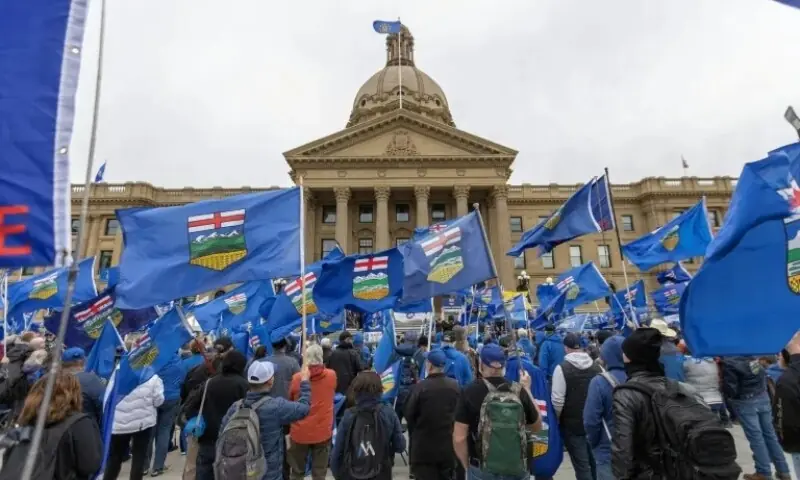
Photo via Global News

Alberta referendum expected to bring finality, but also more questions on separation

Read the original at Global News ↗
Cite

Digital, G. (2026, October 17). Alberta referendum expected to bring finality, but also more questions on separation. Global News. https://globalnews.ca/news/12106405/alberta-referendum-expected-to-bring-finality/

Dated from the outlet's own feed. Check the original for its byline.

Global News · collected 2026-10-17 · by Globalnews Digital

Quick Summary

On Monday, Albertans will vote on whether to remain in Canada or hold another binding referendum on separation. Polls suggest a majority will choose to stay in Confederation, which Premier Danielle Smith says should be accepted and move discussions forward. However, political experts argue that feelings of western alienation may sustain the independence movement indefinitely if Alberta perceives it is not fairly treated by Ottawa regarding its resource economy. The situation differs from Quebec’s secession efforts due to distinct historical and cultural contexts; Quebec’s movement stems from a deep-seated nationalist sentiment while Alberta's is more recent, driven primarily by economic grievances.
Written by AI on 2026-10-17, from this article's own text only (the story summary below draws on all the coverage).
See how they differ ↓

AI analysis

Story summary

On October 19, 2026, Albertans voted in a referendum that included ten questions, primarily focusing on immigration and constitutional issues. The last question asked if the Government of Alberta should commence legal steps to hold a second binding referendum on separation from Canada. Voting began with advance polls on October 13 at 311 polling stations.

The results released later showed that three-quarters of Albertans voted against pursuing separation, with strong support for remaining in Canada. However, there was a noticeable rural-urban divide, where questions pertaining to immigration and constitutional changes garnered more support from rural areas compared to urban centers like Calgary and Edmonton.

Premier Danielle Smith's request for "strong mandates" on the nine ballot questions did not materialize as expected, with most provincial ridings rejecting many of the proposed measures. This has left her government hesitant about swift action despite winning majorities in some areas related to immigration policies.

Written for “Alberta Referendum Results” on 2026-11-20, grounded in this article and the 104 other(s) covering the same event.

How they differ

19 outlets covered “Alberta Referendum Results”.

What each outlet says

One AI summary per outlet of its latest article on this story, written from that article alone and checked against it. Open the article for the outlet's own words.

Global NewsThis outlet17 Oct

On Monday, Albertans will vote on whether to remain in Canada or hold another binding referendum on separation. Polls suggest a majority will choose to stay in Confederation, which Premier Danielle Smith says should be accepted and move discussions forward. However, political experts argue that feelings of western alienation may sustain the independence movement indefinitely if Alberta perceives it is not fairly…

Alberta referendum expected to bring finality, but also more questions on separation (this article)14 articles from Global News on this story
Toronto Star23 Oct

A union representative from Cargill’s beef processing plant near Calgary warns of potential labour shortages if recent Alberta referendum proposals limiting access to or charging for provincially funded services based on immigration status are implemented. With 98% of polls reporting, the referendum narrowly passed with slim majority support for these changes, despite Premier Danielle Smith's government arguing that…

Advocates flag contributions, not costs, of newcomers in Alberta referendum aftermath →30 articles from Toronto Star on this story
The Globe and Mail23 Oct

Danielle Smith, Alberta’s Premier, faced mixed results from Monday’s provincial referendum regarding immigration control and constitutional amendments. While proposals related to immigration received narrow majorities between 52% and 55%, those for constitutional changes fell short at below 50%. The proposal for proof-of-citizenship requirements garnered the highest support with 58%. These outcomes highlight a…

Mixed results on Alberta referendum questions highlight urban-rural divide →14 articles from The Globe and Mail on this story
CBC27 Oct

Alberta's recent referendum saw most provincial ridings reject Danielle Smith’s ballot questions, despite her seeking strong mandates for her proposals. Of the nine questions, seven would have lost in a riding-by-riding contest, with only Questions 1 and 5 receiving majority support. Edmonton and Calgary showed particular opposition to restricting services for temporary residents, while rural areas largely supported…

Nopes to the nine? Blue walls? Five takeaways from Alberta's referendum results →12 articles from CBC on this story
National Post25 Oct

This article compiles letters discussing Alberta's recent referendum on sovereignty. Writers express mixed views: while some see it as a positive development that may prompt federal attention to Western Canada, others fear it could embolden separatist movements elsewhere, like Quebec. One letter criticizes U.S. Ambassador Pete Hoekstra for lecturing Canadian politicians about interfering in American politics, citing…

Letters: The good and bad of Alberta’s vote →8 articles from National Post on this story
Euronews21 Oct

Alberta voters overwhelmingly rejected starting the process toward separation from Canada in a recent referendum, with about 75% supporting unity. This outcome gives Prime Minister Mark Carney a boost as he pushes for national unity amid US President Donald Trump’s trade war and annexation threats, which have rallied Canadians around their flag. Edmonton voter Shawn Campbell explained his vote: “It sends a message…

Alberta’s “no” to separation gives Carney a boost as Trump pressure unites Canadians →4 articles from Euronews on this story
Show 13 more outlets
BBC20 Oct

Albertans have voted overwhelmingly to stay part of Canada in a recent referendum, with over two-thirds of voters choosing unity despite calls for separation from some groups. Prime Minister Mark Carney celebrated the outcome as a victory for national unity, while provincial leader Danielle Smith acknowledged the results and suggested a path forward. Proponents of independence had argued that Alberta’s economic…

Alberta votes overwhelmingly to remain part of Canada →3 articles from BBC on this story
CBS News20 Oct

Voters in Alberta rejected a proposal to start the process toward independence from Canada, with 76% choosing to remain part of the country and only 23% supporting the path towards separation. The referendum was held due to tensions between Alberta and the Canadian federal government over issues like oil regulations and trade policies. Despite some support for separatism, particularly among conservatives who feel…

Voters reject separation of Alberta from Canada in referendum →2 articles from CBS News on this story
Al Jazeera20 Oct

In Alberta's first-ever independence referendum on Monday, 76% of voters chose to remain part of Canada, with results showing an overwhelming support for staying within the country. This outcome is seen as a significant victory for Canadian Prime Minister Mark Carney, who campaigned against separation, while disappointing those advocating for Alberta’s independence due to long-standing grievances with Ottawa. The…

Alberta rejects separation referendum: What’s next for Canadian province? →2 articles from Al Jazeera on this story
The Guardian20 Oct

Alberta voters rejected a proposal to initiate a process toward independence from Canada, with CBC projecting that about 76% of votes supported remaining in Canada while only 23% favored beginning the separation process. With over a million votes counted early Tuesday morning and nearly a third of ballots tallied, this outcome marks a significant victory for Canadian unity and Prime Minister Mark Carney. The ballot…

Alberta voters reject plan for referendum to leave Canada, CBC projects →2 articles from The Guardian on this story
The Straits Times20 Oct

On October 19, Canada awaited results from a divisive independence vote in Alberta, with less than one-quarter of voters reportedly supporting separation according to polls. Mitch Sylvestre, leader of the separatist movement, remained optimistic despite low polling numbers, stating his goal was to ignite provincial spirit regardless of initial outcomes. With 3.1 million eligible voters and 1.4 million advance…

Canada awaits result in Alberta independence vote →2 articles from The Straits Times on this story
Dawn19 Oct

Alberta is holding a non-binding referendum on Monday where residents will vote on ten questions related to separation from Canada and provincial governance. Premier Danielle Smith announced this after months of campaigning by separatists who argue that Alberta's wealth subsidizes other parts of the country and hinders its economy. The final question asks if Albertans want to remain in Canada or start a process for…

What does Alberta's referendum on separation from Canada mean? →2 articles from Dawn on this story
The Independent20 Oct

Voters in Alberta, Canada's oil-rich province, decisively rejected a move toward independence, with CBC projecting that about 76 percent of voters supported remaining within Canada, while only 23 percent backed the process towards separation. More than one million votes were counted from over 1.35 million cast, representing 43 percent of eligible voters. The vote reflects deep-seated tensions between Alberta and the…

Alberta rejects independence and votes to remain in Canada, CBC projects →2 articles from The Independent on this story
NPR20 Oct

In Alberta’s recent referendum, voters overwhelmingly rejected proposals toward provincial independence with 76% supporting remaining part of Canada and only 23% backing the process for potential separation. The vote came as tensions rose due to U.S. President Donald Trump's trade policies and annexation threats. Despite strong sentiment against Ottawa in some circles, a majority of Albertans chose unity, reflecting…

Alberta voters reject a move toward independence in referendum backing Canadian unity →2 articles from NPR on this story
South China Morning Post20 Oct

Alberta voters rejected the idea of separating from Canada in an overwhelming referendum, with 77% supporting staying within the country while 23% favored initiating a path toward separation. Early results provided a significant boost for Canadian Prime Minister Mark Carney's efforts to maintain national unity amid tensions with the US over trade and annexation threats.

Alberta voters choose Canada over independence in boost for Carney →2 articles from South China Morning Post on this story
Washington Examiner18 Oct

Alberta residents are set to vote in a referendum on October 19 that could lead to discussions about the province's potential independence from Canada. The ballot does not directly decide Alberta’s separation but asks if the provincial government should initiate the necessary steps for a future binding referendum on independence. This vote has significant implications for Canada's political structure and its…

What to know about the Alberta referendum on leaving Canada →
Fox News19 Oct

Alberta residents started voting on Monday in a non-binding referendum to decide if the western-Canadian province should separate from Canada. The poll involves about three million eligible voters amid tensions following recent military incidents in Alberta. Despite a majority of decided voters favoring remaining in Canada according to polls, nearly 30% support initiating the process for a binding referendum on…

Alberta holds non-binding separation vote as independence fight grips Canada →
New York Post20 Oct

Alberta residents voted to remain part of Canada in a recent referendum, with 76% supporting unity as initial results showed. The nonbinding vote, announced by Premier Danielle Smith in May, came amid growing calls for separation from a small but vocal group advocating for Alberta’s independence due to perceived economic injustices and bureaucratic impediments from the federal government. Prime Minister Mark Carney…

Alberta votes to remain part of Canada, rejects independence →
Daily Mail20 Oct

Alberta, Canada’s oil-rich province, voted overwhelmingly against separation from the country in a recent referendum, with 76% of voters supporting unity. Despite this outcome, Albertans also approved measures to tighten immigration laws and restrict access to social benefits for non-permanent residents. The vote reflects ongoing tensions between Alberta and the federal government over environmental policies and…

Oil-rich Canadian province of Alberta votes to remain part of the country... but demands immigration is slashed and voter ID laws are tightened →

Where they agree and split

Agreed

AI · cited, from two or more outlets

  • The referendum vote was not a direct decision on independence but would have set Alberta on a path toward a future vote on separation if passed.35
  • More than two-thirds of voters in the province chose to remain part of Canada rather than pushing for independence according to unofficial results from Elections Alberta.45
Quoted from the coverage (4)

With more than 1 million votes counted, about 76% supported remaining in Canada, compared with 23% who backed beginning a process that could lead to separation.

8 outlets

Prime Minister Mark Carney said on Tuesday that "it's a great result for Canada" and he is "thrilled that Albertans have chosen unity".

8 outlets

Alberta Premier Danielle Smith, a conservative, said she voted against independence but called the referendum to settle an issue that has divided the province.

6 outlets

Carney, who grew up in Alberta, has called the referendum “a dangerous bluff” as US President Donald Trump imposes punishing tariffs and levels annexation threats aimed – the prime minister says – at breaking Canadian resolve.

6 outlets

Disputed

Picked by our model, which is sometimes wrong

  • Separatist leaders vow to continue fighting for separation despite the referendum results, whereas Prime Minister Carney celebrates unity.45

Framing

How the first headlines put it

  • The Toronto Star frames the event as a timeline of events leading up to the vote, while CBS News presents it as a decisive rejection of separation.13
  • CBC highlights the rural-urban divide on additional referendum questions, whereas The Globe and Mail focuses on presenting the results of those nine other questions.67
The full story: what happened, how it changed, and all 105 articles →

Compared with similar articles

This article reads unscored and hedges 19% of its claims. Each row says how that neighbour differs.
Dawn
Leans right Hedges 1 of 26 claims Outlet record 67/100
The Globe and Mail
Leans right Hedges 1 of 29 claims Outlet record 51/100
Al Jazeera
Hedges 2 of 34 claims Outlet record 60/100
The Guardian
Leans left Hedges 5 of 22 claims Outlet record 64/100
BBC News
Leans left Hedges 9 of 40 claims Outlet record 65/100
BBC News
Hedges 1 of 28 claims Outlet record 65/100
Toronto Star
Hedges 3 of 51 claims Outlet record 64/100
The Globe and Mail
Hedges 0 of 2 claims Outlet record 51/100
The Independent
Leans left Hedges 3 of 24 claims Outlet record 59/100
New York Post
Leans left Hedges 2 of 23 claims Outlet record 66/100

Story

Alberta Referendum Results
Politics · 105 article(s) covering the same event. Compare every outlet's account →
How this article was measured signals, leaning charts, publisher record, byline, topics and claims

Signals How these are calculated →

Claims extracted
31
sentences that state something as happening or true
Uncertain
19%
6 of 31 hedged ("reportedly", "may", "according to")
Leaning
withheld
no quote in the article backed the model's score
Publisher signals
63/100
Global News's corrections and hedging, across everything collected from it. Not a measure of accuracy.
Outlets on this story
105
Politics
Same framing elsewhere
1
articles that frame the event the way this one does
Analyzed 2026-10-17 · how these are computed

How this is being covered How these are calculated →

Article leaning vs. publisher reliability
Source leaning vs. consistency

Publisher

Global News · 3492 article(s) · 12 correction(s) detected
Running correction rate · 12 correction(s)

Who wrote this

Globalnews Digital
920 article(s) here · 1 carrying a prediction
There also will be additional licensing requirements for sales of chips for Indonesia, Malaysia, Singapore, Thailand or Brazil — countries that “present a higher-than-normal risk of diversion” to unauthorized destinations, the rule says.
Manila, the Philippine capital, is Trump’s first stop on a three-day trip that will later take him to China for historic three-way nuclear talks with Chinese President Xi Jinping and Russian President Vladimir Putin, and, according to Trump, potentially for a meeting with North Korea’s leader Kim Jong Un.
The Manitoba government is set to outline its plans for the upcoming election year in today’s throne speech.
The meeting took place mid-morning on Tuesday in the high-tech hub in the Pearl River Delta megacity region in southeast China, where Xi will host the APEC leaders summit on Wednesday and Thursday.
CTV Edmonton reported someone had posted a City of Champions sign on the southern entrance to the city on Monday, but mayor Andrew Knack told reporters the signs are still in the archives.
2026-11-16 · assertive framing · Elks want City of Champions signs to return
The Opposition NDP has called it gerrymandering and said it would take the new maps to court, as it alleges some riding changes only serve to favour the governing United Conservative Party by diluting the power of urban votes.
The 48-inch diameter pipeline would add an initial billion cubic feet per day of new capacity, serving the oilsands region in the province’s northeast.
I’ve shown that I could do it.
2026-11-16 · assertive framing · Raptors emphasize accountability after Knicks loss
He briefly served as interim general manager after Fletcher stepped down in May 1997, before Dryden took over that August.
2026-11-16 · assertive framing · Former Leafs executive Bill Watters dies at 83
The changes were set to come into effect on Monday, but the college says it’s pausing enforcement to allow time to respond to the injunction.
Also by Globalnews Digital
Nothing else under this byline is closely related to this article, so these are simply their most recent.
All 920 articles by Globalnews Digital →

Topics

Alberta Albertans Canada Ottawa Quebec

Subjects

Alberta GPE · 14× Quebec GPE · 10× Canada GPE · 5× Scotland GPE · 4× Albertans NORP · 3× Castro-Rea PERSON · 2× Ottawa ORG · 2× Confederation ORG · 1× Danielle Smith PERSON · 1× Julian Castro-Rea PERSON · 1×

Narrative

Julian Castro-Rea, a political-science professor at the University of Alberta who studies the separation debates in Quebec and Alberta, believes as long as Alberta feels alienated from the Canadian capital — feeling that Ottawa benefits from Alberta’s resource economy without giving back — the movement will have fuel.
framing: assertive · carried by 1 article(s) · first seen 2026-10-17
If the vote goes as polls suggest, a majority of Albertans will mark an X to stay in Confederation, and Premier Danielle Smith has said if that’s so, she expects everyone to accept it and move on.

Claims (31 extracted, 6 hedged)

On Monday, Albertans vote on whether to stay in Canada or hold another binding referendum on quitting Canada. asserted
Albertans → vote → Canada
If the vote goes as polls suggest, a majority of Albertans will mark an X to stay in Confederation, and Premier Danielle Smith has said if that’s so, she expects everyone to accept it and move on. asserted
everyone → go → it
Leaders of the independence movement contest that. asserted
Leaders → contest → that
And political watchers are divided about whether separation — previously a fringe sentiment — will now be a prominent, permanent feature of Alberta’s political landscape, as in Quebec. asserted
separation → divide → Quebec
Julian Castro-Rea, a political-science professor at the University of Alberta who studies the separation debates in Quebec and Alberta, believes as long as Alberta feels alienated from the Canadian capital — feeling that Ottawa benefits from Alberta’s resource economy without giving back — the movement will have fuel. asserted
movement → study → fuel
“Even if the referendum is lost, the westernization will still be around, because it’s kind of a way which, traditionally, Albertans have related to the rest of Canada,” says Castro-Rea, who believes western alienation may remain indefinitely. uncertain
alienation → lose → Canada
Alberta’s independence movement has been compared to Brexit and separation in Scotland, but the most obvious comparator is Quebec. asserted
comparator → compare → Scotland
Earlier this month, Quebec elected a minority government led by the Parti Québécois, which has promised to call a third independence referendum to leave Canada, following votes in 1980 and 1995. asserted
which → elect → 1980
Experts say the two provinces differ in their catalysts for secession. asserted
provinces → say → secession
Quebec and its francophone culture have developed over centuries. asserted
Quebec → develop → centuries
Alberta, by comparison, was created alongside Saskatchewan out of the division of the Northwest Territories in 1905. asserted
Alberta → create → 1905
Get breaking National news Alberta’s separatists are driven by western alienation rather than a deep-seated nationalist sentiment, like Quebec, experts say. asserted
experts → get → Quebec
That means it’s difficult to see how the long-term future of the movement could pan out. uncertain
future → mean → movement
“They have different identity, different history, different language, as you know, and therefore they can claim, kind of, this historical legitimacy as the basis for their attempts for separation,” Castro-Rea says. uncertain
Rea → have → separation
Separatist sentiment has been sprinkled into Alberta’s saucepan for the past half-century before coming to a boil in recent years. asserted
sentiment → sprinkle → years
Premier Smith, who has voted to stay in Canada, has repeatedly criticized former prime minister Justin Trudeau’s policies as oppressive to Western Canada’s sovereignty and its energy-driven economy. asserted
who → vote → sovereignty
That criticism has softened against current Prime Minister Mark Carney, who referred to Alberta’s bid for secession as a “dangerous bluff” on Thursday night. asserted
who → soften → night
He also said a decisive result would “settle this question.” asserted
result → say → question
Andrew McDougall, an associate political science professor at the University of Toronto, says he sees Alberta’s referendum as a way to garner political leverage with Ottawa, as Quebec has. asserted
Quebec → say → Ottawa
“This has sometimes been referred to in Quebec as the ‘knife at the throat strategy,’ where Quebec could sort of push its agenda because we’ve had that incredible threat of a referendum,” he says. uncertain
he → refer → referendum
But former UCP premier Jason Kenney, speaking in Edmonton earlier this week, said the knife analogy cuts both ways. “The idea of making the threat by holding a knife to the throat of the federation is how you end up as a have-not province, like Quebec, instead of the ultimate have province like Alberta,” he said. asserted
he → speak → Alberta
“You want to talk about a lack of investor confidence? asserted
You → want → confidence
The next year, moving towards an actual vote on separation when the first one is won — the economic consequences would be catastrophic.” asserted
consequences → move → separation
Political science professor Graeme Young says to understand Alberta’s future, one could look at Scotland. uncertain
one → say → Scotland
Young, at the University of Glasgow in Scotland, grew up in Ontario and kept interest in Alberta’s prospective separation from afar as Scotland bolsters another push to leave the United Kingdom. He says he doesn’t expect Alberta’s separatist campaign will last. asserted
campaign → grow → Kingdom
He believes the movement could deflate with a different federal political party in power. uncertain
movement → believe → power
And he says it can’t draw from the same wellspring of national identity as exists in Scotland. asserted
it → say → Scotland
Young says Scotland’s 2014 campaign was, in large part, defeated by uncertainty about the economics of independence, including pensions, currency, finances and its role in the European Union. asserted
campaign → say → Union
And while Scotland has been preparing for more than a decade for another run at independence, Alberta’s movement is underprepared, Young says. asserted
Young → prepare → independence
“(Alberta’s case) has been put together quite hastily,” he says. asserted
he → put → ?
“It does not seem that they have invested as much time and energy into that case as one would expect for setting up a new country.” asserted
one → seem → country
Give feedback · no sign-in needed

No sign-in needed for now. Your note is sent without a name, so it cannot be answered.

History Support