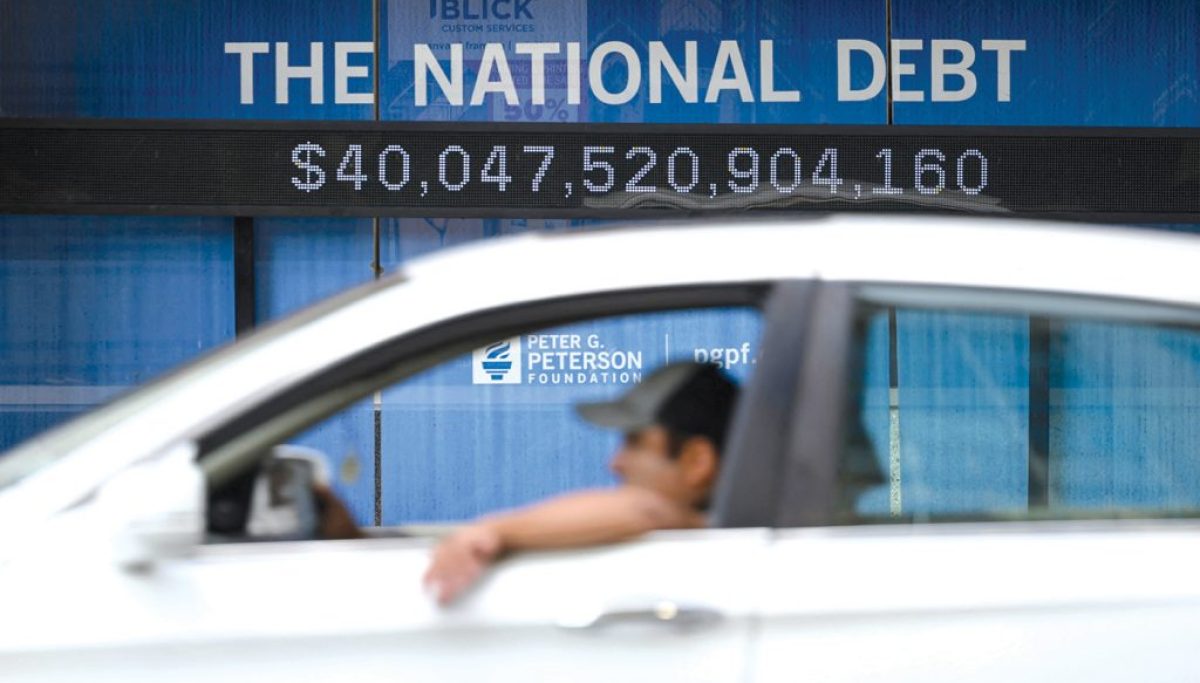
Photo via Washington Examiner

Treasury announces deficit rose to $1.99 trillion in fiscal year 2026

Read the original at Washington Examiner ↗
Cite

Halaschak, Z. (2026, October 16). Treasury announces deficit rose to $1.99 trillion in fiscal year 2026. Washington Examiner. https://www.washingtonexaminer.com/policy/finance-and-economy/4768784/treasury-announces-deficit-rose-to-1-99-trillion-in-fiscal-year-2026/

Dated from the outlet's own feed. Check the original for its byline.

Washington Examiner · collected 2026-10-16 · by Zach Halaschak

Quick Summary

On Friday, the Treasury Department reported that the federal budget deficit for fiscal year 2026 reached $1.99 trillion. This substantial shortfall occurs amid neither wartime nor economic downturn conditions, highlighting persistent challenges in aligning government expenditures with revenue generation over the long term.
Written by AI on 2026-10-16, from this article's own text only (the story summary below draws on all the coverage).

AI analysis

Story summary

On October 16, 2026, the Treasury Department announced that the federal budget deficit rose to $1.99 trillion for fiscal year 2026. This significant shortfall is notable because it occurred when the nation was neither at war nor in a recession, highlighting a long-term issue of government spending exceeding revenues. The Washington Examiner reported this news, emphasizing the financial strain on the government despite stable economic conditions.

Written for “Treasury Deficit Hits Record High” on 2026-11-21, grounded in this article and the 0 other(s) covering the same event.

Compared with similar articles

This article reads leans right and hedges 0% of its claims. Each row says how that neighbour differs.
Evening Standard
Hedges 0 of 17 claims Outlet record 64/100
“The articles describe different reporting periods and financial metrics for government deficit and borrowing.”
Evening Standard
Hedges 0 of 18 claims Outlet record 64/100
“The articles describe different fiscal events occurring at different times and involving different monetary figures and reporting entities.”
Washington Examiner
Leans left further left than this Hedges 2 of 4 claims Outlet record 67/100
“While both articles discuss the $2 trillion deficit for fiscal year 2026, Article A reports on the Treasury Department's announcement of the deficit figure, while Article B focuses on how candidates are not discussing this issue during campaigns.”

Story

Treasury Deficit Hits Record High
Economy/Business · 1 article(s) covering the same event.
How this article was measured signals, leaning charts, publisher record, byline, topics and claims

Signals How these are calculated →

Claims extracted
2
sentences that state something as happening or true
Uncertain
0%
0 of 2 hedged ("reportedly", "may", "according to")
Leaning
Leans right
of the writing, not the subject · beta estimate
Publisher signals
67/100
Washington Examiner's corrections and hedging, across everything collected from it. Not a measure of accuracy.
Outlets on this story
1
Economy/Business
Same framing elsewhere
1
articles that frame the event the way this one does
Analyzed 2026-10-16 · how these are computed

How this is being covered How these are calculated →

Article leaning vs. publisher reliability
Source leaning vs. consistency

Publisher

Washington Examiner · 5250 article(s) · 11 correction(s) detected
Running correction rate · 11 correction(s)

Who wrote this

Zach Halaschak
34 article(s) here · 0 carrying a prediction
At the very least, they hope that the investment vehicles will kickstart wealth-building for millions of today’s children.
Federal Reserve Chairman Kevin Warsh said Monday that the Fed is developing models for how artificial intelligence might shape the labor market in the coming years.
A series of economic reports released after the midterm elections has made another interest rate hike all but certain, and some investors think the Federal Reserve could raise rates even more than normal.
Economists have been closely watching PPI reports and other inflation data amid the war with Iran and concerns that higher energy prices will filter through to overall inflation.
2026-11-13 · assertive framing · Producer prices rose to 6.5% in October
California voters rejected a measure that would have taxed the wealth of the state’s billionaires, a provision that some on the Left saw as a trial balloon for a nationwide wealth tax.
Recommended Stories Amendment 3 in Florida will significantly increase the state’s homestead exemption, from $50,000 to $150,000 in 2027 and then to $250,000 in 2028.
The economy has been the biggest concern for voters this election cycle, with Democrats hoping that discontent will propel them to victory on Tuesday.
2026-11-03 · assertive framing · Where the Trump economy stands on Election Day
While they are unlikely able to get Trump to sign bills undoing his own agenda, they could force Republicans to take difficult votes on the tariffs, from which they have been shielded thus far by GOP leadership.
The Federal Reserve voted to hold its interest rate target steady, a decision that investors mostly anticipated, but that nonetheless had markets on edge because of the off-chance that the central bank could hike rates just before the midterm elections in light of the high rate of inflation.
Also by Zach Halaschak
Producer prices rose to 6.5% in October
2026-11-13 · Washington Examiner
Nothing else under this byline is closely related to this article, so these are simply their most recent.
All 34 articles by Zach Halaschak →

Topics

the Treasury Department

Subjects

the Treasury Department ORG · 1×

Narrative

The shortfall is large for a nation that is not at war or in a recession, and shows that the government faces a long-term mismatch between spending and revenues.
framing: assertive · carried by 1 article(s) · first seen 2026-10-16
2026-10-16 · Washington Examiner
Treasury announces deficit rose to $1.99 trillion in fiscal year 2026 · assertive framing

Claims (2 extracted, 0 hedged)

The federal budget deficit rose to nearly $2 trillion in fiscal 2026, the Treasury Department announced on Friday. asserted
Department → rise → Friday
The shortfall is large for a nation that is not at war or in a recession, and shows that the government faces a long-term mismatch between spending and revenues. asserted
government → show → spending
Give feedback · no sign-in needed

No sign-in needed for now. Your note is sent without a name, so it cannot be answered.

History Support